
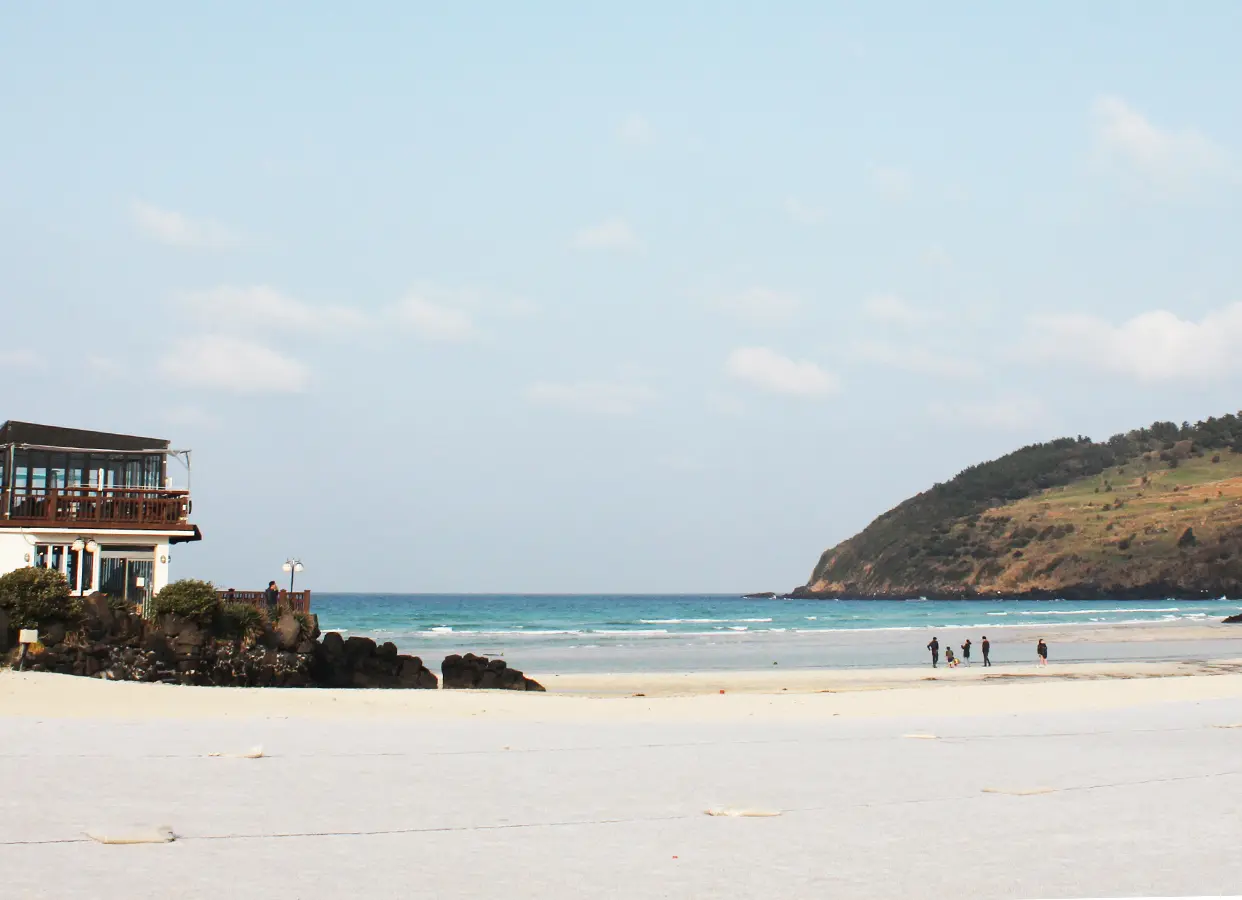
30-second answer: stay in Hamdeok when you expect to reuse the beach several times a day for two or more days—morning walk, daytime swim, return to the room, dinner, then another seaside stroll. If Hamdeok appears only once in the itinerary and your fixed plans are actually around Seongsan, Seopjikoji, Seogwipo or western Jeju, do not let an ocean-view room decide your base too early. The first question is not “which Hamdeok hotel is prettiest?” It is how many times will you realistically come back to this beach?
KoriNavi already has a broader East Jeju stay guide for Seongsan, Seopjikoji and other time-anchored bases, plus a wider Jeju where-to-stay decision guide. This page handles a narrower persona: Hamdeok is not merely somewhere you visit; you want the beach to be repeatedly usable within the same day. If you still have not decided how much time belongs to the east versus the west, settle that first with Jeju East vs West.
Hamdeok earns a hotel base through “beach reuse,” not through beauty alone
Accommodation choices are often distorted by a single distance number. A map shows a hotel near Hamdeok, so it feels automatically more convenient than staying in Jeju City. But convenience is not a fixed property. It has to be multiplied by how often you use the location.
If you visit Hamdeok once, a nearby hotel only saves one arrival and one departure. If you walk the coast before breakfast, return after lunch to change clothes, go back out for the water, shower before dinner and walk beside the sea again later, the same location benefit is being used three or four times in one day. That repeated use is where Hamdeok accommodation becomes meaningfully different from “we can drive there.”
Think of this as BEACH REUSE. You are not paying for the phrase “near the beach.” You are paying to avoid restarting a transport leg every time someone wants the beach again. This matters disproportionately for families: wet swimwear, a tired child, one person who has finished swimming earlier, a midday nap, forgotten sunscreen, or the need to shower before dinner can all turn a nearby room into practical infrastructure rather than a place you only see at night.
The opposite is equally important. If your normal Hamdeok day is arrive at 11:00, eat lunch, walk by the water, take photos and leave at 15:00, the hotel has almost no reuse value. You have merely placed one attraction next to the room while possibly making tomorrow's Seongsan day, the next day's south-coast plan and the final airport morning more fragmented.
In summer 2026, “I want the beach at 7 a.m.” does not mean you can swim at 7 a.m.
Visit Jeju currently lists Hamdeok's 2026 designated beach season as June 24 to September 6, with official swimming hours of 10:00 to 19:00. Night swimming is not permitted. That detail changes the value calculation because travelers often convert “hotel by the beach” into “I can swim whenever I wake up.” You cannot assume that.
Staying nearby can still make the morning valuable. You can see the water before the crowds build, walk the coast, spend time around Seoubong and start the day without first getting into a car or bus. But if your sole reason for paying more is “we will swim before breakfast,” the official operating window removes that benefit. The same is true at night: an evening coastal walk remains part of the Hamdeok experience, but it is not interchangeable with legal nighttime swimming.
For families, this distinction is useful rather than disappointing. It tells you what the hotel is actually buying. A nearby room can make it easy to start slowly, return for lunch, swim during the managed hours, get children cleaned up and reappear outside later. That is a stronger reason to stay than a fantasy schedule that depends on access the beach does not officially provide.
One beach visit does not make Hamdeok an “east Jeju base”
Hamdeok sits on the northeast side of Jeju, but “east” is too broad to make the hotel decision. Seongsan, Seopjikoji and Hamdeok can all appear on an east-side itinerary while behaving very differently as morning and evening bases.
If your non-negotiable event is an early Seongsan morning, a ferry connection or a long activity block farther east, sleeping in Hamdeok because the beach is attractive can still leave you with the same early drive you were trying to avoid. The East Jeju base guide is the better page when a fixed activity clock—not repeated beach use—is driving the decision.
Hamdeok becomes persuasive when the first or last part of multiple days keeps returning here. A beach-first family may spend one day mostly around Hamdeok and another day on a short northeast loop, then come back before dinner. A couple may want slow mornings by the water and only one major outing per day. A no-rush trip may treat the coast itself as one of the main reasons for coming to Jeju. These are Hamdeok-shaped itineraries. “We will pass through Hamdeok on Tuesday” is not.
Use the “two days, three returns” test before moving your luggage
A simple threshold keeps the decision from becoming emotional: look for at least two days on which Hamdeok is relevant, and at least three meaningful returns to the Hamdeok area across those days. A return means the location changes what you can do—not merely that you happen to sleep there.
For example: morning walk on Day 1, return after swimming to shower, dinner and evening walk nearby, then another slow Hamdeok morning on Day 2. That hotel location is being used repeatedly. By contrast, check in at 20:30 after a full day elsewhere, sleep, leave at 08:00 for Seongsan and never come back until midnight: the room may have a Hamdeok address, but the itinerary is not using Hamdeok.
This matters even more on a short trip. With only three nights, adding a second hotel needs to earn back the packing, checkout, luggage handling and check-in friction. KoriNavi's three-night one-hotel-or-two decision uses the same principle: a second key card needs a job. “I want one ocean night” can be a valid luxury purchase, but it is different from claiming the move improves logistics.
Families get more value from Hamdeok when the room can interrupt the beach day
Family travel is where beach reuse becomes easiest to see. A beach day rarely stays in one clean block. Children get cold, one person wants lunch earlier, another wants to keep swimming, someone needs dry clothes, a stroller or bag was left in the room, and adults may prefer to split rather than force everyone into the same rhythm.
If the hotel is genuinely close to the part of Hamdeok you use, the room becomes a reset button. One adult can take a child back without ending the whole outing. Wet clothes do not need to stay in a bag until evening. Lunch does not have to become a major transport decision. After the official swimming window ends, the group can clean up and still return to the coast for dinner or a walk.
But a family should not pay for Hamdeok simply because the beach is shallow and popular with families. If every day involves a long drive elsewhere and the children will only touch Hamdeok once, a Jeju City or other route-based hotel can still be easier overall. Family convenience is the sum of all four days, not the convenience of the most photogenic afternoon.
Couples and friends should decide whether the evening belongs to Hamdeok too
For couples and friends, the strongest Hamdeok argument is often not swimming but the ability to let the car stop being useful before the day ends. If dinner, drinks and an evening walk are all intended to stay around Hamdeok, a nearby hotel can turn the last few hours into a local evening rather than another transport problem.
Do not assume that “busy beach area in the afternoon” automatically means every restaurant, café or bar you saved will still match your late-evening plan. Check actual locations and operating hours for your dates. The hotel should work with your real dinner cluster, not with a vague idea that the whole coast is one nightlife zone.
If alcohol is part of the evening, make the transport rule before booking. Do not build a plan that assumes the rental car will somehow remain available after drinking. The clean version is either walkable evening activity, taxi, or a designated non-drinking driver. A beach hotel is useful when it makes that rule simpler.
No-car travelers need a higher threshold, not a lower one
Hamdeok can look attractive without a car because the beach, food and accommodation are clustered. That can be true—but it does not erase the transport cost of the rest of Jeju. The right question is whether Hamdeok reduces more repeated trips than it creates.
If two days are genuinely centered on Hamdeok and nearby northeast stops, staying here can remove daily returns to Jeju City. If each day begins with a long onward bus journey to a different side of the island, you may have traded one convenient beach walk for several awkward first and last legs.
Use KoriNavi's Jeju bus travel guide to inspect the actual first and last legs for your itinerary rather than assuming that a place on the same side of the island is easy by public transport. For a general base comparison, Jeju City accommodation remains the useful counterfactual: what repeated journeys disappear if you stay in Hamdeok, and what new ones appear?
Do not pay for an ocean-view room before proving that the hotel area itself is right
There are two separate decisions here. First: should your trip stay in Hamdeok? Second: which property and room type should you buy? Reversing that order is how travelers end up justifying an inconvenient base because a room photo was persuasive.
Once Hamdeok has passed the beach-reuse test, then the property differences matter. A room with a better view has more value when you actually spend morning or afternoon in the room. A larger resort has more value when hotel time is part of the day. A hotel slightly farther from the sand can still be fine if you are not repeatedly walking back in wet clothes. The “best Hamdeok hotel” changes with the way you use the beach.
Three existing KoriNavi hotel pages cover three different Hamdeok decisions
The useful route is not “pick the hotel with the highest star count.” Start with the constraint that is most likely to change your booking:
If your shortlist is specifically Gloucester versus Ramada, go straight to the Gloucester vs Ramada Hamdeok comparison after deciding that Hamdeok itself is the correct base. That order matters: a perfect comparison between two hotels in the wrong area still produces the wrong booking.
Gloucester makes more sense when a paid private-use block is part of the evening—not when you merely want “a hotel with a pool”
Gloucester's decision problem is unusually specific. The rooftop Jacuzzi / Modern Ryokan experience should not be mentally bundled into the base room rate as if every guest automatically receives a normal hotel pool. If that experience is central to the evening, confirm the product, time slot, party size and current terms. If it is not, compare the hotel as a Hamdeok sleeping base and treat the Jacuzzi as removable.
This distinction matters for the beach-reuse persona because a traveler may already be spending most daylight hours at the beach. Paying extra for another water-oriented experience only makes sense if the evening hotel time is genuinely part of the plan. Otherwise you can end up buying two versions of the same holiday mood while still leaving the room early the next morning.
Ramada works better when you are willing to separate “near Hamdeok” from “walk out of the room onto the sand”
Wyndham currently lists Ramada by Wyndham Jeju Hamdeok at 470 Sinbuk-ro, Jocheon-eup. That confirms the physical property, but it does not turn every room into beachfront access. The hotel decision still needs exact walking geometry, room view and the actual part of Hamdeok you plan to reuse.
If you expect to walk back in wet clothes several times, small differences in the final approach become more important than they look on a booking map. If you only use the beach once a day and the room is mainly for sleeping, those same differences matter much less. This is why the beach-reuse decision must come before the hotel comparison.
Sono Belle becomes stronger when “go back to the room” is a feature, not a failure
Visit Jeju lists Sono Belle Jeju at 577 Sinbuk-ro, Jocheon-eup, in the Hamdeok area, and VisitKorea lists family, ocean-view and suite categories together with kitchen facilities and on-site amenities. That makes it a different kind of candidate from a simple sleep-and-leave hotel.
For a family that expects to interrupt the day—breakfast in, beach, return to wash, rest, go out again—the ability to treat the property as part of the day can justify a larger or more resort-like product. But “there is a kitchen” is not automatically an upgrade. The exact room type, whether cooking is permitted, bed layout, occupancy and the cleanup obligations associated with the booked product still need to be checked before payment.
Arrival and departure nights should be separated from the beach decision
A late arrival can make Jeju City the sensible first night even if Hamdeok is the correct base for the middle of the trip. An early flight can do the same at the other end. Do not force every night into one base just to keep the itinerary visually tidy.
At the same time, do not automatically split the stay because Hamdeok is outside central Jeju City. On a three-night trip especially, every hotel move consumes part of the limited full-day inventory. The move should remove a repeated transport problem, not simply make a map look balanced.
This is where the three-night split-stay guide is useful. If Hamdeok only earns one evening and one morning, the second room key may not pay back its friction. If it earns two beach-heavy days, two evenings and a slow morning, the case is much stronger.
The weather test: would you still choose Hamdeok if the beach day becomes a walk-and-café day?
A beach-first base should survive imperfect weather. If rain, wind or sea conditions remove swimming, do you still want the Hamdeok coast, Seoubong, nearby food and a slower northeast day? If yes, the location is probably part of the trip identity. If no, the hotel may have been selected for one fragile activity.
This does not mean you should predict weather months in advance. It means the base should have more than one job. A room you can return to, an evening you can keep local, a walk you still enjoy and a second nearby day give the location resilience. One planned swim does not.
A practical booking sequence that keeps the beach photo from making the decision for you
First, mark the actual Hamdeok moments. For each day, write whether Hamdeok is the first stop, midday return, dinner area or final walk. If the answer appears only once across the trip, stop—the hotel move is probably not a routing decision yet.
Second, separate swimming from being by the sea. In the 2026 designated season, official swimming is 10:00–19:00 and night swimming is not permitted. Morning and evening coastal time still count, but they are different benefits.
Third, compare Hamdeok against the counterfactual base. Usually that means Jeju City for mixed itineraries or a deeper east-side base for Seongsan-heavy trips. Count which repeated drives disappear and which new ones appear.
Fourth, choose the hotel product. Only now compare Gloucester, Ramada, Sono Belle or another verified property. Lock the exact entity, exact room, view, occupancy, breakfast and cancellation terms. An ocean-view premium should be justified by time spent in the room, not by the existence of an ocean nearby.
Finally, recheck dynamic information before payment. Beach operations, room inventory, facility hours and hotel policies can change by date, season and room product. The 2026 beach information in this article is current as checked on August 20, 2026, but your booking date may be later.
Verdict: Hamdeok is worth sleeping in when the beach becomes a habit
Choose Hamdeok when: you have at least two northeast-oriented days; you want the coast both early and late; a midday room return genuinely improves the trip; family members may split up; dinner stays local; or your idea of Jeju includes slow beach time rather than only a checklist of attractions.
Do not move to Hamdeok just because: you like ocean views, you saved one famous beach photo, one east-side day passes through Hamdeok, or a hotel search result says “beach.” If most fixed plans are elsewhere, the base can create more transport than it removes.
NO-GO: if you will arrive late, leave early, spend every full day around Seongsan or southern/western Jeju, and only touch Hamdeok once, the beach-first persona does not fit. Keep the itinerary base where it solves the repeated movements, and visit Hamdeok as a destination.
Related reading
- Visit Jeju — Hamdeok Beach (Hamdeok Seoubong Beach): address, Seoubong/coastal-walk context, 2026 designated beach season, 10:00–19:00 swimming hours and no nighttime swimming.
- Visit Jeju — 2026 Jeju Beach Opening Information: June 24–September 6 standard beach operating period and standard managed hours.
- Wyndham Hotels — Ramada by Wyndham Jeju Hamdeok: current property identity and 470 Sinbuk-ro location.
- Visit Jeju — Sono Belle Jeju: current Hamdeok-area property listing and 577 Sinbuk-ro location.
Actual beach operations, room inventory, facility access, meal plans and hotel policies can vary by date, room type, weather, season and operating policy. Reconfirm official or booking-platform information before paying.