
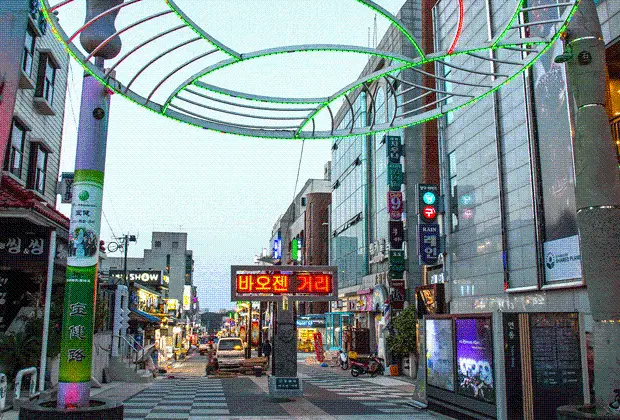
30-second answer: if you drive during the day but want to park once and be done for the evening, start with Yeondong. You can use the car for the east, west or south coast, then return to the hotel and leave dinner, drinks and a short walk to your feet. If your evenings are already anchored in Jungmun, Aewol or Seogwipo, however, returning north to Yeondong creates exactly the extra driving this strategy is supposed to remove.
KoriNavi already has a Jeju accommodation-base guide, a Jeju City area decision guide, and a one-hotel-versus-two-hotels guide for a three-night trip. This page handles one narrower conflict: you accept daytime self-driving, but you do not want the final trip after dinner to remain the driver's responsibility.
You are not really buying “downtown”; you are buying an evening where the navigation can finally be switched off
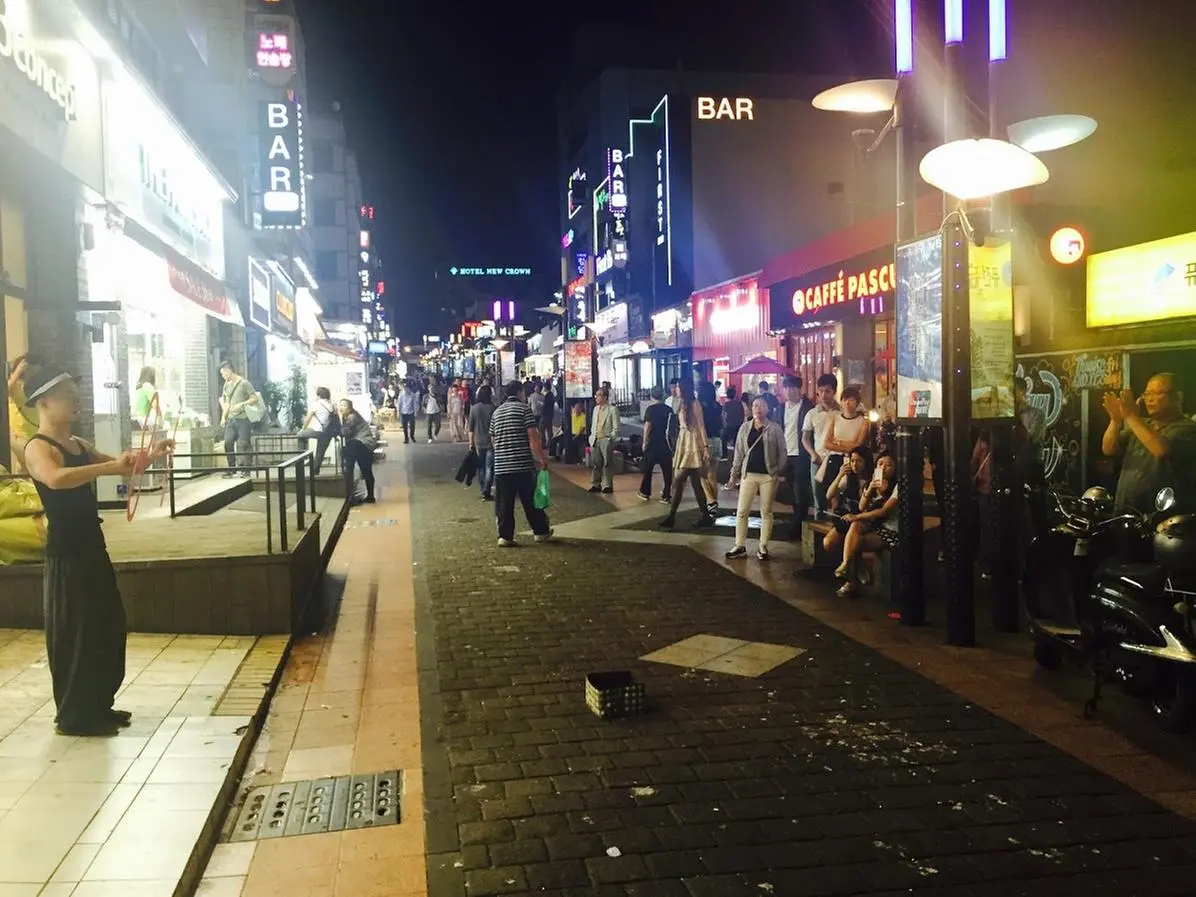
Visit Jeju currently places Nuwemaru Street in Yeondong and describes a commercial area with restaurants, bars, fashion stores and souvenir shopping. For this persona, those businesses are not bonus sightseeing. They are part of the accommodation product. The useful sequence is simple: finish the day's driving, park, check in or return to the room, then walk to dinner without restarting the itinerary.
This is different from choosing Jeju City because you are traveling without a car. You may rent a car for the entire trip and drive for hours during the day. The distinction is that you do not want “having a car” to mean every kilometer is free. The driver still pays in concentration, fatigue, parking searches and the need to stay sober. If you have not decided whether to rent a car at all, start with whether a Jeju rental car is actually necessary for your itinerary. Once you do rent one, the hotel should reduce repeated friction rather than encouraging another late-night leg simply because the keys are in your pocket.
Yeondong is not a universal answer; it only works when “return north for the evening” is a repeated behavior
If your sightseeing direction changes each day but you keep wanting the same kind of night—restaurants, convenience stores, shopping and a predictable walk back to the room—Yeondong works as a stable closing point. That repeated behavior is what gives the location value. The hotel does not need to be close to every attraction; it needs to be close to the thing you repeat every night.
The opposite is equally important. If two full days are concentrated around Jungmun, or you want to wake up on the Seogwipo coast rather than drive there, do not let “city convenience” pull you back north every evening. Use the broader Jeju City versus Seogwipo accommodation decision first. Geography should follow your repeated daily movements, not a generic claim that one district is the most convenient.
Another warning sign is when only the first night needs Jeju City. If the real plan is to move south from day two onward, Yeondong may be a useful arrival-night tool rather than the correct four-night base. In that case, combine the airport-to-hotel arrival chain with the cost of changing areas. First-night convenience should not automatically become an all-trip accommodation strategy.
Four hotels KoriNavi has already reviewed win for four different reasons
This page does not need another “10 best hotels” list. The useful move is to take existing Jeju City hotel decision pages and ask which one best matches this specific after-dinner persona.
If dinner includes alcohol, the decision becomes easier: do not make the car an option that night
If someone plans to drink, the rule should be settled before the booking: nobody drives afterward. The accommodation question therefore becomes more concrete. Either stay within a walkable dinner zone or use a taxi for the whole evening movement rather than keeping the rental car as a vague backup plan.
This is particularly useful for couples and groups of friends. Daytime navigation can be shared or tolerated because everyone still has energy. Late at night, however, the “last small drive” often lands on the same person again. Yeondong is easier to justify than a supposedly central compromise point because the benefit is not mathematical average distance. You are buying the ability to end transport decisions for the day.
If that does not matter to you—if you are happy to eat at the hotel, do not drink, and enjoy driving after dark—there is no reason to pay extra for Yeondong's density. The area should win because you will actually use it, not because an accommodation article says city locations are always safer choices.
Your first and last nights have different costs from a normal sightseeing night
Arrival and departure days add baggage, rental-car pickup or return, flight timing, check-in and check-out. Yeondong can reduce airport-side friction, but “near the airport” still does not mean every hotel solves the same problem. For example, Maison Glad Jeju's airport shuttle is tied to fixed operating slots, so a flight that does not line up with the shuttle should not receive imaginary shuttle value in your hotel comparison. Shilla Stay Jeju also frames airport travel time as traffic-dependent rather than a guaranteed fixed transfer.
If you land late, use the Jeju late-arrival first-night decision. If you have an early flight, use the early-flight last-night guide. Those pages should decide the flight-day nights first. Only then should this Yeondong persona decide whether the middle nights also belong in the same area. One awkward flight should not be allowed to dictate four nights of geography.
Three questions can eliminate the wrong hotels before you compare live rates
- How many nights will you actually eat near the hotel? If the answer is one, do not pay a four-night city-location premium. If it is three or four, a walkable evening zone has a chance to pay you back repeatedly.
- Who is doing the driving? If the same person drives every day, the hotel should reduce that person's late-night workload. Driver fatigue is a real accommodation cost even though it never appears on an OTA receipt.
- Will anyone drink in the evening? If yes, turn “walkable dinner or taxi from the hotel” into a hard condition. Do not keep driving as the emergency default.
If these questions reveal that your real problem is an entirely car-free trip, switch to the Jeju four-days-without-a-car base strategy. If your bigger problem is that every day points in a different direction, use the Jeju east-versus-west planning guide before you choose a hotel. Route logic should come before hotel loyalty.
Do not confuse “parking once” with “never moving again”
This strategy is not an argument for staying in the hotel neighborhood all day. The whole point is the opposite: use the car aggressively when it creates access during daylight, then stop demanding another trip from it when the day is already functionally over. The hotel earns its value at a repeated transition point—return, park, eat, walk, sleep.
That also means parking practicality matters. A hotel can sit in a great evening zone and still be annoying if arrival, valet or parking rules do not fit your trip. The individual KoriNavi hotel pages are where those property-level details should be verified. This persona page should not duplicate every parking rule because those policies can change. Its job is to tell you why the rule matters for this traveler type.
Couples, friend groups and families feel the same geography differently
A couple may value the ability to have drinks and walk back. A friend group may value not nominating a permanent designated driver. A family may care more about being able to get dinner quickly after a child has reached the end of the day. The common denominator is not nightlife. It is reducing the number of decisions and transfers after everyone's energy is low.
This is why the same Yeondong hotel can appear on several persona pages without the reasoning becoming repetitive. The property is not “good for everyone.” The value changes with the repeated friction being removed. For this page, the relevant friction is late-evening movement after a driving-heavy day.
If you drive during the day but want the car parked for good once evening starts, begin your Jeju hotel search in Yeondong. Then narrow the shortlist through Hotel Leo Jeju, Shilla Stay Jeju, Maison Glad Jeju and LOTTE City Hotel Jeju according to your room, facilities and transport needs. If two consecutive days and evenings are already in southern Jeju, ignore this recommendation. Geography should serve repeated behavior, not a pretty hotel photo.
The next step is not an OTA; it is reducing the shortlist to one or two exact properties
A persona page should stop before the transaction. Once you have one or two candidates, open the individual hotel decision pages and verify exact room type, legal occupancy, breakfast, parking, shuttle timing, cancellation and current OTA totals. Actual arrangements can vary by date, room type, season and operating policy, so re-check the hotel's official information and the live booking platform before payment.
- Visit Jeju, Nuwemaru Street: Yeondong location, restaurant/bar/shopping context and imagery, checked 2026-08-20.
- Shilla Stay Jeju official information: 100 Noyeon-ro, nearby transport and airport-access information, checked 2026-08-20.
- LOTTE Hotels & Resorts official information: LOTTE City Hotel Jeju address at 83 Doryeong-ro, checked 2026-08-20.
- Existing KoriNavi decision pages for Hotel Leo Jeju, Maison Glad Jeju, Shilla Stay Jeju and LOTTE City Hotel Jeju. This persona page routes readers to those property pages instead of duplicating their live room and OTA decision logic.