
For a single event at Busan Asiad Main Stadium, Sajik Gymnasium or Sajik Baseball Ground, I would not automatically move your hotel next to the venue. I would raise the venue-side option quickly if you are attending two nights, expect a late finish, travel with someone whose energy drops sharply at night, or simply hate making a transfer after a long show. If the event is only one night inside a three- to five-night Busan trip, Seomyeon often remains the more useful whole-trip base. The real comparison is not “which map pin is closest?” It is how much friction you remove on event night versus how much extra movement you create on every other day.
| Your trip | Compare first | Why |
|---|---|---|
| You came to Busan mainly for one event and stay one night | Near Sports Complex / Sajik | Removing the post-show ride affects a large share of the entire trip. |
| You attend two consecutive nights | Venue-side first | The same exit, station and transfer cost repeats twice. |
| You stay 3–5 nights and attend only one event night | Keep Seomyeon in the shortlist | Do not sacrifice several ordinary travel days to optimize one night. |
| You travel with children, older relatives or someone with limited late-night stamina | Raise the weight of venue proximity | Fifteen minutes at 23:00 can cost much more energy than fifteen minutes at 14:00. |
| You need Busan Station or central-city movement early next morning | Seomyeon becomes stronger | A venue-side hotel may simply move tonight’s saved travel into tomorrow morning. |
| You arrive from Seoul with a large suitcase on event day | Solve luggage first | “Where does the bag go during the event?” is a separate failure point from hotel location. |
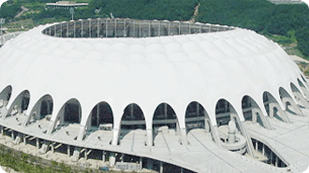
Before searching for a Busan Asiad concert hotel, confirm which venue is actually on your ticket
Busan Metropolitan City groups Busan Asiad Main Stadium, Sajik Gymnasium, Sajik Baseball Ground and other facilities within the Busan Sports Complex. The city’s current transport guidance for the complex points travelers to Metro Line 3, using Sports Complex Station Exit 9 or Sajik Station Exit 1. That is enough to show why a generic search for “Busan concert hotel” is too loose: the ticketed venue and the organizer’s entrance instructions should come first.
The official English Asiad page currently lists the stadium at 344 World Cup-daero, Yeonje-gu and describes it as a multipurpose facility used for performances and cultural events as well as sport. Busan’s own event-transport material also routes public-transport users to Sports Complex Station on Line 3. These are useful normal-routing anchors, but they are not a promise that a sold-out concert will have normal walking speed, normal station entry or an empty train immediately after the encore.
There is also a future-dated reason to recheck the Asiad venue rather than treating today’s layout as permanent. Busan is proceeding with plans to use the Asiad Main Stadium as a temporary baseball venue while Sajik Baseball Ground is rebuilt. Current city material targets Sajik construction from 2028 through 2030 and a new stadium opening in 2031, while a 2026 design competition covers the temporary Asiad conversion. If your event is in a later year, the decision method in this guide can remain useful, but entrances, venue use and access arrangements must be checked again from the organizer and Busan City.
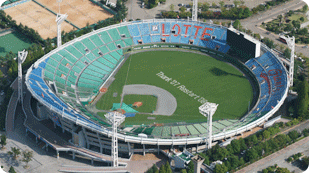
Seomyeon is not simply “farther away”; the real cost is the post-show transfer
Travelers often reduce this question to “How many minutes from Seomyeon to the stadium?” That number is not the most durable part of the decision. The route structure matters more: Seomyeon is served by Metro Lines 1 and 2, while Sports Complex and Sajik are on Line 3. A metro trip between Seomyeon and this venue cluster therefore requires a transfer rather than one uninterrupted ride.
In daylight, one transfer is ordinary city travel. After several hours inside a venue, it can feel different. You may have queued for merchandise, stood for part of the show, used most of your phone battery, carried purchases, and reached the station at the same time as a large part of the audience. The decision is no longer “can I make one transfer?” but “do I still want to make it now?”
That is why I prefer a Seat-to-Bed test over a map-distance test. Start the clock conceptually when you leave your seat, not when you reach the metro entrance. You still have to exit the venue, cross the surrounding complex, reach a station entrance, get through the station, wait, potentially transfer, then complete the last walk to the hotel. A venue-side hotel earns its premium only if removing some of those steps is worth more to you than the compromises it creates elsewhere in the trip.
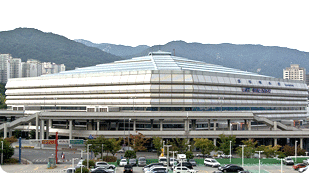
Walk the same post-show route twice and venue proximity changes from a comfort to a repeatable benefit
If you attend only one night, the first counter-question is simple: do you have to move hotels just to sleep near the venue? Imagine a four-night trip based in Seomyeon, with the concert on night four. Checking out, storing luggage, moving across the city and checking into another hotel can create more work than accepting one post-show transfer. Before splitting the stay, run the same test used in our one hotel versus split stay guide: what repeated journey disappears after the move, and is that saving larger than the move itself?
Two event nights change the arithmetic. The first night you may think, “That transfer was fine.” On the second night, after another long show, the exact same exit and transfer sequence returns. The cost is no longer a one-off inconvenience; it becomes Repeated Night Friction. That is why someone attending two nights has a much stronger case for paying to stay near Sports Complex or Sajik than a traveler who has only one event inside a longer sightseeing trip.
Even then, do not make “concert traveler = venue hotel” the rule. If your daytime plans still repeatedly pull you into Seomyeon or toward other central transport nodes, a nearby venue hotel may simplify two nights while making three mornings and afternoons less efficient. Count the friction that repeats most often, not the one that looks most dramatic on the booking map.
If the event is only one night, judge Seomyeon across the whole trip
The useful reason to keep Seomyeon is not a vague “central location” label. It is that one base can serve more than one kind of day. A typical four-night trip might look like this: arrival and Seomyeon on Day 1, Haeundae or Gwangalli on Day 2, Nampo and Yeongdo on Day 3, then Asiad or Sajik on Day 4. In that shape, the venue is important, but it is not the geographic center of the trip.
If moving toward Sajik adds a little extra travel to three ordinary days, those smaller costs can add up to more than the one transfer you eliminate after the concert. Use the broader Busan hotel decision guide to keep the whole itinerary visible rather than letting one event night take over the accommodation decision.
This is also where a split stay can look attractive for the wrong reason. “Three nights Seomyeon, one night Sajik” sounds tidy on paper. In practice you create checkout, luggage storage, cross-city movement, a second check-in, another room orientation and another packing cycle. If the only journey you eliminate is one late-night transfer, the switch may be a poor trade. If you are already debating two bases for a three-night trip, our three-night Busan split-stay test helps expose when a move is actually buying a repeated benefit.
Do not turn the Seomyeon fallback into a Top 10 hotel list
Once you decide to keep Seomyeon, the next question is not “Which ten hotels are popular?” It is what you will need after returning from the event and on the mornings that follow. The English KoriNavi inventory does not yet mirror every Chinese hotel article, so this page routes only to English hotel pages that actually exist.
You want a normal Seomyeon hotel decision with room details: Arban Hotel
Arban Hotel Busan is useful when your unresolved question is the room itself. Its KoriNavi guide focuses on window wording, ventilation, outside view, bathtub and bed layout rather than pretending every room of the same square-meter figure is interchangeable. For an event traveler, that matters if the concert is only one night and the hotel still has to work as a normal three- or four-night base.
Do not choose it merely because it is in Seomyeon. If you only return after midnight, leave early every morning and barely use the room, room-upgrade details may have less value than a simpler or cheaper base.
You travel alone and do not want to overbuy the room: Busan Business Hotel
For a solo traveler, the post-concert temptation is often to buy extra room “because I will be exhausted.” Our Busan Business Hotel solo-room guide starts from a true single-room baseline and asks whether paying for a Double actually buys comfort you will use. That is a more disciplined event-night question than assuming a larger room is automatically worth it because the night is late.
Do not force the single-room logic onto a couple or group. The point of this route is that solo travelers should compare a one-person product first, then upgrade only when the added bed or space solves a real need.
You are comparing similarly named Brown Dot properties: verify identity before the event
Browndot Business Seomyeon solves a different failure point: property identity. Brown Dot names can look nearly identical across listings. An event night is a bad time to discover that you saved the wrong map pin, mixed reviews from another property or arrived at a different branch. The guide therefore treats the full name, Korean address and map pin as the first booking check.
NO-GO: if the OTA address, Korean property name and your navigation pin do not agree, stop comparing prices. A late return from a concert magnifies a location mistake that would already be annoying on a normal night.
Arriving with a suitcase? Solve “where does the bag go?” before “where do I sleep?”
A common event-day pattern is Seoul in the morning, Busan by train, then the venue in the afternoon. That can make hotel location feel like the only decision: “Should I sleep next to Sajik because I am going straight there?” But the first operational problem is where the large luggage will be during the event.
Station facilities can exist without guaranteeing capacity when thousands of people arrive together. Even if the relevant station lists lockers, that is not the same as a reserved large locker waiting for you. If your event-day plan fails when no large compartment is available, the plan is too fragile. A hotel that has explicitly confirmed luggage storage, a pre-arranged delivery/storage service, or another option you can verify before the day is safer than hoping the station has space.
If your train or flight reaches Busan late enough that the first-night base itself is uncertain, use the late-arrival first-night decision to separate arrival logistics from the concert-hotel question. You do not want “I can reach Busan” and “I can store the bag, reach the venue and enter without stress” to be treated as the same claim.
For children or older relatives, 15 minutes at night is not the same as 15 minutes in daylight
The same transfer has a different cost at 14:00 and 23:00. In the afternoon, another escalator, platform or connection may simply be mildly annoying. After a concert, a child may be asleep, an older relative may be tired, and everyone may be carrying merchandise or bags. The final transfer becomes disproportionately expensive in energy.
That is why the accessibility question should cover the entire chain from the venue seat to the hotel room. Station escalators or accessible facilities are helpful, but they do not guarantee that every path from the venue, every event-day entrance and every interchange will be step-free or uncrowded. Recheck the organizer’s designated entrance/exit, the actual venue, current metro guidance and an accessible route close to the event date.
If you are traveling with older family members, the Busan stay guide for older travelers shows why arrival and return-route friction deserve more weight than a generic “central hotel” label. For families, the family Seomyeon-versus-Haeundae guide uses the same principle: the answer changes when a midday reset or a low-friction return matters to the group.
Do not publish a permanent “last train” time: recheck event-day operations
This guide deliberately does not give you one supposedly permanent “last metro at XX:XX” number. The useful fact is not a static clock time; it is whether your specific event date still follows normal operations. A delayed finish, long encore, crowd control, engineering work, special services or temporary route arrangements can change what is safe to assume.
One to three days before the event, check Busan Transportation Corporation and the organizer again for late service, transfers, exit instructions and any event-specific transport notice. A baseball game, arena concert and stadium show should not borrow each other’s crowd assumptions. If missing the final viable train would create a serious problem for you, the correct response is not “walk faster after the encore.” It is to raise the value of staying nearer the venue or to budget for a taxi fallback you would genuinely accept.
The same rule applies to other event districts. For example, BEXCO event accommodation is a separate decision because the useful base and transport structure are different. “Event hotel” is not one universal Busan category.
Three situations where I would not move next to the venue
- You attend one night but must change hotels to do it. Checkout, storage, the move, another check-in and repacking can cost more effort than one transfer back to Seomyeon.
- You need Busan Station, Nampo or another central/southern direction early next morning. You may simply be moving tonight’s saved travel into tomorrow morning.
- Venue-area rates surge and you are comfortable with transfers. Buy a location premium only when it removes friction you actually feel, not because concert advice says everyone should sleep nearby.
Three situations where I would put the venue area first
- You attend two nights. The same post-show friction repeats, so location starts paying back more than once.
- You came for one night and leave the next day. The event is almost the whole trip; there is little reason to preserve a multi-day city base you will not use.
- Your group’s weakest point is late-night mobility. Children, older travelers, injury, pregnancy or any other reason that makes late-night transfer friction materially harder can make one fewer connection more valuable than several daytime minutes.
Final verdict: count repeated friction first, then choose the hotel
The key question for a Busan Asiad or Sajik concert hotel is not how many meters it is from the venue. It is how much of your trip is controlled by the event. One event night inside a four-night trip usually keeps Seomyeon competitive. Two event nights inside a two-night trip push much harder toward the venue. If your companions are sensitive to late-night transfers, move the answer toward Sports Complex/Sajik; if most other days rely on central Busan, move it back toward the broader city base.
Once Seomyeon wins, stop searching for a generic “concert hotel.” Route the next unresolved decision instead: Arban Hotel if room configuration is the question, Busan Business Hotel if you are a solo traveler deciding how much room to buy, or Browndot Business Seomyeon if property identity and map-pin verification are the immediate risk. If none of those decision frames matches you, return to the Busan hotel guide rather than forcing one property into the trip.
- Is your ticket for Busan Asiad Main Stadium, Sajik Gymnasium or Sajik Baseball Ground?
- Have you rechecked the expected finish and current event-day transport notice?
- If you stay in Seomyeon, does the transfer still feel acceptable after the show rather than only in a daytime map search?
- Are you attending one night or two, and how many times will the same post-show sequence repeat?
- If you move near the venue, how many extra cross-city trips appear on your other days?
- Does your large luggage have a confirmed destination, or are you assuming a locker will be free?
- If your hotel uses self-service or unusual check-in procedures, do you already have everything needed to enter after the event?
FAQ
Do I need to stay next to Busan Asiad Main Stadium or Sajik for a concert?
No. A venue-side stay becomes more compelling for a one- or two-night event-focused trip, two consecutive event nights, or a group that finds late-night transfers especially difficult. If the event is one night of a longer Busan trip, Seomyeon can remain the better overall base.
What is the main downside of staying in Seomyeon for an Asiad or Sajik event?
It is not the daytime journey to the venue. It is finishing the exit, station walk, wait, transfer and final walk after the event. Sports Complex and Sajik are on Line 3, while Seomyeon is on Lines 1 and 2, so the metro journey is not a one-line ride.
Is Seomyeon still reasonable if I attend two concert nights?
Yes, but count the same post-show friction twice. If both nights end late, your daytime plans do not need Seomyeon, or someone in the group has limited late-night stamina, paying for venue proximity becomes easier to justify.
Can I rely on station lockers for large luggage on event day?
No guarantee should be assumed. Facilities may be available, but major-event demand can remove the capacity you need. If lack of a large locker would threaten entry time, use a luggage arrangement you can confirm in advance.