
Start with the decision: Daegu's Kim Gwangseok Street is worth visiting when you treat it as a short music neighbourhood rather than a major mural village. The public lane beside Bangcheon Market is about 350 metres long, free and open around the clock. Allow 60–90 minutes to connect its murals, songs, the singer's story and the surrounding market. If you do not know Kim Gwangseok and will not stop to listen or read, a 30-minute walk may already be enough.
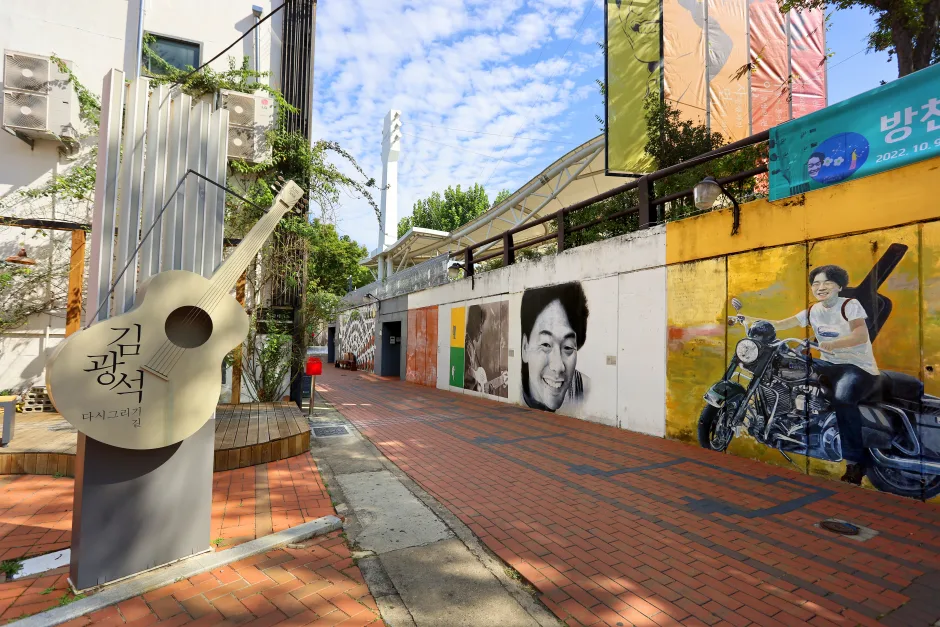
- STREET: a free, 24-hour public lane of roughly 350 metres, useful for a compact walk.
- MUSIC: lyrics, portraits, sculptures and songs tell the story together; skipping the sound and words removes much of the point.
- ROUTE: Bangcheon Market, cafés and central-Daegu plans turn a short wall into a complete neighbourhood segment.
- No compulsory spending: the Story House, food, drinks, souvenirs and activities are optional additions.
What is Kim Gwangseok Street? It is not simply another colourful mural village
Kim Gwangseok Street, also listed in some official English material as Kim Kwangseok-gil Street, runs beside Bangcheon Market in Daebong-dong, Jung-gu. It commemorates the late Korean singer-songwriter Kim Gwangseok, who spent his early childhood in this neighbourhood. The approximately 350-metre wall uses portraits, song imagery, lyrics and sculptures to connect his music with the district.
The Korean name, Kim Gwangseok Dasi Geurigi-gil, carries the ideas of drawing him again and remembering him again. That double meaning explains why the lane works as both public art and a memorial. Place it inside a Daegu one-day itinerary, not in a half-day block of its own. The scale feels right when the lane is one central-Daegu chapter rather than a destination expected to behave like a large museum.
Free and open 24 hours applies to the street, not every business
VISITKOREA's current attraction listing states that the street is free and open 24 hours. It gives the address as 2238 Dalgubeol-daero, Jung-gu, Daegu, and notes that there is no dedicated attraction parking. Those details describe the public outdoor lane. They do not mean that the Kim Gwangseok Story House, cafés, restaurants, stalls, toilets or performances operate all night.
You can still walk here late, but the experience becomes narrower after indoor venues and shops close. Use a Daegu evening plan to protect dinner, night views and the journey back first. The street works best as a flexible opening or transition, not as the reason to postpone everything until after normal business hours.
Is it worth visiting if you do not know Kim Gwangseok?
It can be, but expectations matter. Kim Gwangseok remains important in Korean popular music for direct songwriting and a voice associated with ordinary lives, memory and youth. Fans recognise a line or image immediately. A visitor without that background may see a collection of unrelated portraits unless they hear a few songs and understand whose life the walls are following.
You do not need to study a complete discography. Listen to two or three representative songs before arriving or while you walk. Then notice how one mood appears through speakers, written words, a guitar-shaped seat and a portrait. If nobody in your group cares about the music, reduce the stop to 30–45 minutes and let the market, a café or the next district carry more of the visit.
How long do you need? Walk it once before choosing where to stop
30–45 minutes: enter at one end, follow the main wall and pause at two or three signature pieces. This suits a tight day trip. 60–90 minutes: read the artwork, listen, then turn into Bangcheon Market or sit down for a drink. Two hours or more: only makes sense when you also enter the Story House, eat, wait for a performance or have a strong interest in the music.
Walking the whole lane first is more efficient than joining the first photo queue without knowing what comes next. If you are still deciding whether Daegu deserves only a day or a night, settle that through Daegu day trip versus overnight. A short urban lane is excellent for filling a central gap; it should not displace an attraction with fixed admission or a long journey.
Daytime or night? They do different jobs
Daytime is the safest first visit. Murals, text and small details are easier to see, and indoor venues or market businesses are more likely to be open. Late afternoon and evening bring lighting and a better connection to dinner or a date-night walk, but do not assume there will be live music every night. The art also becomes harder to read after dark.
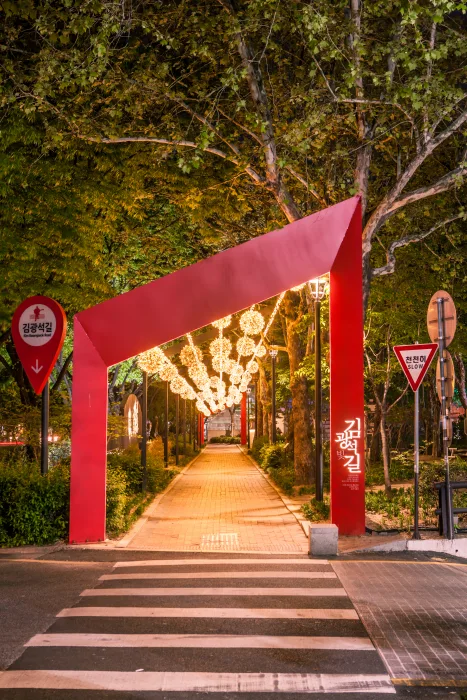
A useful compromise is to arrive about 45 minutes before sunset. See the wall in natural light, watch the entrance lighting switch on, then continue to dinner. This is not a landmark that requires hours of waiting for darkness. Seasonal installations, event lighting and performance schedules can all change.
Getting there by subway: search the full Korean place name
Official tourism routes commonly use Kyungpook National University Hospital Station on Daegu Metro Line 2, written 경대병원역 in Korean. Older accessibility guidance describes a roughly 500-metre approach from the lift near Exit 2, while other tourism material gives Exit 3 as the ordinary walking direction. Construction, crossings and lift access can change, so navigate to 김광석다시그리기길 rather than searching only the singer's name.
This is an attraction where travelling without a car is usually an advantage. A metro ride plus a short walk avoids searching for parking at a site whose official listing says there is no dedicated parking. Use Daegu without a car to separate Dongdaegu Station, your hotel, the metro transfer and the final walk. A Korea transport card handles the fare, but it cannot choose the right crossing or lane entrance for you.
Should you enter the Kim Gwangseok Story House?
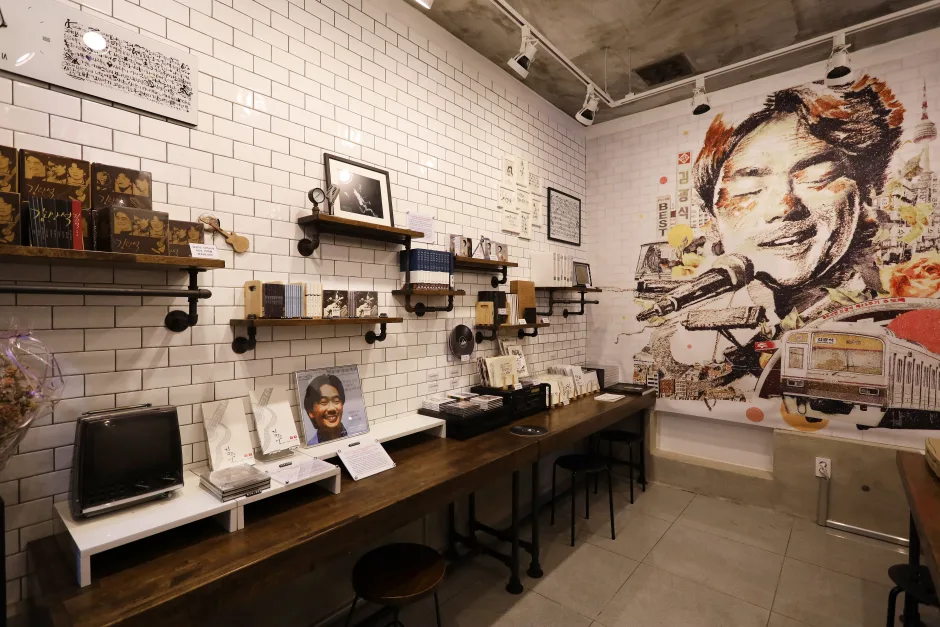
The Story House near the lane adds biography, records, photographs and listening material. It is most useful after the street has made you curious about the person behind the murals. If your goal is simply an outdoor walk and food, skipping the interior does not make the free street incomplete.
The Story House has previously used seasonal opening hours, a regular closing day and separate admission. Those operating details can change more easily than access to the public lane. This guide does not present an older timetable or ticket as a current promise. If the Story House is your main reason to visit, verify its opening day, final entry and fee directly before travelling.
Bangcheon Market does not automatically mean a nightly food market
Kim Gwangseok Street sits beside Bangcheon Market, and small passages lead toward workshops, food and independent shops. This relationship gives the mural lane some neighbourhood life. It does not guarantee a full row of tourist food stalls at a fixed time every evening. Individual businesses can keep different hours, close on different days or change character.
Treat food as an optional extension. Finish the lane, see which businesses are genuinely open and choose one that suits your group. If nothing works, continue to another central-Daegu dining area. A free attraction does not create an obligation to buy from the first shop simply to prove that you experienced the neighbourhood.
Are weekend busking and the autumn singing contest guaranteed?
Official tourism material describes street performances and an annual Kim Gwangseok singing contest associated with the Bangcheon Market and Dongseongno area. These are reasons the district can feel lively, not daily services included with the street. Weather, permits, seasons and event programming affect what happens.
Do not build a one-day visit around a generic promise of busking. If a particular performance matters, find a dated notice from the organiser. Otherwise, plan a route that remains worthwhile with only the permanent wall, recorded music and open businesses. An unexpected performance then becomes a bonus rather than the condition that makes the journey succeed.
Rain, summer heat and step-free access still create friction
The main attraction is outdoors. Heavy rain reduces the ability to read, photograph and stop along the wall; hot summer sun can make a slow walk uncomfortable. The Story House and cafés offer only partial shelter. Use a Daegu rainy-day plan to protect genuinely indoor stops, then walk this lane during a lighter period instead of pretending it is a full wet-weather backup.
Tourism accessibility information has described a lift-assisted metro approach, but it has also noted steps at some older shop entrances. Separate “reaching the public lane” from “entering every business.” Crowds, outdoor furniture and narrow side alleys may also affect wheelchairs, pushchairs and slower walkers. If sound or weekend congestion is difficult for someone in your group, choose a weekday daytime visit.
How to connect it to two days in Daegu without repeating the centre
Kim Gwangseok Street fits an afternoon or early evening in central Daegu. It can follow a heritage district, precede Dongseongno or lead into dinner. It should not be placed between Palgongsan and another distant outdoor direction, creating a cross-city zigzag for a 350-metre lane.
Use a purposeful second day in Daegu to keep dense central stops together, then reserve the other day for a farther direction. This also gives the free street its best feature: you can shorten or lengthen it according to weather, energy and what is actually open.
Your accommodation changes whether this is a planned stop or an easy spare hour
From a central hotel, Kim Gwangseok Street can be a low-risk evening walk or a fallback when rain clears. From Dongdaegu Station, it requires a metro journey and cannot be treated as if it were below the hotel. Check where to stay in Daegu before deciding whether the lane belongs before dinner, after check-in or as a formal part of a day route.
If you arrive with luggage, leave it at your accommodation or a confirmed storage point first. Brick paving, photo stops and narrow passages are not improved by pulling a suitcase. The attraction's value comes from being able to pause, turn into a side lane and change the plan without managing baggage at every step.
Eight checks before you go
- Do you want murals, music context or simply a free central walk?
- If you do not know Kim Gwangseok, will you listen to two or three songs first?
- Are you walking only the street, or also entering the Story House and market?
- Have you verified the date-specific hours for any indoor venue or event that matters?
- Which subway exit or lift route is currently easiest for your group?
- Do you prefer daylight for reading or evening atmosphere before dinner?
- Will rain, heat, crowds or steps remove the reason you chose this stop?
- If there is no performance and the Story House is closed, is a 30-minute street version still worthwhile?
Worth 60–90 minutes: you enjoy music, urban lanes and small-scale public art, and you will connect the wall to Bangcheon Market or another central stop. Worth a short pass: you do not know the singer but are already nearby; see the main portraits and guitar installation in 30–45 minutes. Skip this time: you need a large attraction, a full indoor programme or a cross-city journey for one replicated photograph. The street's strengths are that it is short, free and easy to combine. Forcing it to fill half a day only exposes its limits.
Checked 23 August 2026. VISITKOREA's current attraction page is the basis for the 350-metre length, 24-hour public access, free admission, address, lack of dedicated parking and basic facilities. Korean Tourism Organization and DaeguTour material were used for the neighbourhood history, Story House, metro approach and images. Recheck indoor admission, business hours, performances, lighting, exit works and accessibility on the visit date.
VISITKOREA | Kim Kwangseok-gil Street KTO | Story House and mural street KTO | Daegu music route DaeguTour | Official themed routes