

30-second answer: if the night is only arrival → shower → sleep, and tomorrow begins with rental-car pickup or an immediate departure from Jeju City, the short-drive airport / Doryeong-ro belt is usually the cleanest product. If you still need dinner, water, pharmacy or travel supplies after check-in, and the real itinerary starts tomorrow, Yeondong can be more useful than saving another few minutes to the terminal. If you arrive early enough to keep two or three usable evening hours and tomorrow is not time-sensitive, Yongdam / Dodu coast becomes a different first-night product: a little sea, walking or coffee instead of pure sleep. If you have not yet decided whether staying north is correct at all, first use the late-arrival first-night decision.
The first hotel is not a standalone purchase. Its job is to hand you to the first task of day two. Write down the earliest non-negotiable action between roughly 08:00 and 10:00 tomorrow: enter a rental company’s pickup/shuttle process, catch your first long-distance bus, buy breakfast and supplies, or simply leave after a full sleep. The best area is the one that shortens checkout → first task, minimizes luggage handling and avoids paying for another unnecessary ride. A room can be physically close to the terminal and still be badly positioned for your morning.
“Near Jeju Airport” is at least three different hotel products, not one circle on a map
None of the three is universally “best.” A 23:30 arrival that only needs sleep should not pay for a coastline you will see through a taxi window. A 19:00 hotel arrival that still needs dinner and basic supplies may get more value from Yeondong than from shaving a few airport minutes. The shorter the first night, the more ruthless the hotel should be about doing one job well.

If tomorrow starts with a rental car, do not confuse “near the airport” with “near the rental-car workflow”
Korea Airports Corporation’s current Jeju Airport instructions separate the terminal from the rental workflow. After arrival, passengers are directed toward Gates 3 and 5, across the road and under the canopy toward the Rental Car House; the operator shuttle boarding area is outside Gate 5. KAC also tells passengers to contact the individual rental company for details. The practical meaning is simple: airport distance only solves one small piece of the pickup chain.
The correct J102 question is therefore not “Which hotel is closest to the Rental Car House?” It is: how will people and luggage get from this hotel into my operator’s actual pickup process tomorrow? A direct taxi to the rental operator may be cleaner than returning to the terminal area. Another operator may require a specific shuttle sequence. If you are still deciding whether a car is worth it, use the Jeju rent-a-car-or-not decision. If the car is already booked, verify pickup and shuttle conditions with the Jeju car-rental guide and the provider’s current instructions.
Always compare door to first task: airport → hotel tonight, then hotel → rental operator / bus stop / breakfast / route start tomorrow. Two short-looking segments can still add more luggage friction than one slightly longer but cleaner base.
Yeondong is useful when “city functions” remove a second trip after check-in
“Good local amenities” is too vague to guide a booking. The useful version is operational: after collecting bags and reaching the hotel, do you still need a proper meal, water, medicine, toiletries or breakfast supplies—and can you finish those jobs on foot before returning to the room? If yes, Yeondong is doing more than housing you. It can delete the extra taxi that a pure sleep location might require.
Hotel Leo is a clean example of this product. Visit Jeju currently lists it on Sammu-ro in the New Jeju commercial area and notes nearby shopping and urban amenities. KoriNavi’s Hotel Leo page then handles the room-level decision—bed setup, Styler entitlement, breakfast and parking—rather than pretending the district alone makes every room good. If you are stuck between that and the more flight-day-oriented Sirius product, use Hotel Leo vs Hotel Sirius instead of rebuilding the comparison here.
On a one-night late arrival, more facilities can be worth less: depreciate anything your clock cannot use
This is the opposite of a resort stay. If you enter the room at 22:30, a pool, breakfast buffet, gym, bar or premium view may all be technically present but commercially useless to you. J102 applies one harsh but useful test: can you use it between check-in and sleep, or between waking and checkout? If the answer is no, temporarily price that feature at zero.
Hotel Sirius Jeju demonstrates why this matters. Its individual decision page does not sell “near airport + indoor pool” as a generic package; it tests whether the pool’s actual operating clock overlaps your flight-day stay. A late arrival can destroy that premium. An afternoon check-in with a real hotel evening can make it valuable again. The first-night area decision should send you to the correct property logic, not flatten every hotel into star rating and distance.
Families and large-luggage groups should put legal room capacity ahead of airport distance
A family of four, three adult friends, or a party with a stroller and two large suitcases usually loses more from the wrong room product than from five extra minutes in a taxi. First-night stays are too short to tolerate a bad surprise at the payment page—an illegal occupancy, beds that require unwanted sharing, or an unexpected second room.
For parties of three to six, Best Western Jeju Hotel already has a room-product staircase that separates Standard, Triple, Family and Connecting logic. The correct order is legal occupancy → bed topology → late-arrival conditions → morning handoff → distance and headline price. Airport proximity cannot repair a room that does not legally or practically fit the group.
Without a car, the first hotel should serve tomorrow’s first bus direction—not the airport that you are already leaving behind
For a car-free trip, airport proximity is mainly an arrival convenience. The day-two cost begins after checkout: where do you join the first useful long-distance segment, how far do you walk with luggage, and does the hotel force another taxi before the real route begins? Put that first stop or pickup point on the map before paying for the room.
Use Jeju without a car to set the one-direction-per-day rhythm. If day two is east or west, make the first transport segment part of the hotel comparison. A room that is excellent for the airport but poor for the first outbound route can be “close” and still create an unnecessary morning reset.
Yongdam and Dodu become valuable only when the first night is still an evening you can actually use
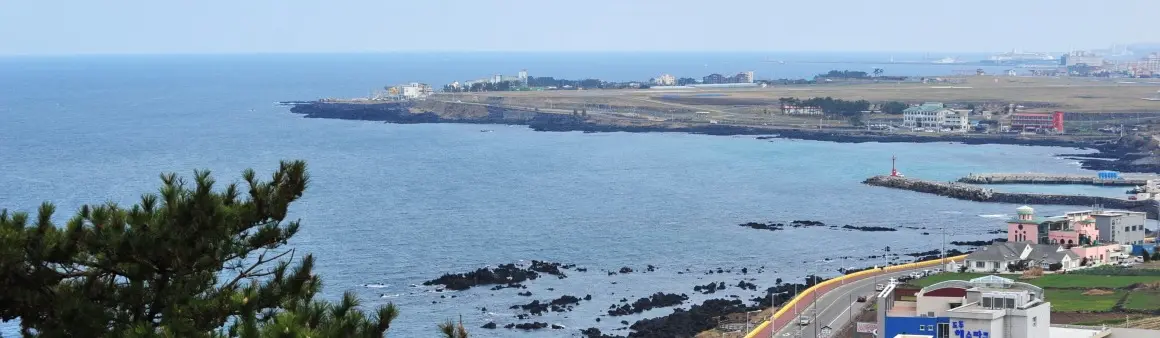
Visit Jeju describes Yongduam Coastal Road Cafe Street as close to the airport, with cafes, restaurants and coastal sights aligned along the shoreline. It also describes Dodu-dong Rainbow Coastal Road as convenient around arrival or departure, with a seaside walk of roughly 15–20 minutes along the rainbow barrier. This supports a genuinely different first-night product: instead of airport → room → sleep, you can finish arrival day with a small amount of sea, dinner or coffee.
But this product is brutally time-sensitive. A scheduled 21:30 landing plus baggage and hotel check-in is not a reason to manufacture a coastal itinerary because the photos are attractive. If you are already in northern Jeju around 18:00 and tomorrow is not an early start, the coast may be worth more than saving five minutes of driving. J102 is not asking you to “maximize” arrival day; it simply recognizes that an early-enough arrival can buy a short emotional payoff, while a late arrival should buy sleep.
The first night and the final night can both be near the airport, but they solve opposite problems
The first night is about arrival recovery + launching day two. The final night is about departure risk + reducing dawn obligations. Do not merge them into one “best airport hotel” list. For an early flight home, use J101’s pre-flight debt test first to decide whether the final night should move north at all. A hotel that is excellent after arrival is not automatically the best departure-night product.
Three first-night products: what each one is actually buying
If you cannot tell which one you are buying, write two lines: “last thing after landing tonight” and “first thing tomorrow morning.” If both are only sleep and transport, choose the pure-sleep product. If dinner or supplies sit between them, put Yeondong in the shortlist. Only if a real block of usable coastal time remains should Yongdam or Dodu enter the comparison.
Eight questions before opening Booking.com, Agoda or Trip.com
- Have you already decided to stay north because the late-arrival chain makes a cross-island first night inefficient—not merely because moving feels intimidating?
- What time will you realistically enter the hotel after baggage and transport, and is there still any usable dinner, facility or walking time?
- What is tomorrow morning’s first fixed task: rental car, bus, breakfast/supplies or immediate departure from Jeju City?
- Does the hotel remove one taxi ride, luggage move or transfer between checkout and that first task?
- If you pick up a rental car tomorrow, have you verified the operator’s actual pickup and shuttle process rather than only hotel-to-airport distance?
- For three to six travelers, have you locked the exact room SKU, legal occupancy and bed layout before comparing price?
- Are you paying for pool, breakfast, view or coast time that the late-arrival clock can actually redeem?
- Does the first-night hotel make you backtrack in the opposite direction on day two? If yes, it may be close to the airport but poor at handing off the trip.
Very late arrival + rental car / immediate departure tomorrow: buy the most reliable short-drive sleep product with a workable late check-in and room contract; do not pay for a coastal mood or facilities you cannot use. Late arrival + dinner/supplies still matter + real touring begins tomorrow: Yeondong often earns more than shaving a few extra airport minutes. Early-evening arrival + no rushed morning + you genuinely want a small coastal finish: Yongdam or Dodu can enter the shortlist. The J102 rule is: the best first-night bed near Jeju Airport is not the bed closest to the airplane; it is the bed that hands you most cleanly to the first job of day two.
Next steps
Reviewed on 2026-08-20. Korea Airports Corporation’s current Jeju Airport rental-car guidance directs arriving passengers toward Gates 3 and 5, across the road to the Rental Car House, and identifies the operator shuttle area outside Gate 5. KAC explicitly tells travelers to check details with the individual rental provider, so this article does not invent one universal pickup time or operator procedure.
Visit Jeju currently lists Hotel Leo at 14 Sammu-ro in Yeondong / New Jeju’s commercial area and describes it as a short drive from Jeju International Airport. Visit Jeju also describes Yongduam Coastal Road Cafe Street as close to the airport with cafes, restaurants and coastal scenery, and Dodu-dong Rainbow Coastal Road as convenient around arrival or departure with a short seaside walking segment. These official pages establish the character and geography of the three first-night products; hotel check-in, exact room inventory, restaurant hours, transport and rental-company operations still require date-specific verification.
Korea Airports Corporation | Jeju Airport car rental and operator shuttle · Visit Jeju | Hotel Leo · Visit Jeju | Yongduam Coastal Road Cafe Street · Visit Jeju | Dodu-dong Rainbow Coastal Road
Actual arrangements may vary by flight delay, baggage collection, hotel late-check-in policy, exact room type, rental-company shuttle/pickup rules, public transport, restaurant hours and weather. Recheck the relevant official operator or booking platform before paying for a non-refundable first night.