
If your west-Jeju day already includes Hyeopjae Beach or Hallim, choose Hallim Park. If the day already points toward Andeok, Jungmun or O'sulloc and the flowers themselves are the main event, choose Camellia Hill. The current official adult gate prices are KRW 15,000 and KRW 12,000 respectively, so the KRW 3,000 difference is not large enough to justify driving out of your route. Hallim is the safer pick when your group wants more than flowers; Camellia Hill is the sharper pick when one seasonal garden is exactly why you are giving up the half-day. In heavy rain, strong wind or on a first trip where the only good-weather west-coast window should be spent by the sea, you can skip both.
Best when you want caves, subtropical gardens, folk and stone areas, birds and several different sections in one ticket. It fits a Hyeopjae or Geumneung route naturally.
Best when seasonal flowers, garden photography and a slower walk are the actual objective. It pairs more naturally with Andeok, Jungmun and O'sulloc.
If this is your only clear west-side half-day and the beach, coast or open scenery is what brought you to Jeju, do not add a paid garden just because the ticket is discounted.
The KRW 3,000 ticket gap is smaller than the cost of putting the wrong garden on the wrong route
Hallim Park's current official individual adult admission is KRW 15,000. Camellia Hill's current official adult admission is KRW 12,000. That makes Camellia Hill cheaper at the gate, but this is a weak tie-breaker in Jeju. Hallim Park sits at 300 Hallim-ro on the Hyeopjae/Hallim side of western Jeju. Camellia Hill sits at 166 Byeongak-ro in Andeok-myeon, much farther into the southwest and naturally closer to the Jungmun/Andeok planning cluster.
Calling both of them “west Jeju” hides the route decision. A traveler already at Hyeopjae can turn Hallim Park into a clean two- or three-stop west-coast day. A traveler already around O'sulloc or Jungmun can make Camellia Hill a natural middle block without adding a north-west detour. Saving KRW 3,000 and then spending extra time crossing the west side of the island is not a bargain.
If you still have not decided whether this trip belongs east or west, use Jeju east vs west first. Once west is clearly the answer, where to stay in west Jeju helps separate Aewol, Iho and the deeper Andeok/Shinhwa direction so the attraction fits the hotel rather than fighting it.
Hyeopjae / Geumneung / Hallim → Hallim Park → food or a coast stop on the same north-west line. The park is a major paid block inside a coast day, not a reason to cross the island.
O'sulloc / Andeok / Jungmun → Camellia Hill → southwest hotel or dinner. The garden works when the route is already deep west/southwest.
Hallim Park buys content density: nine themes and two caves make the ticket less dependent on one flower being perfect
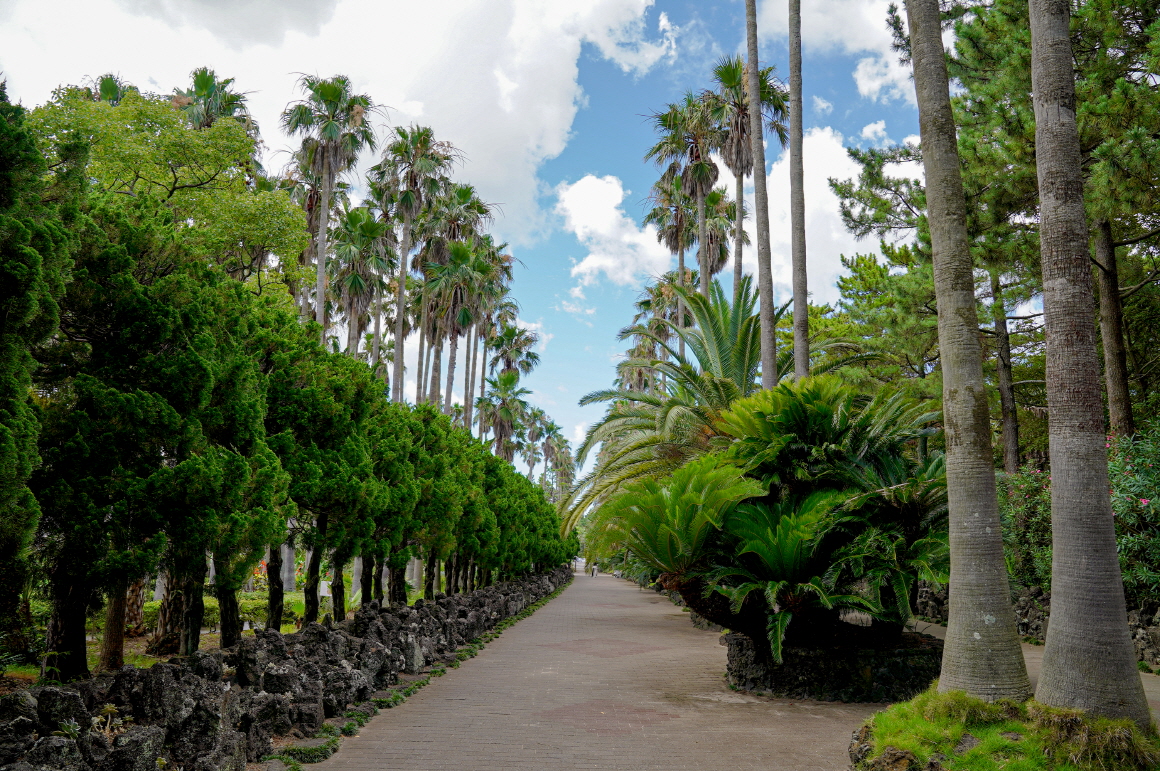
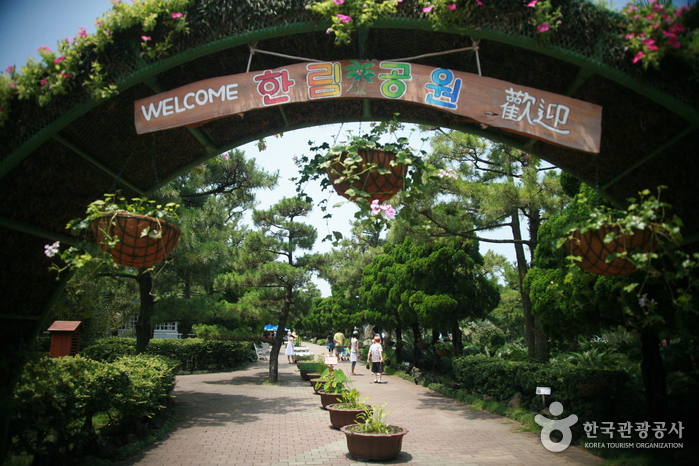
Hallim Park's official and tourism descriptions emphasize a broad mix: Palm Tree Road, a subtropical botanic garden, Jeju Stone and Bonsai Garden, a water garden, folk-village elements, birds and other themed areas. The most important difference for this comparison is that admission also includes Hyeopjaegul and Ssangyonggul caves. Those cave sections give the park a kind of value Camellia Hill does not try to provide.
This matters when your group has mixed interests. One person can care about seasonal flowers, another about caves, someone else about Korean-style folk or stone sections, and the ticket still has more than one reason to exist. That does not mean every section is equally strong for every traveler. It means the visit is less likely to collapse simply because a particular bloom is early, late or past peak.
Hallim Park's own guide gives an ordinary viewing reference of about 1 hour 30 minutes, while the current Klook exact product suggests roughly 2–3 hours. Neither is a promise. The gap is useful because it shows how pace changes the visit. A focused route through the caves and selected gardens can fit around 90 minutes; stopping for photos, covering all themes and taking breaks can easily consume much more.
Camellia Hill buys seasonal specificity: it is stronger when you know which garden you are paying to see
Camellia Hill is not simply “the cheaper Hallim Park.” Its value proposition is narrower and more seasonal. Korea Tourism Organization describes a 172,000-square-meter arboretum with thousands of camellia trees across hundreds of varieties, plus other plants, lawns, garden paths, a café and related facilities. Winter is the most obvious camellia period, while early summer is strongly associated with hydrangeas. Other seasons change the visual character again.
The practical decision is whether that season is part of your intent. If you are going in winter because camellias are one of the trip's planned subjects, Camellia Hill can be the more satisfying choice even though Hallim has more categories of attraction. If you are going in late June specifically for hydrangeas, the same applies. If you are going in a low-expectation month simply because a ticket appeared in a search result, the value becomes much softer.
This is also why the individual Camellia Hill ticket guide treats season before platform price. A ticket guarantees admission under the ticket conditions. It does not guarantee that one flower will be at peak bloom on your date.
Camellias are the headline. Still check current bloom conditions instead of treating a calendar month as a bloom guarantee.
If summer flowers are a major photography goal and your route already reaches Andeok, Camellia Hill becomes much easier to justify.
Caves, subtropical plants and multiple themed areas mean the ticket is not relying on one visual peak.
A beautiful garden on the wrong side of the day's plan can cost more useful time than a small ticket discount saves.
For travelers who are not especially interested in flowers, Hallim Park is usually the more defensible paid stop
If somebody in your group reacts to the word “garden” with polite silence, Camellia Hill becomes a hard sell unless the photography or bloom is genuinely special to them. Hallim Park is easier to explain because the visit changes character as you move through caves, plant areas, folk sections and open garden spaces.
That does not make Hallim Park a universal family winner. It is still a large outdoor park with real walking. Children or older travelers who are already tired can experience the park as “one more long place to walk.” The correct answer is not to force every theme. Choose the sections that justify the ticket and leave before the park turns into a completion challenge.
The larger Jeju itinerary matters here. On a three-day Jeju trip, a long paid garden can displace the coast or another major direction. On a five-day Jeju trip, it is much easier to let one garden become a proper half-day without treating that time as stolen from the rest of the island.
Do not use Hallim's caves as a reason to call it a rainy-day attraction
Hallim has an advantage in poor weather: the cave sections provide genuine shelter and a different experience. But most of the ticket still lives outside. You still move between sections, gardens and open spaces. A rainy forecast therefore does not magically turn Hallim Park into a full indoor replacement.
Camellia Hill is even more directly weather-sensitive because the garden landscape and photography are central to its appeal. KTO's current English listing explicitly notes that admission can be restricted depending on sunset and weather because the grounds do not have lighting facilities. That is not the same as saying light rain always makes the attraction worthless. It means the decision should be based on actual weather, not on the fact that your e-ticket remains valid.
If the day has become an indoor day, use the Jeju rainy-day plan instead of trying to justify a paid outdoor garden because it was already on the list. A sunk-cost argument is not an itinerary.
Late-afternoon visits are more fragile at both gardens than a long-validity voucher makes them look
Hallim Park's official pages currently expose two seasonal cutoff tables that differ by about 30 minutes. One version lists later cutoffs for spring and summer; another guide page lists slightly earlier times. Hallim also states that ticket and viewing cutoffs may move around seasonal sunset. The safe editorial rule is therefore simple: do not publish one late time as a universal guarantee. If you are arriving late, check the same-day official information.
Camellia Hill is clearer in the current KTO English listing: November–February 08:30–18:00; March–May and September–October 08:30–18:30; June–August 08:30–19:00, with last admission one hour before closing. The listing also warns that sunset and weather can restrict admission. An OTA ticket with 30-day validity cannot override the attraction's same-day closing conditions.
For Hallim, the individual Hallim Park ticket guide already separates voucher validity from gate cutoff. Use it when the attraction is chosen and the remaining question is where and when to buy.
If you only have 60–90 minutes, the answer depends on what you are willing to leave unfinished
Camellia Hill can be easier to compress when the group has a very clear purpose: walk the main route, photograph the seasonal sections, stop briefly at the glasshouse or café, then leave. KTO does not promise a fixed visit length, but a focused garden visit can be managed much more deliberately than a “see all nine themes” Hallim visit.
Hallim is harder to compress without making choices. If the caves are the reason you are there, protect the caves and one or two garden sections. If the group wants the full park, give it the larger time block. Do not enter late and then treat every skipped section as money lost. The real loss is making the next stop fragile because you stayed to finish a map.
For self-drive travelers, use the car to connect one west-side line—not to rescue a scattered day
A car makes both attractions reachable. That is not the same as making both attractions a good pair. The useful self-drive plan puts the attraction between other stops that already point in the same direction. Hallim Park works well as a fixed block between Hyeopjae/Geumneung and the rest of the Hallim coast. Camellia Hill works better when Andeok, O'sulloc, Jungmun or a deep-west hotel already appears before or after it.
If you are still deciding whether the vehicle is worth the effort, use the Jeju rental-car decision. The car should remove waits and awkward connections. It should not be used to justify making the day geographically worse.
Without a car, the first question is not which garden is better—it is which route you can return from comfortably
Car-free travelers need a stricter version of the same rule. A map may show that both attractions are technically reachable, but bus transfers, walking to stops and the return to your hotel are part of the attraction cost. If one option requires several awkward transfers from the day's existing route, the other garden can become the better decision even before you compare the ticket.
Use Jeju without a car to plan the return first. If your hotel is north and the day already runs through Hyeopjae, Hallim Park is easier to defend. If your accommodation and other stops are already south-west, Camellia Hill may fit naturally. Do not create a cross-island bus day just to save KRW 3,000 or use a coupon.
Putting both gardens on the same day is possible, but it usually solves no real travel problem
You can visit Hallim Park and Camellia Hill on the same day with a car. The question is why. They are both paid garden-heavy experiences, but they sit in different west-side clusters and reward different pacing. A short trip usually gains more by pairing one garden with a beach, coast, museum, café or hotel area that gives the day contrast.
Doing both makes sense when flowers and gardens are the purpose of the trip, the group deliberately wants a botanical day, and there is enough daylight to give both attractions real time. It should not be the default just because two search results appeared under “west Jeju attractions.”

Buy only after the attraction wins the route test
The current Klook English exact products are live for both attractions. Hallim Park product 140274 currently shows instant confirmation, free cancellation before redemption and a voucher valid until 5 January 2027. Camellia Hill product 142804 currently shows instant confirmation, free cancellation before redemption and a 30-day validity window. These terms can change, and dynamic platform prices can change even faster.
That is why this comparison does not permanently name one platform price as the winner. Choose the attraction first. Then use the individual money page or exact product to check the live terms for your date and party.
Check the live English exact product, voucher validity and cancellation conditions, then confirm the park's same-day late-entry information if you are arriving in the afternoon.
Check the current Hallim Park exact ticketCheck whether your date matches the bloom you actually want, then verify the current 30-day validity, redemption and cancellation terms.
Check the current Camellia Hill exact ticket20-second final decision
- Hyeopjae / Hallim coast + mixed interests: Hallim Park.
- Andeok / Jungmun / O'sulloc + seasonal flowers are the goal: Camellia Hill.
- Someone in the group does not care much about flowers: Hallim Park usually has more ways to justify the ticket.
- You only have 60–90 minutes and everyone mainly wants garden photography: Camellia Hill is easier to focus, but check the same-day last-admission window first.
- Heavy rain, strong wind or a day that has become indoor-only: skip both.
- First Jeju trip + only one clear west-coast half-day: protect the coast if the coast is what you actually came for.
Verdict: choose Hallim Park for content insurance; choose Camellia Hill when the season itself is the point
For most first-time visitors already on the Hallim/Hyeopjae side: I would choose Hallim Park. The ticket is only KRW 3,000 more at the official adult baseline, and the caves plus multiple themed sections make the visit less dependent on a single flower condition. That recommendation disappears if reaching Hallim requires a large detour from a southwest day.
For travelers already around Andeok or Jungmun who care about camellias, hydrangeas or garden photography: Camellia Hill is the more coherent answer. It is cheaper at the official gate and more focused. Its weakness is exactly the thing that makes it special: value changes more with season, weather and what is actually blooming.
For travelers who mostly want sea, open scenery or a non-garden first trip: skip both and keep the half-day. Paid attractions should earn their place in the route; they are not mandatory simply because the checkout page exists.
Hallim Park vs Camellia Hill FAQ
Which is better for families?
Hallim Park is usually easier for mixed-interest families because the caves, plants, folk areas and other sections create more variety. Camellia Hill is stronger when the whole group genuinely enjoys flowers, photography and a slower garden walk.
Which is better in winter?
Camellia Hill gains a clearer seasonal reason in winter because camellias are a major feature. Hallim Park remains broader and less bloom-dependent, so the better choice still depends on whether the winter flower experience is actually your priority.
Which one takes longer?
Hallim Park's official ordinary reference is around 1.5 hours, while the current Klook product suggests roughly 2–3 hours for a fuller visit. Camellia Hill can be shorter if you follow the main route and photograph selectively, but photo-heavy visits can expand. Do not plan either one as a zero-buffer stop.
Can I buy the tickets on the day?
Current Klook exact products show instant confirmation, but same-day use still depends on the attraction's operating and last-entry conditions. Hallim has conflicting official late-cutoff tables, so recheck the park if arriving late. Camellia Hill's current KTO listing sets last admission one hour before closing.
Next step: put the chosen garden back into the Jeju route
- Hallim Park official park guide: official individual admission, viewing-time reference, all-year operation and one current seasonal ticket-cutoff table.
- Hallim Park official guide page: second current seasonal cutoff table; the article preserves the conflict rather than guessing one universal late time.
- VISITKOREA · Hallim Park: English address, KRW 15,000 adult price, garden themes, Hyeopjae/Geumneung geography and seasonal hours.
- VISITKOREA · Hyeopjaegul Lava Tube: Hallim Park admission includes the cave section.
- Camellia Hill official website: attraction identity, address and current visitor-information entry point.
- VISITKOREA · Camellia Hill: 172,000-square-meter arboretum, winter camellia context, current operating hours, one-hour last admission, weather/sunset restriction and KRW 12,000 adult price.
- Klook · Hallim Park exact product 140274: current English product, instant confirmation, cancellation and voucher validity.
- Klook · Camellia Hill exact product 142804: current English product, 30-day validity, instant confirmation and pre-redemption cancellation.
- Images: Korea Tourism Organization / VISITKOREA real attraction imagery; no AI-generated attraction image used.