
Short answer: Seopjikoji is worth visiting if you want to spend 60 to 120 minutes walking through grassland, reddish volcanic terrain, sea cliffs, Seondolbawi Rock and a lighthouse landscape on Jeju's eastern coast. It is not worthwhile merely because one photograph labels it a free stop. Separate WIND, WALK and ROUTE. Current official information describes the public cape as open year-round, accessible 24 hours and free to enter, but parking is charged, the lighthouse branch has a substantial staircase, and Visit Jeju marks the site's assistance or accessibility difficulty as difficult. Public transport does not necessarily stop at the coast; one official example leaves an approximately 50-minute walk after the bus. Seopjikoji fits naturally when you stay around Seongsan or already have an East Jeju day. From Jeju City, a dedicated return journey can be heavier than the walk itself.
- WIND: an exposed cape with little shelter; wind, rain, sun and darkness directly change comfort and safety.
- WALK: the public coast is free, but seeing the grassland, Seondolbawi, volcanic terrain and lighthouse is not a 30-minute roadside photograph.
- ROUTE: best kept with Seongsan, Aqua Planet or an eastern base; a special journey from Jeju City or western Jeju needs honest cross-island time.
- Stable first visit: arrive in daylight, use the named public car park, complete the lower coastal route, then add the lighthouse stairs only if wind and mobility allow.
What is Seopjikoji? A whole cape, not one lighthouse
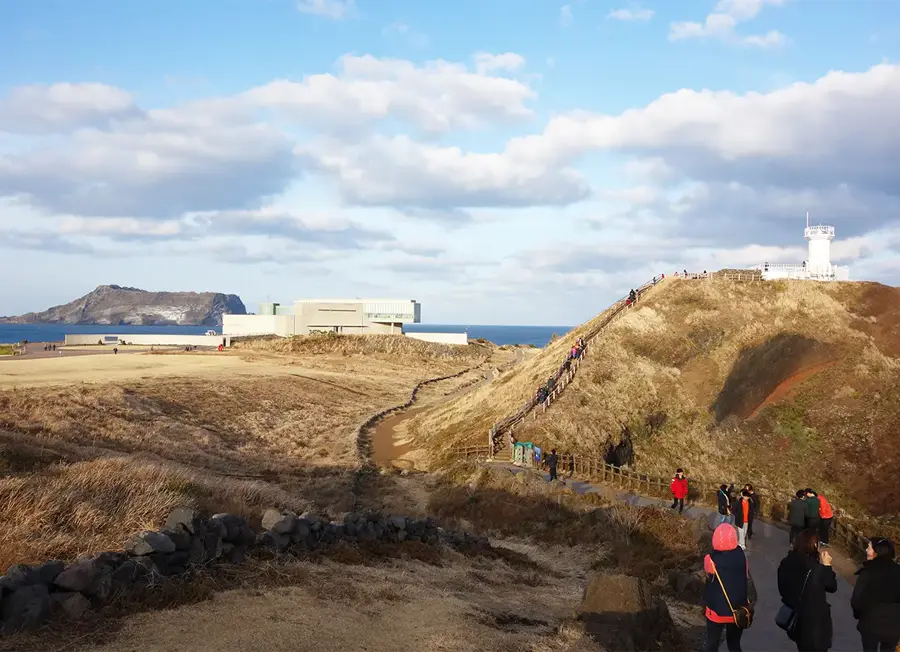
Seopjikoji projects into the sea from Seongsan-eup on Jeju's eastern coast. “Koji” is a Jeju word for a cape or pointed headland, while official sources present more than one interpretation of “Seopji,” including a narrow strip of land and an older local name. The visit crosses grassland, a volcanic shore, Hyeopja signal station, Seondolbawi Rock, Bulgeunoreum and a white lighthouse. It is not a fenced museum with one ticket gate and one controlled route.
Seongsan Ilchulbong frequently appears in the background, so publicity photographs make the two sites feel like a single stop. They remain separate attractions. Seopjikoji is primarily a horizontal coastal walk; Seongsan requires a separate decision about a paid summit climb. In a three-day Jeju itinerary, give the cape a defined window within the eastern day instead of treating it as an unlimited free addition after Seongsan.
Why are the red ground and coastal rocks important?
The current Visit Jeju description identifies reddish volcanic ejecta known locally as songi around Bulgeunoreum. The area includes a scoria cone, spatter and scoria mounds, lava flows and several intrusive bodies. This is why Seopjikoji is not visually limited to blue sea and green grass: exposed slopes reveal red-brown material, while some coastal rock forms become clearer at low tide.
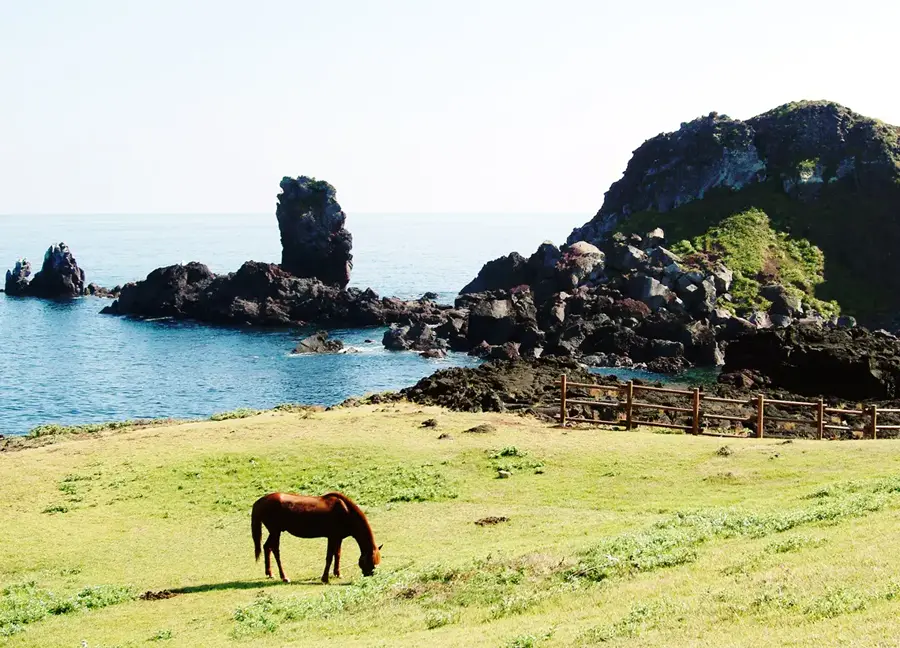
Seondolbawi Rock is interpreted as the remnant of a feeder dyke associated with the scoria cone. A separate legend tells of the Dragon King's youngest son waiting for a celestial maiden until grief turned him into stone. Geological interpretation and cultural narrative can stand beside one another, but a legend is not evidence for geological age. Observe the shore from a safe path; low tide revealing more rock does not authorise a walk across wet, fenced or unstable coast.
Does 24-hour access mean every time is equally suitable?
English VISITKOREA currently lists Seopjikoji as open 24 hours, year-round and free. That describes access to a public outdoor landscape. It does not promise that lighting, staff, toilets, separately operated buildings, food service or parking assistance function for 24 hours. After sunset, slope edges, stone walls, stairs, wet surfaces and gusts become harder to judge.
On a first visit, do not translate “24 hours” into “safe at 02:00.” A pre-sunrise plan still needs a road check, parking plan, light, wind assessment, capable companions and a return route. An evening visit should not extend onto an unlit cliff or lighthouse branch simply because the attraction has no closing gate. Arriving early in daylight is a more predictable way to reduce crowds than walking in darkness.
Entry is free, so what still costs money?
The public cape has no admission charge. Driving, taxis, parking, nearby museums, restaurants and resort facilities remain separate. Visit Jeju currently lists the public Seopjikoji car park for a standard small vehicle at KRW 1,000 for the first 30 minutes, followed by KRW 500 for every additional 15 minutes, with a KRW 3,000 daily maximum. It separately lists Phoenix Island parking at KRW 5,000 per day. Rates can change, so the entrance sign and payment machine on your date control.
This distinction is why a vague navigation search for “Seopjikoji” is not enough. The public coast, Phoenix Island, Glass House and the museum sit in one broad area but do not necessarily share an entrance, car park or access terms. The free coastal walk does not require a purchase button. Your practical job is to select the intended public entrance rather than pay for a different car park and create an unnecessary extra walk.
Why do official pages show both 262 and 107 Seopjikoji-ro?
The current Visit Jeju attraction page gives 262 Seopjikoji-ro. Other official tourism material has displayed 107 Seopjikoji-ro, an address also associated with Phoenix Island information. Because official sources expose different numbers, this guide does not present one street number as a permanent guarantee of the public entrance.
In a Korean navigation app, search for “섭지코지 주차장,” the named Seopjikoji public car park, then inspect the current marker, final approach and car-park label. Do not copy one number from an old article without checking it. On the last few hundred metres, follow current public-attraction and parking signs rather than assuming the first Phoenix sign leads to the same fee or entrance.
How should you choose a 60, 90 or 120-minute route?
Sixty minutes: enter from the public car park, follow the grassland and lower coastal line, choose one strong view of Seondolbawi or Seongsan Ilchulbong, then return. Omit the lighthouse climb, building interiors and repeated photo stops. Ninety minutes: complete the principal coast, then climb the Bulgeunoreum lighthouse stairs if wind, surface and energy remain suitable, pausing at the signal station or grassland on the return.
Two hours: allow slower photography, geological reading, children or an extension towards the architecture around Glass House, but do not assume a full museum visit is included. A four-day Jeju itinerary can protect this margin. Do not let an apparently free stop delay Seongsan and every timed attraction in the same afternoon.
How difficult is the walk? Broad grassland does not mean a flat circuit
The entrance side contains broad views, paved sections and gentle-looking grassland. A complete visit can still involve slopes, stone walls, long stairs, exposed wind and opposing foot traffic. Visit Jeju's data marks assistance difficulty as “Difficult.” That is important counter-evidence to a photograph of one flat path: the whole cape should not be described as effortlessly wheelchair- and stroller-friendly.
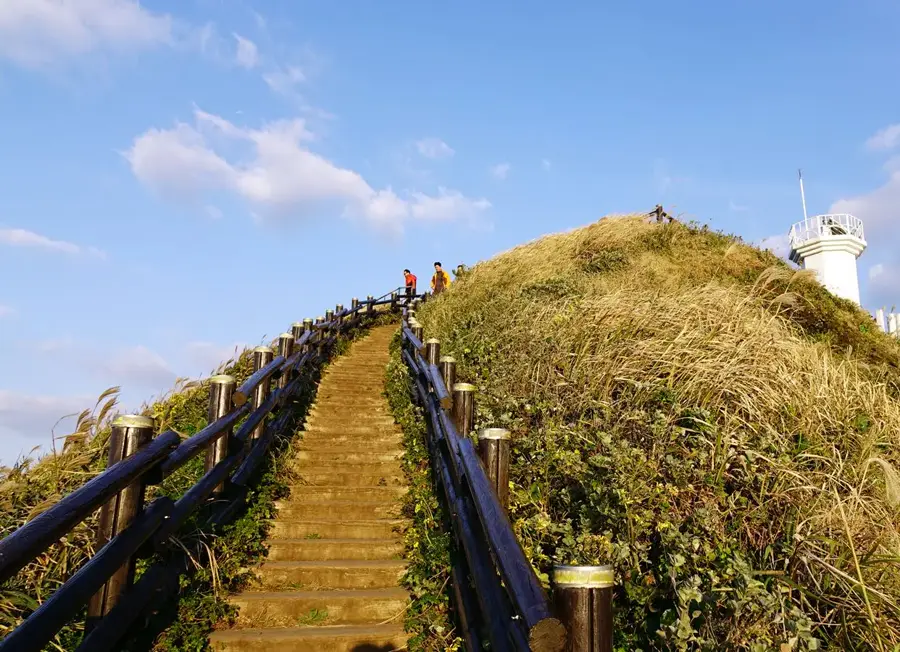
The high lighthouse viewpoint requires stairs, followed by the descent. Travellers with knee limitations, cardiovascular concerns, older companions, small children or a heavy stroller can finish the lower coast and turn back. Reaching the white structure is not the admission test for Seopjikoji. Wear shoes with grip, keep both hands available and do not pause for a posed picture in the centre of a narrow stairway.
How far can wheelchairs and strollers go?
Some paved sections and lower viewpoints near the public entrance may be usable, but that does not prove a step-free circuit through Bulgeunoreum and the lighthouse. Same-day works, crowding, car-park position, slope and wet surfaces can change the practical endpoint. If step-free access is essential, call +82-64-784-2810 before departure and ask a specific question: which viewpoint can be reached from which car park without stairs on that date?
Do not carry a large stroller up a crowded staircase if two adults cannot control it safely. A better group plan is to complete the accessible lower route together, let one adult remain with the child and have others make a brief lighthouse climb before meeting again. Missing the highest point is not a failed visit; the grassland, Seondolbawi, cliffs and Seongsan backdrop already exist on the lower route.
Why does wind matter so much?
Seopjikoji projects into the sea and has limited tree shelter. Strong wind changes perceived temperature and affects hats, umbrellas, strollers, long clothing, tripods and stability on the stairs. A weather app's rain percentage is insufficient. Check sustained wind, gusts, feels-like temperature, lightning and coastal warnings; where barriers or staff directions exist, the same-day restriction takes priority.
In heavy rain and wind, a large umbrella can become more dangerous on a narrow stair. Treat Seopjikoji as a completely outdoor attraction and keep a genuine indoor alternative in the Jeju rainy-day plan. Free entry and 24-hour access are never reasons to preserve the stop through a thunderstorm, closure or severe gusts. After a brief shower, wet stairs, mud and lower visibility still matter.
What time of day is most practical?
Morning: clearer light, potentially lower traffic and a useful first or second stop around Seongsan; before sunrise, darkness and wind require more preparation. Midday: open visibility but almost no shade, producing the strongest summer heat and sun exposure. Afternoon: grassland and the inland mountain direction may gain warmer light, but seasonal sunset and return time become relevant.
Weekends, canola season, long holidays and clear-weather days concentrate vehicles and people on the popular lighthouse stairs. The most effective crowd strategy is not waiting for every frame to become empty. Select two or three views, keep moving with the path and leave space for others. Repeatedly walking backwards for a people-free photograph can turn a pleasant coast into a bottleneck.
Are the canola fields guaranteed in spring?
Seopjikoji is associated with yellow spring canola, blue water, reddish volcanic slopes and distant Seongsan Ilchulbong. Flower condition still varies with annual temperature, wind, rain, planting and land management. An official description saying that canola grows in spring does not guarantee a full yellow field during one particular week, nor permission to enter every planted area.
Do not compress flowers by stepping off the route, cross a low wall or create a portrait inside a restricted plot. Check recent official photographs and the current signs. Without peak bloom, the volcanic terrain, shore, Seondolbawi and cape structure still make a complete visit. If flowers are the only reason you would go, retain schedule flexibility instead of turning a seasonal possibility into a year-round promise.
Is Seopjikoji worthwhile in autumn or winter?
Autumn grasses and silver reeds, or a clear winter horizon and exposed red slope, can make the shape of the land more legible. The cape is not empty outside spring. The tradeoff is stronger perceived cold, earlier darkness and a greater chance that wind or moisture changes the stairs. Choose clothing for an exposed headland rather than the temperature reported in central Jeju City.
Wear a wind-resistant outer layer and close-fitting shoes; secure loose hats and scarves. In short-day months, begin the full walk earlier in the afternoon and preserve daylight for the return. If the group is uncomfortable as soon as it reaches the entrance, complete one lower view and leave. A lighthouse climb is not worth forcing through poor conditions.
How should you view Seondolbawi, Jeju horses and the shore?
Seondolbawi rising from the water, dark volcanic rock, grazing Jeju horses and grassland create one of Seopjikoji's most recognisable combinations. The horses are not a touchable photo prop. Do not feed, chase, approach from directly behind or cross a barrier around them. Coastal rock may become more visible at low tide, but visibility does not establish a safe route.
Use fenced or clearly established viewpoints and photograph the animals within their environment rather than leaving the path for a close-up. Tide, waves and algae can change a rock surface quickly. Another visitor standing somewhere before you is not proof of access. Protecting the land and animals is inseparable from protecting yourself.
Hyeopja Yeondae is not decorative stonework
Hyeopja Yeondae remains on the broad grassland. It was a coastal signal station used to communicate emergencies through fire and smoke during the Joseon period. Visit Jeju describes the stone structure as approximately four metres high and nine metres along each side, relatively well preserved and designated as a Jeju Special Self-Governing Province Monument.
Its location explains a human use of this headland beyond scenery: a high, open coast was valuable for watching and signalling. Do not climb the structure or move stone for a photograph. Viewing its relationship with the sea and horizon tells more than treating it as an old photo wall.
Can you go inside the lighthouse?
When visitors say they “climbed the lighthouse,” they often mean that they reached the exterior viewpoint around the white structure on Bulgeunoreum. Do not assume the tower interior is open. Stair, path, maintenance and crowd access are controlled by same-day signs and barriers. At the top, keep the landing and entry clear rather than using the rail as a permanent camera support.
If gusts are strong, stairs are wet, a companion lacks energy or the branch is closed, the lower viewpoint can show the white lighthouse against the reddish slope more effectively than standing beside its wall. The value of Seopjikoji belongs to the whole promontory, not physical contact with the lighthouse.
Are Glass House and Yumin Art Nouveau Collection included in free entry?
Architecture associated with Tadao Ando, including Glass House and the museum complex, is frequently recommended alongside Seopjikoji. Exterior buildings can form part of the walking landscape, but interiors, exhibitions, closure days, reservations and admission are separately operated. They do not become free or open 24 hours merely because the public cape does.
If architecture is the principal reason for the trip, check the facility's own official page and same-day opening before travelling. If the aim is only the coast, you do not need to buy anything to complete the visit. The free route already provides grassland, volcanic terrain, cliffs and horizon without a forced commercial extension.
How should drivers avoid unnecessary backtracking?
Driving lets visitors adjust the arrival time from Seongsan, Pyoseon or another eastern base according to weather, but a car only reaches the parking area. It does not shorten the cape itself. Resolve insurance, designated drivers, parking and alcohol restrictions through whether to rent a car in Jeju, then save the named public Seopjikoji car park in a Korean map.
Confirm the public entrance before arriving and do not stop on a narrow approach road to release passengers. Set the next navigation destination before entering pedestrian-heavy exit traffic. During spring bloom and weekends, allow time to enter, pay and leave. A low daily parking maximum does not guarantee space and does not mean the Phoenix Island car park uses the same rate.
Can you reach Seopjikoji by bus? The last mile decides
One official Visit Jeju transport example directs travellers from Seogwipo Bus Terminal to bus 201, the Sinyang-ri entrance stop and then an approximately 50-minute walk to the Seopjikoji coast, with a total journey around two and a half hours. Routes change and a different origin may require a different service, so bus 201 is not a universal island-wide instruction.
On the travel date, use the Jeju bus travel guide to verify the current route, stop, final walking terrain and return service. A short taxi from the Seongsan area can be more practical than a bus from Jeju City followed by a long approach. Save the return before walking to the headland; do not discover at the far end that another 50-minute walk separates you from the bus.
How should families, older travellers and people afraid of heights visit?
Children who can follow instructions have many things to observe: horses, Seondolbawi, red volcanic material, the signal station and lighthouse. Before entering, establish that nobody crosses a barrier, chases an animal or runs towards a cliff. If wind takes a hat or object beyond a fence, an adult should not climb over to retrieve it. Keep food, water and rubbish in closed bags.
Older travellers and anyone uncomfortable with heights can use the lower coastal route and omit Bulgeunoreum. Allow the group 90 minutes for a 60-minute route if frequent rests are necessary, rather than adding another timed attraction. A successful visit means seeing the cape together and returning safely, not placing every person at the highest railing.
Combining Seopjikoji with Seongsan Ilchulbong: choose one main climb
The two places share an eastern geography and visual relationship, so one day makes sense. They should not both be described as effortless sea views. A summit visit to Seongsan already contains substantial stairs; adding the lighthouse branch at Seopjikoji compounds the load. Choose one high route and keep the other as a lower landscape walk when the group needs it.
Two nights around Seongsan make early starts and the return easier. Use whether to stay in Seongsan for two East Jeju days to place the base. From a one-night Jeju City stay, Seongsan summit, Seopjikoji, Udo and an evening market are usually too much together. Select one primary attraction and activate the second only when weather and energy support it.
Combining Seopjikoji with Aqua Planet: let outdoor weather set the order
Aqua Planet sits within the same broad Seopjikoji area, so the two work on one day. Walk outdoors first when the morning is dry and less windy, then move inside; reverse the order only when conditions are forecast to improve. The aquarium has its own opening, ticketing and final-entry rules. The cape's 24-hour status does not extend a timed attraction.
Use Aqua Planet versus Snoopy Garden for an East Jeju half day to choose the paid anchor, then cap the coastal segment. Close map proximity does not guarantee that a family will still have daylight and energy for the complete lighthouse route after four hours in an aquarium.
Why not combine Seopjikoji with western Jeju or Jungmun?
Seopjikoji lies near Jeju's eastern edge. Aewol, Hallim, Hyeopjae, Sanbangsan and the Jungmun area are not local neighbours simply because they share one island. A driving map can tempt travellers to fix an eastern cape and western sunset into one day, giving much of the usable light to the road.
Use East versus West Jeju to separate days according to the hotel and weather. Seopjikoji belongs with Seongsan, Pyoseon or one eastern paid attraction, not as a free bonus during a cross-island day. Free admission never cancels driving fatigue or congestion.
A 15-point checklist before departure
- Do you want a real coastal walk or only a lighthouse photograph?
- What are the current wind, gust, rain, lightning and feels-like conditions?
- Is there enough daylight to return from the chosen route?
- Does navigation point to the named public Seopjikoji car park rather than a bare address?
- Do you understand that the public and Phoenix car parks have different charges?
- Have you budgeted parking or transport despite free admission?
- Did you select the 60, 90 or 120-minute version?
- Can every traveller manage the slope and optional lighthouse stairs?
- Has a step-free or stroller endpoint been confirmed directly where necessary?
- Are the final bus walk and return service saved?
- Do you have a wind-resistant layer, shoes with grip, water and sun protection?
- Will you remain on formal paths and avoid horses or coastal rock beyond barriers?
- Have museum or architecture hours and charges been checked separately?
- Is Seongsan or Aqua Planet the primary attraction that day?
- Is a genuine indoor backup ready for severe wind or rain?
Give it a dedicated East Jeju stop: if you want the complete coast, volcanic landscape and Seongsan backdrop, can accept wind and 60 to 120 minutes outdoors. Visit while nearby: if you stay around Seongsan or Phoenix Island, or already plan Aqua Planet, and can use the lower 60-minute route. Skip it this time: if you stay in the west on a short trip, severe wind or rain is present, or the group cannot manage slopes and stairs without a confirmed accessible endpoint. Seopjikoji is not worthwhile because it is free; WIND, WALK and ROUTE must all fit.
Sources and date-sensitive details
Visit Jeju provided the volcanic formation, Seondolbawi, Hyeopja Yeondae, current address, difficulty marker and the two current parking rates. English VISITKOREA was used to cross-check 24-hour access and free entry. Official material exposes both 262 and 107 Seopjikoji-ro, so verify the named public car park and live map rather than using a bare number. Wind, tide, closures, parking, buses, flower condition, nearby buildings and step-free routing can change.
Visit Jeju | Seopjikoji VISITKOREA | Seopjikoji Visit Jeju | East-coast route and bus example