
The answer is not determined by whether you know Korean history. If you’re happy to follow a fixed meeting point, walk for four hours, and want Gyeongbokgung, the National Palace Museum of Korea, Bukchon, or hanok spaces tied together by one narrative, choose the hanbok-inclusive guided tour. If you already know which angles you want to shoot, your companions change clothes at different speeds, or anyone may want to take a break or split off midway, choose simple rental and free exploration. What the tour really buys is not someone reading out facts, but someone who sequences the route, leads the way, answers questions, and makes time decisions for the group. What free exploration buys is not a lower price, but the freedom to stop, reshoot, or abandon an area on your own terms.
The easiest mistake is trying to get three things at once: full historical commentary, polished photos without other people in them, and the freedom to stop whenever you want. If you’re busy finding the right angle while the guide is explaining the palace’s function, you’ll miss the content. If the whole group is waiting for you to retake a shot, everyone else’s visit gets compressed. If a photographer is scheduled at a fixed time, it may also clash with the tour’s movement. Decide what the main character of this morning is, and treat the other element as secondary; otherwise, when the four hours end, all you’ll remember is how much time was spent gathering together.
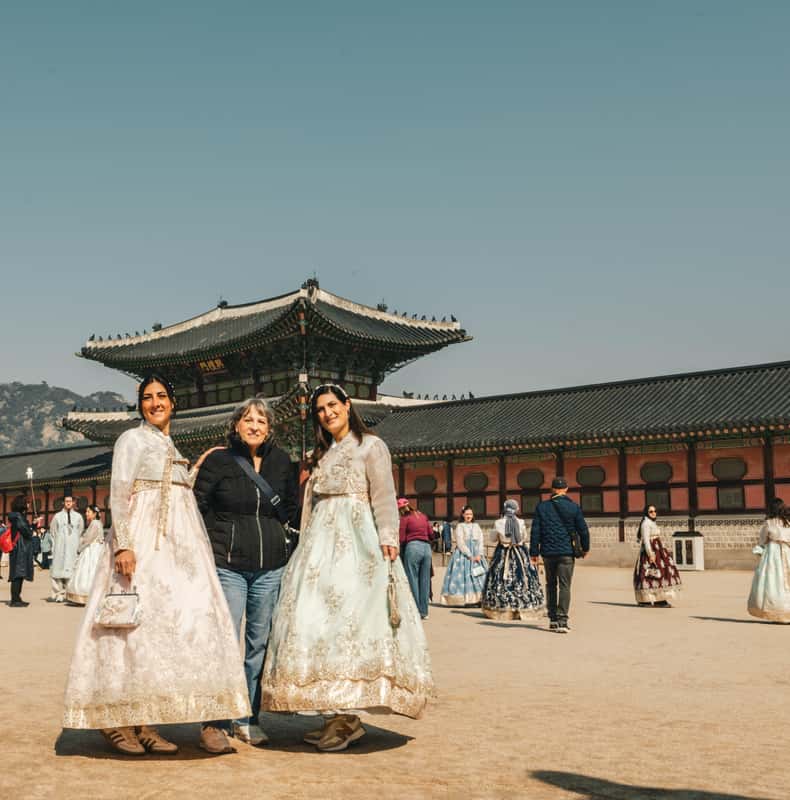
What a guide really takes off your plate is the fatigue of having to decide again at every gate
The first time you enter Gyeongbokgung, building names, directions, and dates can blur together within minutes. Reading the signs yourself may give you facts, but not necessarily which events are worth stopping for, how different halls connect to royal life, or how to understand the reconstructed sections in front of you. A good guided tour turns what looks like a series of similar courtyards into a route with context and picks the stops that best explain the Joseon dynasty and later change within limited time. For travelers who like asking questions and want to be able to talk about the background of their photos after they get home, that structure is more valuable than renting hanbok for two extra hours.
The guide also removes a kind of invisible work from your companions: nobody has to keep opening maps, checking transitions, or pushing the group to move on. In a family or friends group where one person usually becomes the planner, letting the guide absorb the pace for half a day is what allows that person to actually participate. But that only works if everyone accepts the external rhythm. If someone is especially slow on foot, a child needs unpredictable bathroom breaks, or an older traveler can’t stand for long, a small-group or private tour is more likely to preserve that benefit; a large group on a fixed route may instead amplify the strain.
Free exploration is not empty of content — it just means you must set your own stopping point
Free exploration suits people who already know exactly what they want. If you only want to see Geunjeongjeon, Gyeonghoeru, and the palace gates, know how long you’ll spend at each spot, and are willing to read the official intro beforehand, you don’t need to buy a full guided tour. The time saved can go into choosing clothes, styling hair, waiting for the crowds to thin, and returning the hanbok. If your interest in history suddenly deepens, you can use official on-site resources, audio content, or come back another day in regular clothes; you don’t need to tie every bit of understanding to the hanbok experience.
Freedom has a cost, though. Groups often linger too long at the entrance, realize halfway through that the area they most wanted to see is on the other side, or end up with everyone collecting different angles and nobody brave enough to call the outing finished. Before you go, keep only three stops, one optional stop, and a latest turnaround time. Then use hanbok photo backdrops and palace walking distances to confirm that Gyeongbokgung is really the right fit, rather than going in automatically just because the rental shop is nearby.
| What you can’t give up today | Better fit | What control you give up | What to check first |
|---|---|---|---|
| Understanding the buildings, royal life, and historical sequence | Hanbok-inclusive guided tour | Dwell time and part of the route | Tour language, group size, itinerary |
| Everyone wants to appear in the photos, but you don’t need pro-level retouching | A small-group tour may work | Photo angles and number of shots may not be self-directed | Do not assume the guide will take photos; confirm it |
| A specific composition, time to choose clothes, and the option to rest whenever needed | Simple rental and free exploration | You handle your own research, directions, and timing | Rental start time, return time, and late fees |
| You want a complete set and retouched files | Book professional photography separately | Fixed shooting time | Do not stack this on the same morning as a full tour |
When you see “hanbok included,” first check exactly what is included
The same activity page may sell both “with hanbok” and “without hanbok” options, and the meeting point may differ too. Take GetYourGuide’s half-day Seoul palace tour as an example: the activity page lists roughly four hours, an English-speaking guide, Gyeongbokgung, the Bukchon area, and other stops, but hanbok rental depends on the option you select. Hair and makeup are also not part of the standard inclusions. If you only look at the title on the payment page and assume clothes, hairstyle, admission, and transfers are all covered, what you lose first on the day is not the discount — it’s the chance to join the tour on time.
Check exactly how long you stay at the rental shop, whether trying on clothes counts toward the tour time, size availability and children’s outfits, storage, return arrangements, drinks or entrance fees, palace closure days, whether rain or snow changes the operation, and where the tour ends. If the product says it still runs in rain or snow, that means bad weather does not automatically cancel it. If you can’t accept wearing hanbok in rainy conditions, first see the stopping line for outdoor shoots and indoor studio shoots on rainy days — don’t ask the whole group to change plans only after you’ve already gathered at the meeting point.
If photography is the main event, the tour can only be background noise; if history is the main event, accept fewer shots
Many people think listening and photographing at the same time is no problem, but attention doesn’t multitask well. While the guide explains a hall’s function, you’re adjusting exposure. By the time you move to the next stop, you’ve just found a good angle. When the whole group stands together, you want to take individual shots of every companion. The result is that you only catch fragments of the explanation, and the photos feel rushed because you’re afraid of falling behind. If the work matters most, choose simple rental plus professional photography, and use the comparison of hanbok rental and photo delivery to check raw files, retouching, and whether companions appear in the frame. Leave the guided tour for another palace or another day.
If history matters most, let your phone serve only three purposes: one shot of the whole group at the entrance, one close-up of an important detail the guide points out, and one final complete group photo before the end. Don’t ask for the same pose to be retaken in every courtyard. If you still want more photos after the tour, first confirm the hanbok return time and leave 30 minutes to finish near the rental shop, rather than making the group wait. It may look like you’re taking fewer photos, but in practice you’re protecting the explanation you paid for.
If children, older travelers, or non-native-language companions are coming, first ask who will drop out in the second hour
When children are interested in the story, an interactive guide may work better than parents reading signs aloud themselves. But four hours can still be too long for younger kids. Check whether there are breaks, what areas are suitable for strollers, where the toilets are, and which segment is actually covered by vehicles. For older travelers, ask about walking pace, stairs, standing time, and whether short breaks away from the group are possible. Don’t let broad phrases like “family-friendly” reassure you too much; each person’s practical limits are the real answer.
Tour language is not just a matter of whether you understand it or not. Being able to follow everyday English does not mean you can easily absorb dynasty names, building terms, and dates. If the whole group gets distracted by translation, a Chinese-language tour or free exploration with Chinese materials may be more effective. On the other hand, people who like asking questions can still get more context from an on-site guide than from a translated article, even if English is not their first language. The language listed on the platform must be checked by date and session; do not infer your slot from other reviews.
Before you add Bukchon afterward, decide whether you want the neighborhood or just the feeling of finishing a package
Hanbok-inclusive tours often link Gyeongbokgung with Bukchon, hanok, or tea stops. The advantage is that you don’t have to arrange the transfer yourself. The trade-off is that every stop has a fixed amount of time. Bukchon is a residential neighborhood, not an extended photo studio. You need to lower your voice, follow local visiting rules, and you can’t treat every alley as a place to linger. If you only want to go because the package adds “one more stop,” that stop can easily become a checklist item. If you want to understand traditional homes and urban change, then the tour has a purpose.
Free-exploration travelers do not need to treat Bukchon as the mandatory second half of a hanbok experience. Walking from the palace to the neighborhood, uphill, taking photos, and then returning to the shop will noticeably extend your rental time. A two-hour plan usually is not built for that kind of extension. First look at how two-hour, four-hour, and half-day hanbok plans differ, then decide whether you really need to extend the outing to Bukchon.
Use one reverse question to make the final call: if you couldn’t take photos today, would you still want this tour?
If the answer is “yes,” then you’re buying understanding and guided routing, with hanbok adding a more embodied experience. Choosing the tour makes sense. If the answer is “no,” then photos or clothing are the real priority, and simple rental, photography, or an indoor studio session should come first. Don’t treat a tour that bundles a lot into one booking as a way to save money if you don’t need those extras. Unused commentary, tea, or transfers are not free — they take up the time you could have spent taking photos and resting.
Once you’ve decided on the tour, arrive on time, bring only what you need, and accept fewer photos in advance. Once you’ve decided on free exploration, write your three stops, turnaround time, and one main background into your phone. Either choice can still make for a successful hanbok morning. What really causes regret is arriving at the palace and still refusing to admit whether you wanted a story or a finished set of photos.
Break the hanbok morning into a single main character
Then confirm the four decisions that should not be mixed together
- Make sure the rental period covers changing, walking, and return
- Check whether Gyeongbokgung is really the palace you want to understand and photograph
- If you want full photo delivery, handle it with a separate photography plan
- If the tour still runs in rain or snow, decide where you’re willing to stop
- Return to the Seoul experience overview so you don’t schedule another fixed meeting in the afternoon
Sources and verification
- GetYourGuide: Gyeongbokgung, Bukchon, and optional hanbok half-day tour
- Korea Heritage Service, Royal Palaces and Tombs Center: Gyeongbokgung history and palace grounds information
- Korea Heritage Service, Royal Palaces and Tombs Center: visiting information for each palace
- Seoul Metropolitan Government English website: city and visitor notice portal
- Sessions, languages, group sizes, routes, clothing options, rain/snow arrangements, and cancellation terms may change. This article was checked in August 2026; before paying, rely on the exact dated product page.