
If you have not checked the exact venue on your ticket yet, do not book a “Busan concert hotel” just because it looks close on a map. Busan Asiad Main Stadium and the Sajik sports complex are served by Metro Line 3, which means a Seomyeon stay normally involves a transfer on concert night. BEXCO is different: Centum City and Seomyeon are both on Line 2, so moving hotels for a single BEXCO event may solve a problem you did not really have. The real trade-off is not the number of kilometres between your hotel and the arena. It is how many transport steps remain after the show, and whether making one night easier makes the other three or four days of your trip harder.
| Main venue | Transport structure | One event night | Two or more event nights |
|---|---|---|---|
| Busan Asiad Main Stadium / Sajik sports complex | Sports Complex and Sajik are on Metro Line 3 | Seomyeon can still work, but budget for a post-show transfer | Venue-side, Geoje or Yeonsan becomes much more attractive |
| BEXCO / Centum City | Centum City and Seomyeon are both on Line 2 | Seomyeon remains a strong option; moving hotels is not automatic | Centum City and the Haeundae side gain repeated-use value |
| Temporary outdoor or special-event venue | Different for every event | Read the organiser and city transport notice first | Confirm shuttles, special exits and any operating-hour extension |
If your entire Busan base is still undecided, use the same logic as our three-night Busan base-versus-split decision: choose the hotel for the whole trip first, then let the concert adjust the weighting. A concert should influence your base; it should not automatically erase every other day of the itinerary.
The first mistake is treating “Busan concert” as if Busan had one concert district
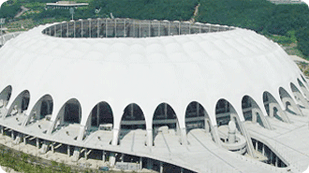
Search results often collapse every concert hotel question into the same shortlist. The metro network says otherwise. Busan’s official sports-complex directions place Sports Complex and Sajik on Line 3. The city’s current event transport page routes travellers to Busan Asiad Main Stadium through Sports Complex Station. BEXCO, meanwhile, is reached from Centum City Station on Line 2, and Visit Busan currently lists Exit 1 as the practical approach to the convention centre.
That difference is enough to produce opposite hotel answers. For BEXCO, a traveller based in Seomyeon can ride Line 2 toward Centum City without changing metro lines. For Asiad/Sajik, Seomyeon is not a same-line ride to the venue cluster. A transfer that feels routine at 3 p.m. can feel very different after a long show, merchandise queues and a crowded exit.
The useful question is therefore not “Which hotel is closest to the concert?” but “Which base creates the fewest bad transport steps at the time I will actually travel?” A hotel that is 700 metres from an arena can still be a poor event-night product if those 700 metres run through a packed exit route. A hotel farther away can still be the better trip base when its transport pattern fits the other days.
Asiad and Sajik: pay for less post-show friction, not for the smallest map distance
Busan’s official directions for the sports complex currently point travellers to Sports Complex Station Exit 9 or Sajik Station Exit 1 on Line 3. The city’s event-specific transport guidance for Busan Asiad Main Stadium also shows how a major concert can change the practical journey: walking time can expand with crowd conditions, and special transport measures may be introduced for one event.
The dangerous conclusion would be to assume those special measures are permanent. They are not. A previous major event may have had extended metro operations, temporary taxi arrangements or extra buses, but none of those should be copied into a future concert plan unless the organiser, Busan Metropolitan City or the transport operator confirms them again. When there is no concert-specific announcement, build your plan around normal operations and add time for crowding.
This creates a clear split. If you attend one concert during a four-night Busan trip and your other days go to Nampo, Haeundae, Busan Station and different parts of the city, moving to the stadium side for one night can be false efficiency. You save one return journey and then spend time checking out, storing luggage, checking in again and travelling from a less useful base the next day.
If you attend two nights at Asiad or Sajik, the arithmetic changes. The same walk, station entry, queue and transfer happens twice. A Geoje, Yeonsan or other venue-side base is no longer just “a hotel near the arena”; it is a way of repeatedly deleting the hardest segment of the evening. For travellers with children, older family members, mobility limits or low tolerance for late-night transfers, that repeated reduction in friction can outweigh a higher room rate.
BEXCO changes the answer because Seomyeon and Centum City share Line 2
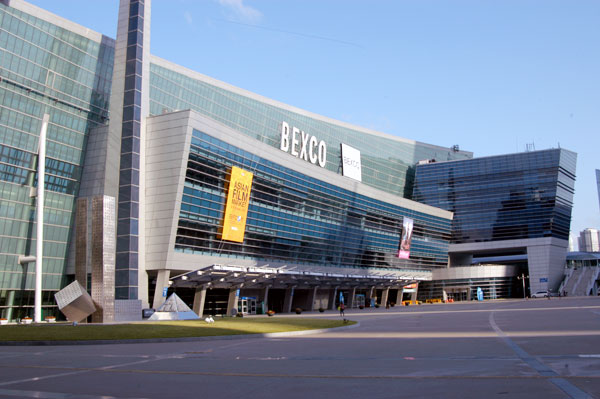
BEXCO is a different hotel decision. Visit Busan currently lists the venue at 55 APEC-ro in Haeundae-gu and describes access from Centum City Station Exit 1 on Busan Metro Line 2. This matters because Seomyeon is also a Line 2 station. You do not need to move your hotel to Haeundae simply because BEXCO is geographically in Haeundae-gu.
For one event day, Seomyeon can be the more complete choice if the rest of your trip values central dining, nightlife or access to several directions. The event night still involves a substantial ride and a crowded station, but it avoids the structural penalty of a metro transfer. That is why the one-day BEXCO case should be compared with the dedicated BEXCO stay decision guide before you pay a premium for a hotel next to the convention centre.
For two or three consecutive BEXCO days, proximity begins to compound. Early registration, daytime sessions, evening events and the possibility of returning to the room between blocks can make Centum City or the Haeundae side genuinely more useful. At that point, moving east is not about shaving a few minutes from one train ride. It is about using the location repeatedly.
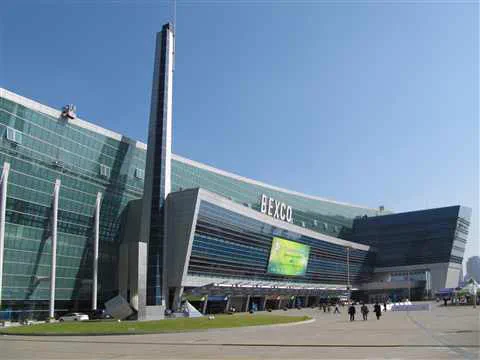
One more detail matters at BEXCO: “near BEXCO” is not precise enough. Event pages may use different walking estimates because the first exhibition hall, second exhibition hall and auditorium have different approaches. Before paying, check the exact hall or entrance printed on your event information and map the hotel door to that entrance, not just to the centre of the BEXCO complex.
One concert night and two concert nights are not the same hotel product
A useful way to compare concert accommodation is to count how many times you will actually use the “near the venue” advantage. The room premium, weaker access to other districts and the inconvenience of changing hotels are costs. The return from paying those costs is the number of difficult event journeys you remove.
- One concert night: the venue-side advantage is used once. On a longer Busan trip, a central base can still win.
- Two concert nights: the same crowd exit, station queue, transfer and final walk repeats twice. Proximity has real cumulative value.
- Concert plus daytime fan activities in the same district: ticket collection, pop-ups, merchandise queues and pre-show events can make the venue-side hotel useful more than once per day.
- Concert is only a few hours of a packed short trip: moving hotels can consume the exact time you thought you were saving.
If you are tempted to split hotels just for the event, read whether to use one Busan hotel or a split stay and count the packing, luggage storage, second check-in and next-morning repositioning. A cheaper room near the venue is not truly cheaper if it creates another half-day of hotel logistics.
Your travel party changes the cost of exactly the same route
Two fit adults can treat a late transfer as normal city transport. The same transfer costs more when you travel with older parents, children, a stroller, a leg injury or several people who move at different speeds. That cost is not the metro fare. It is the probability of taking the wrong exit, waiting for the group, finding an elevator, standing in a packed train and finishing the night with another walk.
This is why a venue-side hotel can be a poor value for one traveller and a sensible purchase for another even when the room rate is identical. Accessibility hardware does not remove event-night crowding. The right decision is to price the route in effort, not only in won.
For travellers with older family members, the same principle appears in our Busan stay guide for seniors: a technically possible route is not automatically a good route if it repeats every night or becomes difficult when everyone is tired.
Arriving from Seoul by KTX or from Gimhae Airport on concert day? Solve the suitcase first
Same-day arrival creates a different risk. It is easy to plan the day as if every link will be exact: KTX or flight arrives on time, the hotel stores luggage instantly, the metro connection has no wait, the venue has no queue and entry takes five minutes. One 20-minute delay can then break the whole chain.
Your first task is therefore not to find the theoretically fastest hotel. It is to decide exactly where the luggage goes. Do not assume a concert venue accepts a large suitcase. Security screening, bag-size limits, lockers and prohibited-item rules belong to the individual event and must be checked against the organiser’s current notice.
If the trip itself is short, use the Busan trip-length guide and the four-day Busan itinerary to protect the fixed-start concert day from too many moving parts. The concert has a fixed entry window, but the finishing time and exit speed are not fully controllable. Treat it as a block with a hard start and a soft end.
If you land late or leave early, your hotel choice may reverse again. The early-flight last-night guide is useful when the morning after the concert has a non-negotiable departure time. A venue-side room is not valuable if it turns the next morning into an avoidable airport risk.
Before you pay, compare these six concert-specific conditions on the same sheet
| Check | Why it can change the hotel decision |
|---|---|
| Exact venue and entrance on the ticket | A venue complex may have several entrances; BEXCO halls should not be treated as one map pin |
| Metro line serving the venue | This determines whether your existing base is direct or transfer-dependent |
| Concert-specific transport notice | Extra trains, shuttles and road controls apply only when officially announced for that event |
| Number of event days | Being near the venue creates value once, twice or several times depending on your schedule |
| Travel-party stamina and luggage | The same late-night transfer has very different real costs for different travellers |
| First commitment the next morning | An early KTX, airport transfer or fixed booking can make a venue-side hotel the wrong trade |
The point is to stop comparing only nightly rates. A refundable room that protects you from an uncertain transport plan can be worth more than a slightly cheaper non-refundable room. Event transport information is often finalised later than hotel inventory, so reversibility has real value.
How I would narrow the choices without defaulting to “Seomyeon versus the arena”
Asiad/Sajik, one concert during a 3–5 night trip: keep Seomyeon or your existing central base in the first round unless the transfer is a genuine no-go for your group. One inconvenient evening can be a fair trade for several easier sightseeing days.
Asiad/Sajik, two consecutive nights: move the stadium side, Geoje and Yeonsan into the top tier. You are buying two easier exits, not just a shorter sightseeing commute.
BEXCO, one event day: do not eliminate Seomyeon simply because the venue is in Haeundae-gu. The Line 2 structure keeps it competitive, especially if the rest of the trip is mixed.
BEXCO, two or more days: Centum City or the Haeundae side becomes more persuasive because the location is used repeatedly. If the event is part of a wider October trip, compare it with the BIFF accommodation framework or the October event-base decision rather than assuming every east-Busan event needs the same hotel.
Temporary or unusual venue: stop reusing an old concert guide. Entrance design, temporary shuttle points, road closures and last-entry rules can be unique to one event. Verify the organiser, venue, city and transport operator again before booking a non-refundable room.
Five minutes before booking: run this final route check
- Open the actual ticket and confirm the full venue name, not just “BUSAN”.
- Put the venue entrance, nearest metro station and hotel door on the same map.
- Test the route at the expected finish time, not the opening time.
- Count how many nights you will repeat that route.
- Only then compare refundable room rates and cancellation deadlines.
Verdict: there is no universal “best area” for a Busan concert. For Asiad/Sajik, the key issue is Line 3 and the transfer after the show. For BEXCO, the same-Line-2 relationship with Seomyeon can keep a central base competitive. For temporary venues, the event-specific transport notice overrides generic advice. What you are really buying is enough margin to get back to the room when the concert ends—not the smallest distance number on a booking map.
FAQ
Is Seomyeon a good place to stay for a Busan concert?
Check the venue first. Seomyeon and Centum City are both on Metro Line 2, so Seomyeon can work well for a one-day BEXCO event. Busan Asiad Main Stadium and Sajik are on Line 3, so the post-show journey from Seomyeon normally includes a transfer.
Do I need to stay next to the concert venue?
No. If the event occupies only one night of a longer trip, the venue-side advantage is used once. It becomes more compelling for two concert nights, very late finishes, or travellers for whom late transfers are a real burden.
Should I stay in Haeundae or Seomyeon for BEXCO?
For one BEXCO day, compare the whole trip first. Seomyeon stays competitive because it is on the same Line 2 corridor. For two or more consecutive BEXCO days, Centum City or the Haeundae side gains much more repeated-use value.
Can I take my suitcase directly to a concert after arriving by KTX?
Do not assume so. Large-bag, locker and security rules are event-specific. Arrange a confirmed luggage drop first, then work backward to the venue entry time.
Sources and what still needs to be checked
Reviewed 2026-08-20. Current venue and metro structure were rechecked against Busan Metropolitan City Sports Facilities Management Office, Busan Metropolitan City event transport guidance and Visit Busan. Busan Sports Complex is served by Sports Complex Station Exit 9 or Sajik Station Exit 1 on Line 3. Visit Busan currently lists BEXCO at 55 APEC-ro and access from Centum City Station Exit 1 on Line 2. Any concert-specific extended service, shuttle, road closure, bag rule, entry gate or late-night operating plan must be confirmed again for the exact event.
Primary references: Busan Sports Complex directions; Busan event transport guidance for Busan Asiad Main Stadium; Visit Busan — BEXCO.