
Short answer: Haedong Yonggungsa Temple is worth visiting, but “free sea view” is not enough reason to force it into every Busan itinerary. Separate COAST, STAIRS and ROUTE. This is an operating religious site built against a rocky coast; the main approach includes the famous 108 steps and narrow crowd channels; and reaching East Busan takes more than riding one subway train. Current official information lists daily opening from 04:30 to 19:20, last entry at 18:50 and free admission. From Osiria Station, you still transfer to bus 139 or 1001 and walk for about 15 minutes after getting off. If you stay in Haeundae or already plan to visit Osiria, a two- to three-hour block can work well. If you stay in Nampo and have only two days, the return journey may take longer than your time inside the temple.
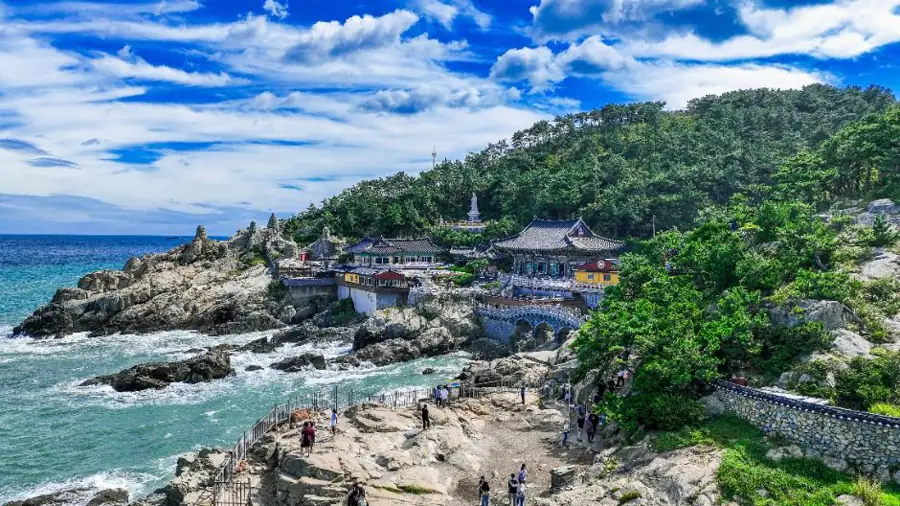
- COAST: an active Buddhist temple beside exposed rock and sea, with worship and ceremonies continuing around visitors.
- STAIRS: 108 stone steps connect the entrance side with the core temple area; crowds, rain, older travellers and strollers materially change the visit.
- ROUTE: from Osiria Station, transfer to bus 139 or 1001, get off at Yonggungsa Temple & National Institute of Fisheries Science, then walk about 15 minutes.
- Best for: travellers based in eastern Busan who will wake early or reserve half a day for a temple, shoreline and horizon in one setting.
What is Haedong Yonggungsa? A temple first, a sea-view attraction second
Haedong Yonggungsa sits in Gijang-gun on Busan's north-eastern coast. Its main buildings, bridge and stone structures cling to the rocky shore, which makes it visibly different from Korean temples set deep inside mountain valleys. Visitors come for waves, unusual rock formations, tiled roofs and sunrise. At the same time, worshippers chant, bow, light offerings and enter Buddhist halls around them.
When you place the temple in a four-day Busan itinerary, do not budget only the 20 minutes required to take one photograph. You must cross the city towards East Busan, walk past entrance stalls and zodiac statues, descend the 108 steps, cross the bridge, move through the temple and climb back to the entrance. Counting only the time when your camera faces the main hall substantially understates the stop.
How should you understand the temple's history?
VISITKOREA traces the temple's origin to 1376, when the Buddhist teacher Naong is said to have established it during the Goryeo period. The complex was later destroyed during the Imjin War, rebuilt by Monk Ungang of Tongdosa in the early 1930s, and restored further after Monk Jeongam became abbot in 1974. The present name is connected to a story of Avalokitesvara Bodhisattva ascending on a dragon in the abbot's dream.
This timeline explains religious continuity; it does not mean every visible hall, statue and pagoda is an untouched object from 1376. Separate the founding tradition from later reconstruction and expansion. Otherwise, one impressive old date turns a layered modern religious complex into an inaccurate claim that every surface is medieval.
Opening hours, last admission and cost: three different facts
Visit Busan and the current VISITKOREA listing give daily opening of 04:30-19:20, with last admission at 18:50, and free entry. Last admission is not a recommendation to arrive at 18:50. The walk from the entrance to the shore includes steps, while fading light, sea wind, ceremonies and the closing of individual spaces can reduce what is practical near the end of the day.
Free entry means that no temple admission ticket is required. It does not make parking, taxis, guided transport, offerings, donations, food or nearby commercial activity free. Official information identifies the temple car park as paid. Travellers based in Nampo or Seomyeon should therefore compare the cost of the whole half day, not assume that a free attraction has no meaningful transport cost.
Is sunrise genuinely the best time to visit?
The open horizon and sunrise rock make Yonggungsa one of Busan's recognised sunrise settings, and a 04:30 opening makes a pre-sunrise arrival possible in some seasons. But the actual sunrise changes by date, season and weather. More importantly, the temple opening does not mean the Donghae Line, bus 139, bus 1001 or buses from Haeundae can deliver you before the sun appears.
A true sunrise plan will often require a pre-booked taxi, a car, or a transfer whose exact early operation has been confirmed. Check sunrise time, cloud cover, precipitation, wind, pickup point and the return plan together. If the horizon is obscured or the pre-dawn transfer is disproportionate, visiting shortly after normal transport starts can still provide a quieter temple without pretending that dawn is compulsory.
Which time of day is most practical?
Around sunrise: fewer people and special light, but weak public transport, darkness, cold or wet steps and a more expensive transfer. 07:00-09:00: often quieter than midday while some ordinary transport has begun; this is the practical early window for visitors who do not require the exact moment of sunrise. 10:00-14:00: tour groups, families and Osiria visitors concentrate around the narrow bridge, the main courtyard and the stairway.
After 15:00: crowds may ease, but seasonal sunset, last admission and the return schedule matter. Buddha's Birthday, New Year sunrise, weekends, long holidays and ceremonies can completely change the pattern. First decide through how many days a first Busan trip needs whether you have a flexible half day; only then decide whether dawn is worth the extra effort.
How difficult are the 108 steps? Remember that you climb them on the way out
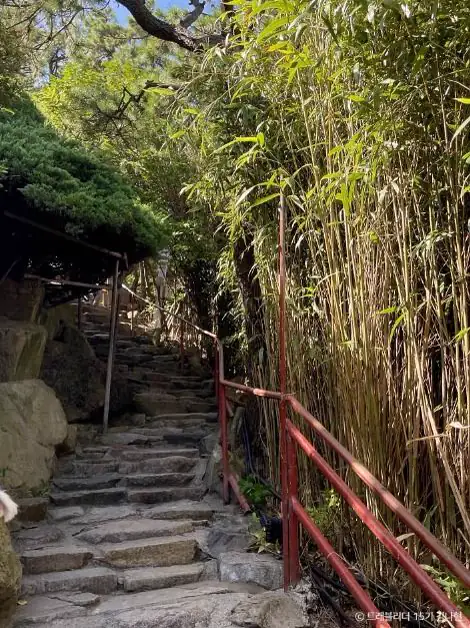
The route from the entrance passes through pine and bamboo before the famous 108 stone steps descend towards the core temple area. Religious interpretations link the number with health, longevity and the transformation of human worries. For practical planning, the important details are uneven stones, bends, two-way traffic and crowd pauses. Rain, leaves, low light, long clothing and unfamiliar footwear all reduce stability.
Descending at the start makes it easy to forget the return climb. Children, older travellers, people with knee limitations, anyone carrying a large bag and visitors in humid summer weather should preserve energy for the way back. Do not stop in the middle of the stair flow for a posed photograph. Rest only on a wide, stable landing where other people can pass.
What should you see inside the temple?
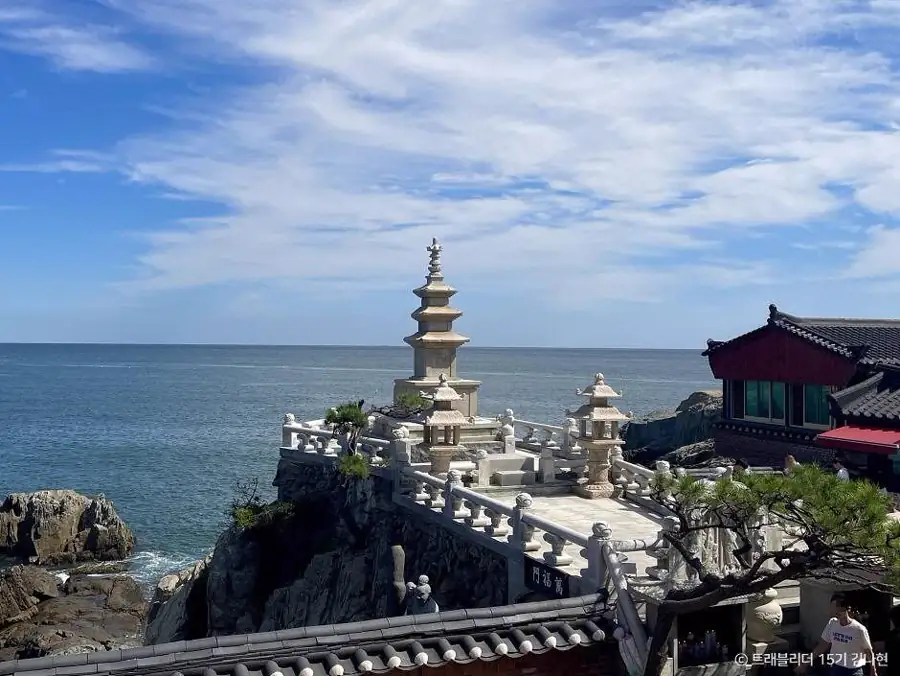
After the entrance gate, zodiac statues and 108 steps, the bridge leads into a dense sequence of halls, a sea-facing Avalokitesvara figure, coastal pagoda structures and sunrise-rock viewpoints. Dragon and wish-related sculptures can turn a first visit into a checklist very quickly, especially when every group stops at the same object.
A more useful visit has three layers. First, notice how waves change the sound and atmosphere below the rock. Second, observe how halls and bridges fit the limited cliff terrain. Third, watch how worshippers use incense, prayer space, lanterns and offering areas. When chanting, a ceremony or a queue for prayer is in progress, wait, move around it or put the camera away. Tourist circulation should not interrupt religious circulation.
Temple etiquette: use side doors, organise shoes and lower your voice
Visit Busan's current etiquette guidance asks visitors to keep their voices down inside the temple, use side doors rather than the central door reserved for monks when entering and leaving a Buddhist sanctuary, and organise their shoes. You do not need to imitate rituals you do not understand. Stand to one side, read signs and observe the established movement of worshippers.
Do not step across offerings, ritual objects, prayer cushions, ropes or temporarily closed areas. Avoid standing with your back close to a Buddha image while loudly arranging a selfie. Free admission does not guarantee that every hall remains open to tourists during every ceremony. On Buddha's Birthday, during a service or when a section is closed, follow the temple's same-day direction.
Photography: let worship and circulation go first
Many of the strongest camera positions are also working routes: the 108 steps, stone bridge, coastal platform, main-hall forecourt and sunrise rock. A good frame does not authorise a visitor to change clothes in the middle, spread a tripod or ask a companion to repeat the same walk ten times. Read the foot-traffic direction, wait for a genuinely open moment, take a brief photograph from the side and move on.
Inside halls, around ceremonies, near worshippers' faces and beside private prayer or donation activity, reduce or stop photography. Follow all same-day no-photo signs. Drone use, commercial production, large equipment and organised shoots cannot be inferred to be allowed merely because entry is free; they require actual permission from the temple and any relevant authorities.
From Osiria Station: rail is followed by a bus and a 15-minute walk
Current official directions recommend the Donghae Line to Osiria Station, Exit 1, then bus 139 or express bus 1001. Get off at the Yonggungsa Temple & National Institute of Fisheries Science stop and walk for approximately 15 minutes. That final walk includes roads, junctions, inclines and the commercial entrance area. It ends at the temple entrance, not at the coastal main hall.
Before travelling, use the Busan transport card and transfer guide to check payment, transfers and multi-person card use. The Donghae Line, urban metro and local bus do not function as one direct-station experience. For the return, budget the stair climb, walk back to the stop, bus wait and transfer to rail rather than measuring only the ride shown in a route-app summary.
From Haeundae: direct bus or travel through Osiria?
Visit Busan currently lists bus 181, 100 or Haeundae 9 from the area around Haeundae Station Exit 7, as well as the Osiria Station transfer using bus 139. The fastest choice depends on your actual boarding point, current schedule, traffic, outside walking and route changes. A bus number with one fewer transfer is not automatically faster if the service is infrequent or the stop is far from your hotel.
When staying in Haeundae, an early taxi can substantially reduce waiting for a sunrise or quiet morning visit, with public transport on the return to balance cost. Use the Haeundae versus Gwangalli base comparison before assuming that every sea-view hotel sits equally close to Yonggungsa. The two beach districts create very different East Busan journeys.
From Seomyeon, Busan Station or Nampo: why the half-day cost rises
Seomyeon, Busan Station and Nampo lie well west of Yonggungsa. Whether you use metro, the Donghae Line, bus or taxi, you must cross a large portion of the city. Waiting, transfers, congestion and the final walk can make the return journey longer than a 60- to 90-minute temple visit.
From a western base, combine the temple with Osiria, Gijang or another eastern coastal stop. Do not return to Nampo for lunch and then travel east again in the afternoon. If Busan has only one full day, choosing Yonggungsa means deciding whether the coastal religious setting matters more than one Nampo, Gamcheon or central-beach cluster. “In Busan” is not the same as “nearby.”
Driving and paid parking: a car solves dawn transport, not the stairs
Official information lists a paid Haedong Yonggungsa car park. Driving can solve weak pre-sunrise transport and make a multi-stop Gijang day more practical. However, weekends, Buddha's Birthday, New Year and good-weather afternoons can produce queues to enter, a full car park and slow departure.
Complete navigation, parking and passenger-drop decisions before reaching the pedestrian-heavy entrance stalls. Parking fees, access process, operating hours and vehicle limits can change, so follow the current signs. “Drive directly” means reaching the parking area; it does not remove the 108 steps and walking inside the temple.
Wheelchairs, strollers and older visitors: do not generalise from one facility icon
Visit Busan displays an accessible-restroom icon for the site. The presence of one accessible facility does not prove that the principal route from entrance to the coastal halls is fully step-free. Yonggungsa has major level changes, the 108 steps, narrow bridges, uneven stone, crowds and thresholds. It would be misleading to call the complete visitor circuit wheelchair-friendly based on a toilet icon.
If you need wheelchair access, a step-free worship route, the nearest vehicle drop, or a specific restroom, contact the temple at +82-51-722-7744 and ask about the route available on that date. Do not test a stroller on the stairway in a crowd if it cannot be carried safely. Older travellers should budget the return climb and rest stops rather than measuring only the descent.
Families: turn statues and waves into observation, not a playground
For children who can follow the group and manage steps, zodiac figures, dragons, pagodas, waves and temple architecture provide plenty to observe. But the stair turns, narrow bridge, wet coastal rock, incense, offerings and ceremonies are not spaces for running, climbing or touching every sculpture.
In a three-day Busan family itinerary, place Yonggungsa in the morning when children have energy. Set four rules before entering: hold hands on stairs, use quiet voices near halls, do not cross ropes, and do not leave the group beside the sea. Families with an infant, a large stroller that cannot be carried safely, or a strict nap schedule can skip the core route. Free entry is not a reason to force an unsuitable circuit.
Rain, strong wind, heat and winter: when should you change the plan?
The exposed coast amplifies wind, perceived temperature, salt spray and wet-surface risk compared with an indoor city attraction. In heavy rain, stone steps, rock, bridge surfaces and entrance lanes can become slippery. A large umbrella also blocks sightlines on a narrow two-way staircase. During strong wind, obey barriers and same-day closures rather than moving towards rock edges for a wave photograph.
An early summer visit avoids some heat and tour traffic but still needs sun protection and water. Before sunrise in winter, cold wind and ice can make the stairs substantially harder. In the Busan rainy-day plan, Yonggungsa should never be treated as an indoor attraction. Sustained heavy rain, thunderstorms, severe wind or a route closure are reasons to change the day.
How long should you stay? Sixty to ninety minutes is inside the site
For a first visit at an ordinary walking pace, with no sunrise wait or special ceremony, allow 60-90 minutes from the entrance through the steps, main temple, coastal area and back to the entrance. Quiet worship, architectural reading, sunrise waiting, crowd delays or an adjoining coastal walk can extend the visit to 1.5-2 hours.
Your itinerary must add the journey from the hotel, station access, waiting, transfers, final walk and onward travel. From Nampo, a “60-minute attraction” can occupy half a day. From Haeundae by early taxi followed by an Osiria stop, the same temple can be much easier. Distinguish dwell time from door-to-door time every time you compare itineraries.
What should you combine with Yonggungsa?
The National Institute of Fisheries Science area and coastal path sit near the temple, while Osiria contains shopping, leisure and other commercial attractions. This makes it possible to build an East Busan half day or full day, but every venue has different opening days, reservations and last transport. A place appearing in the same eastern map area does not make it comfortably walkable.
A stable sequence is early Yonggungsa, one principal Osiria stop, then return to Haeundae; or a morning East Busan activity, afternoon temple and departure well before last admission and darkness. Open each leg in navigation before deciding the order. Do not build the day from straight-line map proximity.
Why not combine Nampo, Songdo or Taejongdae on the same day?
Yonggungsa is in north-eastern Busan. Nampo, Songdo and Yeongdo sit in the south-western side of the city. They all provide “Busan sea views,” but they are not one local cluster. A day containing Yonggungsa sunrise, Nampo lunch, Songdo and Taejongdae sunset can spend the most reliable daylight inside trains, buses and road traffic.
Use one night versus two nights in Busan to separate east and west. If you have three full days, follow the geographic logic in the Busan three-day itinerary rather than connecting attractions by the word “coast.” A good East Busan day leaves the western harbour district for another day.
A 15-point checklist before departure
- Is your purpose the coastal temple, sunrise, worship or photography?
- Is the current opening still 04:30-19:20 with last entry at 18:50?
- What are sunrise time, cloud, rain, wind and coastal conditions?
- Does public transport genuinely operate early enough for your dawn target?
- Did you include the bus from Osiria and approximately 15 minutes of walking?
- Did you preserve energy to climb the 108 steps on the return?
- Will rain, darkness, long clothing or knee limitations change the route?
- Have wheelchair, stroller or step-free needs been confirmed directly with the temple?
- Will you lower your voice, use side doors and organise shoes in halls?
- Will worship, ceremonies and ordinary foot traffic take priority over your photograph?
- Can your equipment stay clear of stairs, bridges, halls and coastal platforms?
- If driving, do you understand that parking is paid and can queue?
- Did you add door-to-door transport beyond the 60-90 minutes inside?
- Are you pairing only one Osiria or Gijang cluster rather than crossing Busan repeatedly?
- Have you saved the return bus, Donghae Line or taxi pickup point?
Make a dedicated visit: if you want to see an operating temple pressed against the East Sea, will wake early or reserve a half day, can manage the 108 steps and will follow religious etiquette. Visit while nearby: if you stay in Haeundae or already plan Osiria or Gijang and can give the temple 60-90 minutes inside. Skip it this time: if you stay only one night in Nampo, do not want a long cross-city journey, or cannot manage stairs and have not confirmed a feasible step-free route. Free admission is not the deciding factor. Location, stairs, weather and the needs of a functioning temple must all fit.
Sources and date-sensitive details
Opening, last admission, free entry, paid parking, Osiria and Haeundae directions, and temple etiquette come from Visit Busan. Address, historical context, the 108 steps, images and basic facilities come from VISITKOREA. Opening, sunrise, bus schedules, parking, ceremonies, maintenance closures and accessible routing can change; recheck them on the visit date.
Visit Busan | Haedong Yonggungsa Temple VISITKOREA | Haedong Yonggungsa Temple VISITKOREA | K-Temple Tours Haedong Yonggungsa official site