
Short answer: Taejongdae is worth visiting if you want forest, wave-cut cliffs and a lighthouse beyond Busan’s urban beaches. It is not worth treating the Danubi Train itself as the entire attraction. Park admission is currently free, while an adult Danubi circuit ticket is 4,000 won. Allow two to three hours for a first visit. The decision is about how COAST, TRAIN and STAIRS work together, not how quickly you can remain seated from the entrance back to the entrance.
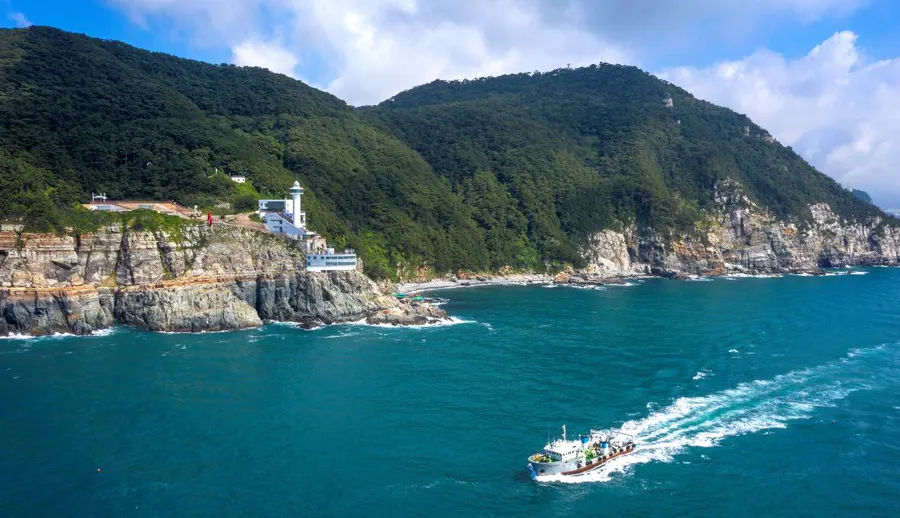
- COAST: look at layered rock, erosion, forest and open water rather than photographing blue sea from one balcony.
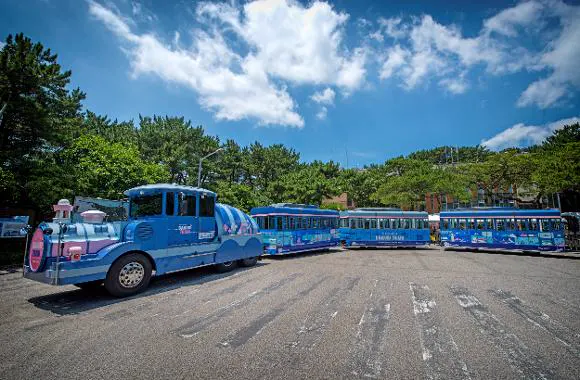
- TRAIN: Danubi reduces the 4.3-kilometre ring-road walk but depends on Monday closure, weather, seasonal hours and queues.
- STAIRS: reaching a train stop is not reaching the shoreline; Yeongdo Lighthouse and lower viewpoints still require substantial descent and ascent.
- Best fit: travellers willing to get off, walk slopes and give the coastal landscape at least two hours.
What is Taejongdae? It is not a single sea-view observatory
Taejongdae occupies the southeastern end of Yeongdo, combining dense warm-temperate forest, a rocky coast and open sea. Long-term wave action has cut steep cliffs and exposed layers with different colours and directions. The site became Korea’s Scenic Site No. 17 in 2005 and joined the Busan National Geopark in 2013.
An oral story links the name to Silla’s King Taejong Muyeol, who is said to have practised archery here after the work of unifying the Three Kingdoms. Treat that as a transmitted place-name story rather than a visible archaeological fact. What you can inspect is the scale at which forest, rock and sea meet. In a three-day Busan itinerary, Taejongdae should supply a natural and geological chapter, not merely another blue-water photograph.
Admission is free, but park, train and cruise are separate
The current Busan city park FAQ lists the recreation area as open 04:00–24:00 from March to October and 05:00–24:00 from November to February. Admission has been free since 2006. Those hours describe access to the recreation area, not continuous operation of the Danubi Train, indoor observatory facilities, lighthouse cultural spaces, cafés, cruises or visitor services.
You may walk without buying a train ticket. Danubi and sightseeing boats charge separately. If the trip is already short, use how many days a first Busan trip needs to decide whether the journey to Yeongdo belongs at all. A free attraction can still consume half a day through cross-city buses, queues and stairs.
Current Danubi fares and seasons: do not copy an old English price
The current Korean Busan city FAQ lists an adult circuit ticket at 4,000 won and an adult one-way ticket at 2,000 won. Youth tickets are 2,000 won and children’s tickets 1,500 won; age and eligibility discounts require the appropriate proof. Some older English pages still display lower fares, so this guide uses the newer Korean city information.
Danubi is routinely closed on Mondays and may stop in poor weather. The current seasonal table lists operation at 09:20–19:30 in June–August, 09:20–18:30 in September–October and 09:20–17:30 in the remaining low season. Ticketing begins at 09:00, and a descent-only bus runs for a period after normal operations. The city also warns that ticket sales can close two or three hours early as capacity fills. Recheck the date rather than treating any timetable as a guarantee.
Is Danubi worth it? You are buying uphill energy, not zero walking
The main ring road is about 4.3 kilometres. Walking it reveals the forest and gradual changes in view, but stops can push the visit towards two and a half or three hours. Danubi is most useful when you want to save energy for the observatory and lighthouse stairs. It circulates between main points and allows passengers to get off and use a later service, but busy-day queues and vehicle capacity break the assumption that the next train is immediate.
Worth buying: a first visit, an older or younger group, summer heat, and a plan to leave at two core stops. Not essential: strong walkers, an early visit before service starts or a Monday arrival. Poor use: buying a ticket and never getting off. A Busan transport card pays for local bus travel but should not be assumed to include the separate Danubi ticket.
Allow 90 minutes, two hours or three hours?
Compressed 90 minutes: Danubi runs smoothly, you use one observatory stop and return. Standard two to two and a half hours: combine the main observatory and Yeongdo Lighthouse, including waits and stairs. Three hours or more: walk the full ring, add Taejongsa, descend towards the coast, photograph slowly or use a cruise already confirmed.
Two dots close together on a map do not make the vertical distance flat. Before entering, choose one “must see” and one “only if time remains.” If the train queue is excessive, switch promptly to a shorter walk or fewer stops. Taejongdae does not become more worthwhile because you collect every stop; it works when you spend time where the rock coast becomes legible.
Observatory or Yeongdo Lighthouse: which is better?
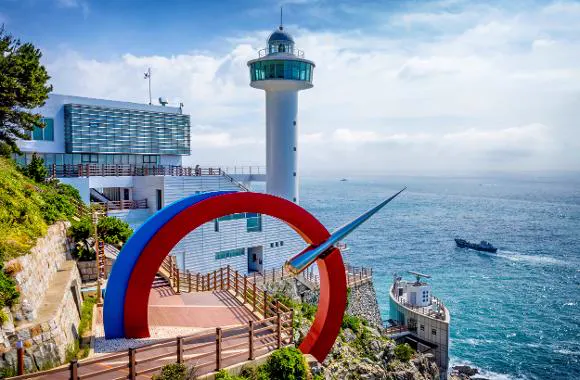
Taejongdae Observatory: easier to approach from the ring road and suitable for a quick, open view. Official information says Oryukdo and even Tsushima may be visible in exceptionally clear conditions, but visibility is never guaranteed. Yeongdo Lighthouse: gives more dimensional views through upper and lower platforms, the lighthouse structure and closer cliff angles, but it requires more stairs.
When energy permits only one, start with the observatory. If geology, lighthouse architecture and the cliff line matter, the lighthouse is more rewarding. A train stop is near the route, not at every lower platform. Seeing the white tower from above is not the same as completing the descent, and reaching the bottom does not remove the climb back.
The real cost of the lighthouse stairs is the return
The route from the ring road descends towards Yeongdo Lighthouse. Going down initially feels easy; returning to the stop after seeing the sea is the effort people underestimate. Summer exposure, winter wind and a wet surface can make the same vertical distance much harder. Wear shoes with grip, carry water and ask every companion whether they can climb back before committing to the lower level.
The lower platforms, Sinseon Rock and Mangbuseok area sit beside cliffs and active waves. Do not cross a rail, enter a closed section for an empty photograph or approach an edge during strong wind. The geology is impressive because the sea continues to erode this shore. That same process means it is not a controlled decorative pond.
Rain, fog and strong wind: Danubi is not an all-weather guarantee
Taejongdae depends on outdoor forest, cliffs, open water and stairs. Thick fog removes the main long view, heavy rain makes steps and rock surfaces slippery, and sea wind can make observation decks uncomfortable. Danubi may suspend operation in bad weather, so “we can look from the train if it rains” is not a reliable backup.
Use a Busan rainy-day plan to protect genuinely indoor activities, then visit during a lighter interval with useful visibility. If you arrive and the train is stopped, choose a short entrance-area forest walk only if conditions and mobility allow, or reschedule. A long bus ride to the terminus is not a reason to force wet lighthouse stairs.
Sunrise is possible, but Danubi will not carry you back
The Busan city FAQ identifies Yeongdo Lighthouse and the Taejongdae Observatory as sunrise locations available without a separate admission fee. Seasonal park opening precedes the first Danubi service, so the sunrise version is fundamentally a walking plan with darkness, winter cold, wind and the return route handled independently.
First-time visitors without a light or route familiarity should not read a 04:00 or 05:00 gate opening as proof that solo cliff access is comfortable. Check sunrise time, entrance, lighting, closures and weather on the date. A park open until midnight similarly does not mean every cliff stairway has complete lighting and staffed services.
Wheelchairs, older visitors and families: support does not cover every step
Current Visit Busan information lists accessible parking and toilets, guide-dog access, free wheelchair rental at the main-gate tourist information centre and a wheelchair lift on Danubi. These features make the ring road and main stops more workable. They do not make every lighthouse stair, rocky platform and forest path step-free.
For an older relative or young child, “Danubi plus the main observatory” is a successful version; add the lighthouse only after checking knees, weather and the return climb. In a three-day Busan family itinerary, include queues, toilets, naps and the bus back rather than demanding the full 4.3-kilometre loop. Confirm wheelchair stock, lift service and station access directly.
Hydrangeas and the Secret Forest are not automatic extras
Taejongsa is known for hydrangeas, and festivals have operated in past years. Bloom dates, volume, temple activities and festival schedules change annually. Do not reuse an old June or July festival date as a current promise. The temple and forest can still have value without full bloom; if flowers are the only reason, check official same-year conditions.
Visit Busan has also described a roughly 3.5-kilometre “Secret Forest” trail with narrow, steep and rocky parts, and possible seasonal closure for fire prevention. It is not an easy shortcut through the main circuit. Only treat it as a separate hike when an official current notice shows it open and you have hiking shoes, water, navigation and enough time. Never follow an old blog through a closed entrance.
Is a sightseeing cruise worth adding?
Boats around Taejongdae offer a sea-level view of cliffs, rock layers and the lighthouse. The current Busan city FAQ lists 15,000 won for adults and 8,000 won for children aged 12 or younger, and explicitly says operation changes with weather. Different piers and operators require direct confirmation; one old timetable is not a unified schedule for the whole coast.
The sea view can add geological context, but the cruise also adds a descent to a pier, waiting, sailing and a climb back. If motion sickness, waves or a two-hour limit applies, finish the land route first. Free park admission does not create a compulsory package of train plus boat.
Taejongdae, Oryukdo or Songdo: choose the type of coast
Taejongdae: forest, wave-cut cliffs, a ring road and lighthouse; the strongest natural-geology experience. Oryukdo: a short glass skywalk and direct headland view; easier to compress, but opening is sensitive to wind. Songdo: a paid cable-car ride with an aerial crossing, beach and concentrated visitor facilities.
Choose Taejongdae for forest walking and rock layers, Oryukdo for a short headland stop, or Songdo when you prefer to remain seated for the main sea view. Putting all three into one day usually creates more north–south and east–west transport than coastal time. In a Busan one-night versus two-night decision, preserve one coherent coastal area rather than collecting distant viewpoints.
Connect Yeongdo and Nampo instead of making an isolated return trip
Taejongdae has no metro station. From the Nampo direction, common buses include 8, 17, 30, 88 and 186; from Busan Station, routes 17, 88 and 101 are commonly listed. Alight near the Taejongdae or Taejongdae Hot Springs terminus. Routes and stop positions can change, so save the Korean destination “태종대” in your map.
The sensible pairing is with Nampo, Yeongdo or the southwest, not an isolated morning from Haeundae followed by another eastbound crossing. A four-day Busan itinerary can dedicate one day to the west and southwest. With five days, a five-day Busan itinerary gives enough flexibility to move Taejongdae away from fog or strong wind. More days should reduce backtracking, not justify every distant sea view.
Eleven checks before you leave
- Do you want the COAST, or only a ride on the TRAIN?
- Is the visit during summer, autumn or low-season service?
- Will Monday closure or bad weather stop Danubi?
- Could ticketing finish early because of capacity?
- Is the observatory or Yeongdo Lighthouse the priority?
- Can everyone climb back after descending the lighthouse stairs?
- Will fog, wind or rain erase the coastal value?
- Should wheelchair, older or family travel remain on the ring-road version?
- Have hydrangeas, sunrise, cruise or Secret Forest been checked separately?
- Is there a buffer for the return bus and next stop?
- If the train stops, will you accept a shorter walk or another date?
Worth a complete visit: you enjoy forest, geology, lighthouses and open sea, and can give two to three hours plus some stairs. Use Danubi: you want to save ring-road energy but will still get off at the observatory or lighthouse. Skip this time: only 90 minutes remain, the park is far from your base, weather hides the coast or the group cannot manage slopes and stairs. The blue sightseeing train is not what makes Taejongdae worthwhile. Its value begins when the train stops and the forest suddenly opens into cliffs and sea.
Checked 23 August 2026. The Busan city park FAQ was used for seasonal gate hours, free admission, current Danubi fares, seasonal operation, Monday closure, bad-weather suspension and possible early ticketing closure. Busan National Geopark supplied the geological and historical context. Visit Busan supplied the address, buses, observatory, lighthouse, accessibility services and images. Recheck train, observatory, lighthouse, cruises, Secret Forest, flowers, construction and night lighting on the visit date.
Busan City | Park FAQ Busan National Geopark | Taejongdae Visit Busan | Taejongdae Park