
Short answer: Suseongmot Lake is worth visiting when you want a relaxed Daegu evening, but not because a music-fountain show is guaranteed. Make three separate decisions: LAKE is the free public waterfront, SHOW covers seasonal and weather-dependent operations, and LOOP is its place on the south side of your city route. Official attraction pages list the lakeside as free and accessible around the clock, with a circuit of just over 2 km. The fountain, boats, MOTII visitor centre, amusement facilities, restaurants and tour bus all keep separate hours. Allow 60 to 90 minutes for a sunset walk; do not send an entire evening from Dongdaegu across the city for a fountain time you have not confirmed that day.
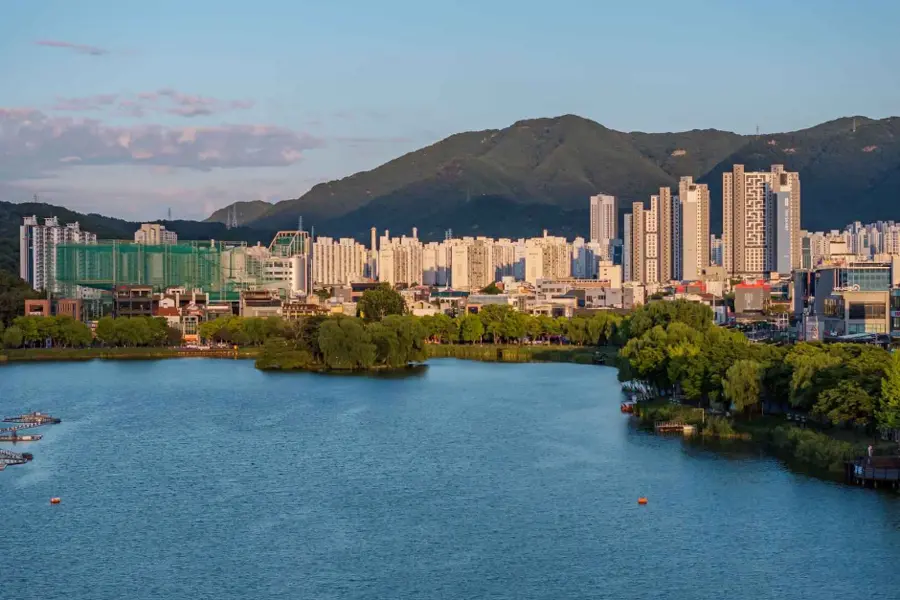
- LAKE: Public access is free and the circuit is about 2.02 km. A brisk lap and a walk with photographs, wildlife and rests are different time commitments.
- SHOW: Fountain and boat operations depend on season, weather, maintenance and the operator. Around-the-clock access applies to the lake, not every service.
- LOOP: MOTII is about a ten-minute walk from Suseongmot Station on Metro Line 3. The lake works best before dinner nearby or as one principal Daegu evening stop.
- Safest first visit: Arrive about 30 minutes before sunset, walk a chosen section, then see the city lights. Add the fountain only after confirmation and leave for dinner on schedule if it is not running.
What is Suseongmot Lake?
Suseongmot is a man-made lake in Daegu's Suseong district. VISITKOREA describes it as a reservoir completed in 1925 for agricultural irrigation before it evolved into an urban waterfront recreation area. Today's visit includes not only the water but walking paths, viewing decks, green space, small stages, boat areas and a surrounding food district.
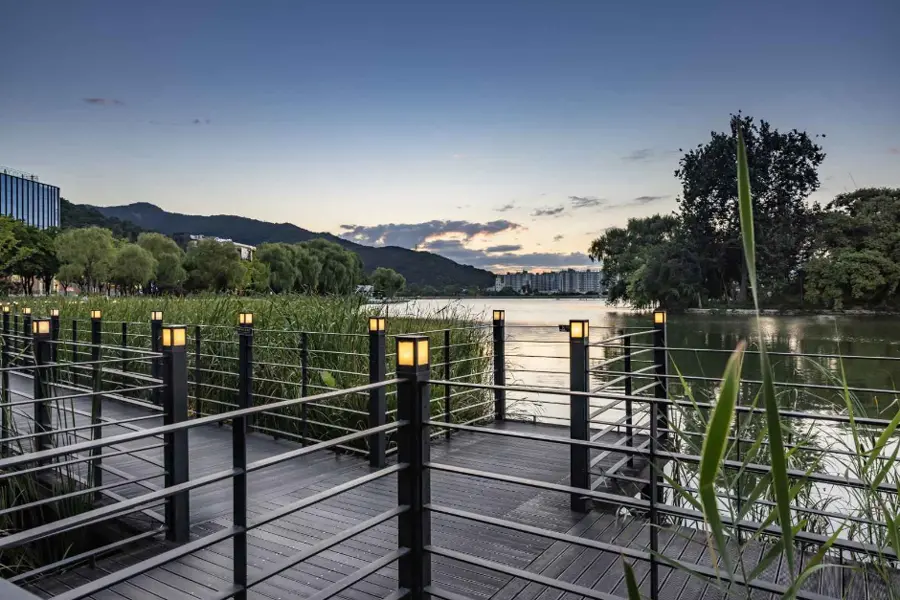
Suseong-gu completed an ecological restoration project in 2013, adding boardwalks, observation decks, an ecological viewing area and waterside cultural spaces. That history explains why the lake behaves like a residents' park rather than a gated attraction with one entrance, one exhibition and a fixed route.
Is Suseongmot worth a special trip?
It is worthwhile if you want to slow down after central Daegu, watch sunset and have dinner nearby. In a practical one-day Daegu itinerary, the transition from daylight to city lights produces a complete experience without a ticket or reservation.
If the music fountain is your only reason and you have not verified that day's operation, the trip is fragile. The fountain is a bonus rather than the test of whether the lake exists. Decide whether your evening belongs in the city at all with our Daegu day trip versus overnight guide, then choose whether Suseongmot is the main evening or merely an optional walk.
Why check hours if the lake is open around the clock?
DaeguTour and VISITKOREA describe the public lake area as available at any time or 24 hours a day. That statement does not make the fountain, boats, rides, visitor centre, restrooms, cafés, restaurants or lighting operate all night.
Very early and very late visits also change the amount of lighting, foot traffic, public transport and available assistance. A first-time visitor should not translate “24 hours” into “the same experience at every hour.” Arriving before sunset gives you clear paths, daylight scenery and a straightforward return.
How long does one lake circuit take?
Official tourism material places the circumference at roughly 2,020 metres. DaeguTour estimates about 40 minutes for a light lap. That estimate assumes continuous walking; photographs, birds, benches, companions, restrooms and viewing decks easily expand the visit to 60 or 90 minutes.
Completing a circuit is not an admission requirement. With 30 minutes, walk from the metro side to one open viewpoint and return. A family with a stroller, an older companion or anyone moving slowly can choose a well-lit, level section without sacrificing dinner or a train merely to close the circle on a map.
Daylight, sunset or night: which is best?
Daylight is clearest for paths, vegetation, the island and hills, and it lets families judge surfaces before dark. Sunset layers the distant ridge, apartments and warmer water. Night emphasizes buildings, path lights and the fountain when it actually operates, but darker edges and the journey home require more attention.
For a first visit, arrive 30 to 45 minutes before sunset and decide after one section how long to stay. Our Daegu evening plan does not combine Suseongmot, Apsan, E-World and Seomun Market in one night because every night-view option competes for the same sunset and return window.
When does the music fountain run?
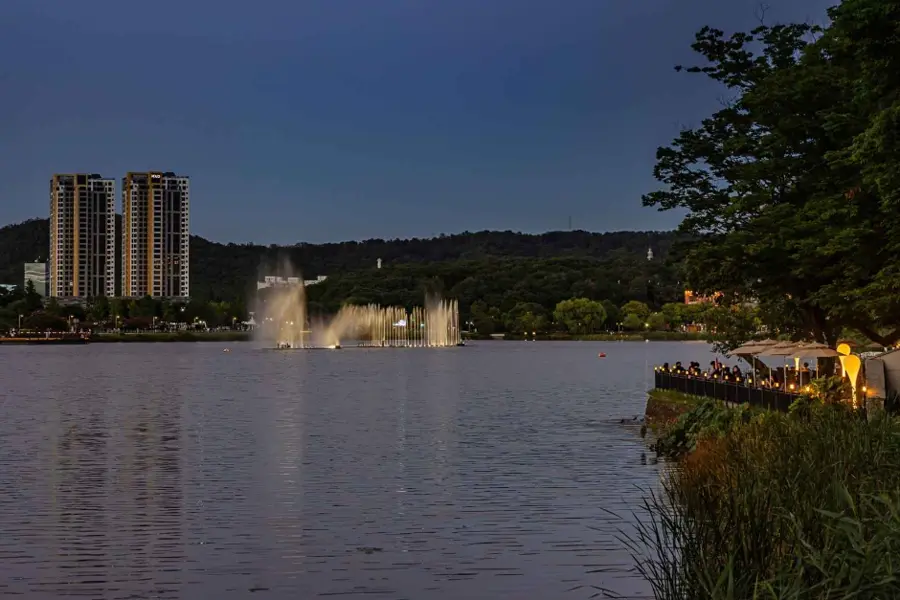
There is no single published source that this guide can safely present as the guaranteed current timetable. An older VISITKOREA attraction page says four daily performances from May to October. A 2024 smart-tourism page lists daytime water-only sessions at 13:00, 14:00, 17:00 and 18:00, plus night sessions at 19:00, 20:00 and 21:00, with Mondays and rainy days cancelled.
An official English medical-tourism PDF gives yet another season, March to October, for three evening sessions, and 2026 public material refers to fountain-facility improvements. Treat these as evidence that schedules have changed, not as choices from which to select your favorite. Ask Suseong-gu tourism or MOTII at +82-53-761-0645 on the visit date. Without confirmation, write the plan as “lake walk, fountain if operating.”
Are daytime water jets and the night show the same?
The 2024 smart-tourism content distinguished daytime water operation from evening sessions with music and lighting. Even if a similar structure applies during your season, seeing jets in daylight does not establish that the complete night program will follow, and path lighting does not prove the fountain is scheduled.
Ask “which performance today includes music and lighting?” rather than simply “is the fountain on?” Rain, wind, maintenance and events can cancel a show. If nothing begins, do not let an unverified next session extend your stay indefinitely.
Can you ride a duck boat or cruise at any time?
Suseong-gu tourism material describes duck-shaped paddle boats, transparent kayaks and powered boats. An older facilities page gives a broad operating window from 30 minutes before sunrise to 30 minutes after sunset. It should not be read as a promise that every craft operates every day in every season.
Wind, thunderstorms, water conditions, maintenance, ticket sales, age rules, life jackets and final boarding can all change. Read the operator's current signs at the pier. If you only want to walk, you do not need to buy a ride; the public waterfront remains the main free experience.
What is the MOTII visitor centre for?
MOTII is at 37 Suseongmot-gil by the east entrance of Sanghwa Garden. It provides tourist information, souvenirs and a nursing room. Suseong-gu lists it as about a ten-minute walk from Suseongmot Station, making it a useful starting point for questions about the fountain, bus, restroom or an accessible approach.
It is not open 24 hours. The district page lists 10:00–19:00 from April through October, 09:00–18:00 from November through March, and 09:00–21:00 on weekends and public holidays, while warning that hours can change. Late arrivals should save the map and essential answers before the desk closes.
Is the walk from Suseongmot Station easy?
Suseong-gu estimates about ten minutes from Suseongmot Station on Metro Line 3 to MOTII. Reaching your chosen bank, pier or restaurant adds more walking. The station name does not mean that the full water view begins at the exit; navigate to the visitor centre or a specific lakeside entrance.
Without a car, use our car-free Daegu guide to keep the metro as the main structure and reserve a taxi for late hours, rain, reduced mobility or an awkward hotel connection. Save the return direction and final-service information before you begin the night walk.
Is the Suseong tour bus useful?
The official schedule updated in May 2026 divides the bus into a Suseongmot–museum course and a Suseongmot–Deulangil food-town course. The ordinary fare is KRW500, service runs roughly from 11:00 to 19:40 with a break, and Mondays plus Lunar New Year and Chuseok day are listed as closures.
The vehicle has 13 places, including one wheelchair position. Payment is by a DaeguTrip App QR code or an on-site transport card; the official page says cash, credit cards and simple-payment services are not accepted. Prepare with our Korea transport-card guide, but keep a metro or taxi fallback because weather, traffic, festivals, maintenance and group bookings can restrict service.
Is driving easier than the metro?
Official attraction information lists parking, and the tour-bus route includes a public Suseong Recreation Area parking stop. The actual evening problem can still be finding a space, queueing and leaving with the crowd. Weekends, blossom season, festivals and fountain times need a parking buffer.
Do not occupy a restaurant or amusement-facility lot and assume it permits a long free stay. Public and private conditions are separate. If anyone will drink at dinner, remove driving from the return plan. For a visitor near Dongseong-ro or a convenient metro connection, rail plus walking can be simpler than circulating around the lake by car.
How should you use 30, 60, 90 or 120 minutes?
Thirty minutes: enter from the station side, reach one open lakeside view and return. Sixty minutes: walk roughly half the lake slowly or one brisk circuit, with one viewing-deck stop and no wait for an unverified show.
Ninety minutes: arrive before sunset, walk at an unhurried pace and watch the transition to night; add one fountain show only if confirmed. Two hours: suitable for a family, boat ride, MOTII, coffee or dinner connection, but not because the walking loop itself requires two hours.
How does it fit from Dongseong-ro or Banwoldang?
Suseongmot lies south of central Daegu. The efficient pattern is to finish Dongseong-ro, modern-history streets or the Kim Gwang-seok area in the afternoon, then make the lake the evening destination. Visiting the lake in the morning, returning downtown and crossing south again for another sunset point creates avoidable direction changes.
If dinner is in Deulangil, a 60- to 90-minute walk before the meal fits naturally. If dinner is booked back in Dongseong-ro, reserve the return metro and walking time. Free admission does not make a transfer disappear.
Is it worth going directly from Dongdaegu Station?
Arrival at Dongdaegu still requires metro or taxi travel plus the final walk from Suseongmot Station. With only an hour and large luggage, store the bags or check into your hotel rather than rolling them around a 2 km circuit. With a full evening, settle in first and keep the lake and dinner on one side of the city.
The same rule applies on departure day. Work backward from a fixed train, and do not bridge the gap with a fountain show that has not been confirmed. Missing an intercity service costs much more than ten extra minutes beside a free lake.
Can a Seoul day trip include the night view?
A Seoul return involves the intercity train, Dongdaegu transfer and lakeside return. Lock in a real departure in our Seoul-to-Daegu transport guide, then work backward from sunset. The lake being open around the clock does not make every departure equally convenient.
If your return is early, a daylight lake walk still works. If the meal, sunset and night view are central to the experience, one night in Daegu preserves far more value. Free access cannot cancel the time cost of a long round trip.
On an overnight trip, first evening or second day?
When the first evening includes a complete sunset window, pair Suseongmot with dinner and leave a distant direction for the next day. If you arrive late, use the second afternoon instead of reaching the lake after MOTII, boats and fountain information are no longer available.
Our two-day Daegu plan after an overnight stay gives the second day its own purpose rather than dragging unfinished stops forward. Suseongmot's strength is that it can expand or contract with weather; it does not need a fixed two-hour block.
How should you combine Suseongmot with Deulangil dinner?
Deulangil is a restaurant district connected by the official Suseong tour-bus course. That makes a lakeside walk plus dinner a coherent evening. “Food town” does not mean every restaurant opens daily, takes walk-ins or suits every budget, so check the specific venue separately.
The clean order is to walk before sunset, decide after dark whether a confirmed fountain show is worth staying for, then eat. If you hold a restaurant reservation, the fountain must remain removable rather than making the whole group miss the booking.
Can you visit Apsan the same night?
Both are associated with night views, but they solve different needs. Suseongmot is a flexible flat-waterfront walk. Apsan requires a mountain approach, possible cable-car timing, weather at elevation and a final descent. With one evening, choose rather than treating “both are in Daegu” as a free connection.
Select Apsan for a city panorama and Suseongmot for a low-pressure walk, dinner and flexible departure. With two nights, give each one its own weather window. Trying to chase both in one sunset usually weakens both.
Should you add Palgongsan or another outskirts day?
Palgongsan lies in a different direction and already involves mountain weather, buses, cable-car operation and a substantial half-day. Suseongmot can remain an optional evening after you return, but it should not become a second compulsory headline attraction.
Write a clear deletion rule: if the mountain runs late, remove the lake. Around-the-clock access is not an instruction to complete a circuit when everyone is tired, it is late and the final transport is near.
Does Suseongmot justify adding Daegu to a first Korea itinerary?
The lake is a strong local evening, not by itself a reason to add another hotel move between Seoul and Busan. It becomes valuable when Daegu also gives you food, markets, modern culture or another full direction. A multi-city traveler should compare that added night with the existing Seoul–Busan–Gyeongju structure rather than adding one more stop without removing anything.
If the only sentence you can write for Daegu is “maybe catch the fountain,” keep the trip simpler. If Suseongmot closes a day that already has Daegu-specific reasons, the lake is doing the correct job: completing a city, not manufacturing one.
Is Suseongmot worthwhile in rain?
Light rain can create reflections and reduce crowds, but it can also cancel the fountain and boats while making boardwalks, leaves and banks slippery. Do not use “24 hours” as a reason to complete the circuit in thunderstorms, high wind or heavy rain.
Prepare a genuine indoor alternative with our Daegu rainy-day plan. Keep Suseongmot as a 30-minute option only if the rain is brief. On a narrow crowded section, control umbrellas and look at the waterfront rather than walking entirely through a phone screen.
What changes in summer, winter and blossom season?
Daegu summers are hot and shade around the water is not continuous. Move the walk toward evening, carry water and use sun protection instead of arriving hours early for a fountain. Summer thunderstorms are another reason to leave the open water when lightning or an official warning appears.
Winter sunset comes early and wind across the lake can make the apparent temperature lower than downtown. A windproof layer and gloves help. Blossom season and weekends increase people, parking and restaurant waits; the bloom depends on each year's temperature and cannot be promised for fixed dates.
Is the full circuit accessible for wheelchairs and strollers?
Official material shows boardwalks, observation decks and walking paths, and the tour bus has one wheelchair space. That evidence is not enough to promise a step-free route from every metro exit or parking lot through the entire bank, restrooms and restaurants. Construction, crowds and surface conditions can also change.
If step-free access is essential, ask MOTII for a specific starting point, restroom and reachable section before departure. Choose a 30- or 60-minute out-and-back route. One level segment plus a viewing stop is a complete visit; the map circle does not need to dictate mobility.
What should families with children know?
The water, boats, amusement facilities and open space appeal to families, but each paid facility sets its own age, height, life-jacket, price and operating rules. The public bank has no attraction gate, so adults need to maintain close supervision beside water, decks and crowded paths.
Do not feed waterbirds human food, chase wildlife or cross a barrier for a closer view. Observing the island, hills, birds and changing lights makes the visit resilient even when an individual ride is closed.
What are the three most useful photo positions?
Open bank: combine the apartment skyline, distant hills and water. Boardwalk or viewing deck: use railings and aquatic planting as foreground. Fountain viewing area: arrive early only after confirming that evening's performance and choose a place that does not obstruct movement.
Before sunset, preserve detail in the sky. At night, reduce exposure slightly to protect bright water jets and building lights. Never block a running path, boardwalk or wheelchair route with a tripod. If the fountain is off, the lake and city remain photographable without entering planted areas or crossing railings.
If admission is free, where might you still spend money?
The public lake is free, but boats, rides, coffee, dinner, the tour bus, taxis and some parking may cost money. “Suseongmot is free” does not mean the entire evening costs nothing, and it does not create an obligation to purchase an experience.
The simplest version needs only transport and a walk. Compare a boat or meal only when you already want it. There is no forced CTA here: spending should follow an itinerary need rather than making a public lake appear more complete.
15 checks before you go
- Is your real goal a lake walk, sunset or music fountain?
- Around-the-clock public access does not apply to every facility.
- Has the fountain been confirmed by a same-day official source or MOTII?
- Do you accept that rain, wind and maintenance can cancel it?
- Have you checked the current boat type, last boarding and life-jacket rules?
- Can your group handle 2.02 km, or should you use an out-and-back route?
- Have you checked sunset and apparent temperature?
- Have you allowed about ten walking minutes from the station to MOTII?
- Is the tour bus operating, and do you have its accepted payment?
- Have you separated public parking from private restaurant parking?
- Is the metro or taxi return saved before the night view?
- Can the fountain be deleted if you hold a dinner reservation?
- Is there a real indoor fallback for bad weather?
- Will children stay away from barriers and avoid chasing birds?
- Can you leave on schedule even if no show runs?
Final verdict: who should visit Suseongmot?
Highly worthwhile: you will remain in Daegu through evening, want a walk or dinner, and see the fountain as a bonus. Worth a short stop: you have 30 to 60 minutes and the metro direction fits; select one bank. Do not force it: you are crossing from another city solely for an unconfirmed show, a thunderstorm makes a full circuit unsafe, or the same evening already contains another sunset-dependent attraction.
Suseongmot's genuine role is to slow a Daegu itinerary down, not to demand a completed lap or a defended show time. Separate LAKE, SHOW and LOOP. If the fountain is cancelled, the free waterfront remains a complete choice; if none of the three layers fits, skipping it costs you nothing.
Sources and update limits
Public access, free admission, the roughly 40-minute light circuit, address, metro route, parking and separate shop hours were checked against DaeguTour's English pages. The 2 km trail, fountain background and Deulangil connection were cross-checked against VISITKOREA. MOTII and the 2026 tour-bus details come from Suseong-gu's official tourism pages.
Fountain information differs among an older attraction page, 2024 smart-tourism copy, an official English PDF and 2026 improvement material, so this guide does not label any one timetable as guaranteed current. Fountain, boats, bus, visitor centre, parking, events, weather and construction can change; same-day official notices and on-site safety closures take priority.
DaeguTour | Suseongmot Lake VISITKOREA | Suseongmot Lake Resort Suseong-gu | 2026 tour-bus timetable