
Start with the decision: Gangneung Seongyojang House is worth visiting when you want to understand a Joseon upper-class household rather than collect one pretty hanok photograph. Current adult admission is 5,000 won, and a first visit needs about 60–90 minutes. The important part is not counting tiled roofs. It is seeing how courtyards, domestic rooms, hospitality spaces and Hwallaejeong Pavilion worked together as one family compound.
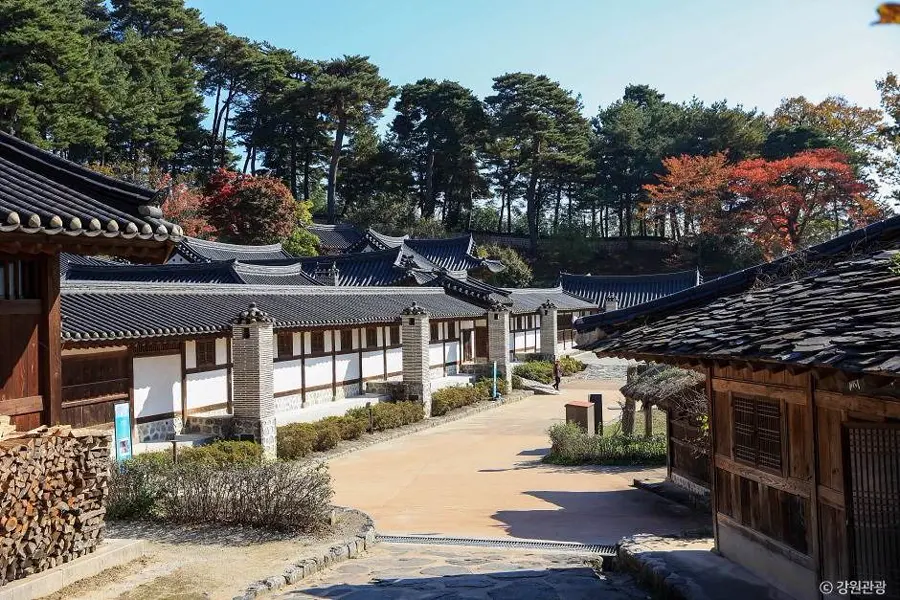
- HOUSE: read roofs, gates, long wings, courtyards, Hwallaejeong and the pine backdrop as one composition.
- LIFE: distinguish domestic, reception, family and service functions instead of treating every room as a photo background.
- ROUTE: Seongyojang, Ojukheon and the Gyeongpo area sit in a compatible direction and can form a half day.
- It is paid: if you will not slow down and read the space, the 5,000-won ticket plus transport may not be worthwhile.
What is Seongyojang? The word “house” understates its scale
Seongyojang was the upper-class residence of Lee Nae-beon (1703–1781) and his family in Gangneung. It was designated a National Folklore Cultural Heritage in 1967. VISITKOREA describes it as a well-preserved Joseon residence that helps researchers and visitors understand the living conditions of an elite household. It is not a modern folk village assembled from relocated buildings.
The “seon” in Seongyojang means boat. When the house was established, Gyeongpoho Lake reached much closer to this area and people could travel by boat. That origin matters because the roads and distance from today's lakeshore do not reproduce the eighteenth-century landscape. In a Gangneung one-day itinerary, treat the house as part of the wider Gyeongpo cultural landscape rather than an isolated hanok stage set.
Current admission and hours: winter closes earlier
VISITKOREA's current listing gives individual admission as 5,000 won for adults, 3,000 won for teenagers and senior citizens, and 2,000 won for children. Opening hours are 09:00–18:00 from March through October and 09:00–17:00 from November through February. The site is listed as open year-round. Its address is 63 Unjeong-gil, Gangneung, and parking is available and currently listed as free.
“Open year-round” does not guarantee that every room, museum display, cultural experience or accommodation space operates identically every day. Winter also removes an hour from the published schedule. If you are travelling from Seoul and back on the same day, decide through Gangneung day trip versus overnight how much fixed time remains before giving the house a full 90 minutes.
What should you look at first? Begin with the courtyards, not a checklist of buildings
The weakest way to visit Seongyojang is to photograph each façade straight on and leave with a set of similar roofs. Stand at a wider point first. Notice how the long outer wing, walls, gates, inner yards and pine-covered slope create layers. Moving through one threshold changes who could see, enter or use the next space. That sequence communicates scale better than a single wide-angle photograph.
Domestic quarters, detached halls, reception rooms and service areas did not perform the same job. Some spaces are understood through doors, windows and furnishings rather than by walking inside. Follow current arrows, ropes and staff instructions. Do not cross thresholds or open a closed room for an empty interior photograph; protecting the house is more important than completing a personal shot list.
Hwallaejeong Pavilion is not decorative scenery
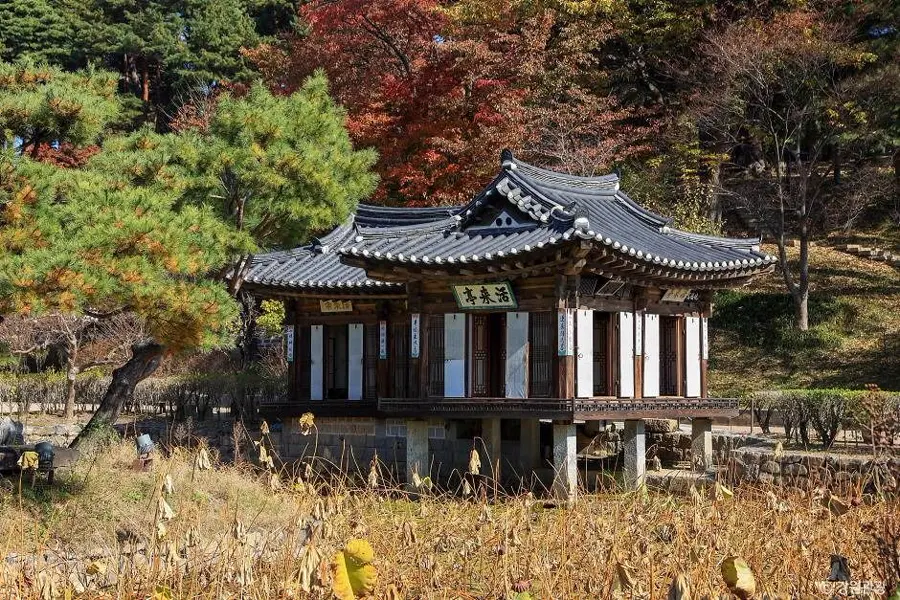
Hwallaejeong stands beside a pond and provides one of Seongyojang's clearest visual anchors. The pavilion, water, trees and surrounding residence shift the visit from practical household courtyards toward reception, leisure and landscape. It shows that an elite residence organised not only sleeping and work but also taste, hospitality and seasonal viewing.
Lotus and trumpet vine are well-known summer images, but they are not guaranteed by admission. Autumn foliage, sparse winter branches and spring green each reveal something different. If water level, flowers or maintenance differ from a promotional photograph, the pavilion still has value through its structure, position and sight lines. Do not reduce the whole visit to whether a pond is full of lotus on your date.
Seongyojang or Ojukheon: are two old houses repetitive?
They answer different questions. Ojukheon centres on Shin Saimdang, Yi I, the room associated with his birth, black bamboo and museum interpretation. Seongyojang is stronger as a large family residence: the hierarchy of courtyards, domestic life, hospitality and garden space. Ojukheon is easier to enter through famous people; Seongyojang asks you to enter through how a household worked.
If both are only “hanok” on your list, they will feel repetitive. If you want biographical history and clearly labelled exhibits, choose Ojukheon first. If you want spatial history and a slower architectural visit, choose Seongyojang. Their proximity is a reason they can fit the same half day, not a reason you must buy both admissions.
How long do you need: 60, 90 or 120 minutes?
60 minutes: cover the main courtyard sequence, residential exteriors, Hwallaejeong and one display space. This suits a dense day trip. 90 minutes: slow down for building functions, furnishings, the pond and a garden walk; this is the most balanced first visit. Two hours or more: make sense only with a confirmed activity, detailed museum viewing, seasonal photography or a planned rest.
Use the first ten minutes to understand the plan and principal names. Give the middle of the visit to the courtyards and pavilion. Add a museum, trail or café only after the essential sequence is complete. Spending twenty minutes at the first gate and racing through the final rooms before closing reverses the site's priorities.
Seongyojang is not a fully indoor rainy-day substitute
Hanok eaves and some exhibition rooms offer shelter, but much of the value lies outdoors: yards, paths, pond and building exteriors. In heavy rain you still cross between structures, and stone, soil and wooden thresholds can become slippery. Summer heat also makes it unlike a climate-controlled museum.
Use a Gangneung rainy-day plan to protect genuinely indoor stops, then place Seongyojang in a lighter interval. Gentle rain can deepen the colour of wood and roofs; wind-driven rain that prevents you from observing the compound removes the reason to force a complete circuit.
Which season is best? The most photogenic can be the least comfortable
Spring brings new growth but changeable temperatures. Summer can provide lotus and trumpet vine, together with humidity, sun and afternoon rain. Autumn gives clear layers between pine, coloured leaves and roofs but can draw more visitors. Winter may be quieter and architectural lines become clearer, while closing shifts to 17:00 and daylight is shorter.
The right season depends on whether you value flowers, structure, quiet or easy walking. Do not anchor a cross-country date to one official image. Verify each year's flowers, foliage or snow, and keep a version of the visit that remains meaningful without seasonal effects.
Can you visit without a car? Yes, but bus waiting is part of the route
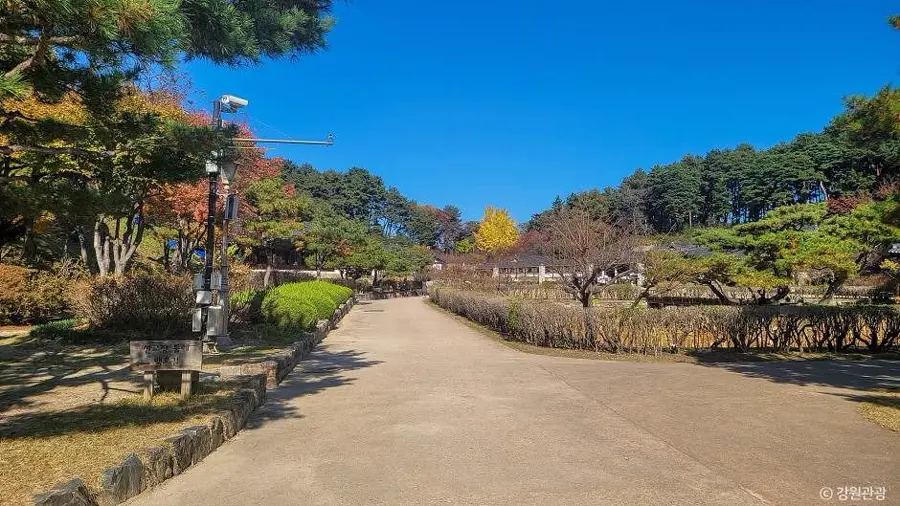
Seongyojang lies in the Gyeongpo direction; it is not immediately outside Gangneung Station. Official tourism itineraries have previously used local buses from the Gyeongpodae area and short taxi connections, but routes, stop names and frequency can change. Use Gangneung without a car to connect Gangneung Station, the historic houses, Gyeongpo and your return in one direction.
A Korea transport card handles bus payment, not the gap until the next bus. A day trip becomes fragile when every attraction requires a separate wait. For three or four travellers, a short taxi between close sites can sometimes cost less in time than splitting the route around infrequent services. Check transport after closing as carefully as transport to the gate.
Step-free access and older travellers: reaching the site is not reaching every room
A historic hanok compound naturally contains wooden thresholds, steps, uneven stone and rooms viewed from outside. Parking and a main path do not prove that every side path, pavilion and interior is wheelchair accessible. Travellers who need a step-free route should contact the site to verify the entrance, accessible toilets, wheelchair areas, rest seats and temporary works.
Older travellers do not have to complete every path to justify the ticket. Make the main courtyard sequence, Hwallaejeong and one display the core. Rest before deciding whether to add the rear path. This is a place for observation, not a step-count challenge.
Can you stay overnight or join an experience?
Seongyojang also advertises hanok accommodation and traditional-cultural activities. Room type, sleeping facilities, private areas, language, date, booking method and price belong to separate reservations. A daytime admission ticket does not allow entry to guest rooms or automatic participation in every programme, and an overnight stay does not necessarily provide unrestricted access to all exhibition spaces.
If accommodation is the real purpose, compare sleep comfort, shared facilities, sound transmission, luggage and evening transport rather than relying on daytime courtyard photographs. Day visitors should remain on the open route and respect guest or family areas. A living accommodation function makes privacy more important, not less.
How do you connect it to Gyeongpo without doing half of each?
Seongyojang, Ojukheon and the Gyeongpo lake area sit in a compatible direction. A morning or afternoon can therefore carry a “history and lake” theme before the coast takes the time with better light and weather. The danger is trying to complete full versions of two historical sites, the lake and the beach in one compressed block.
Choose the day's lead. If history matters most, finish Seongyojang and either Ojukheon or another cultural stop in daylight, then use the coast as a flexible ending. If sea views matter most, choose only one paid historical attraction. Protect the transition through a Gangneung evening plan so that a late house exit does not destroy dinner or the journey back.
An overnight stay can give day two a real theme
A common Gangneung problem is spending the second day on the same coast in search of another similar café. Use whether one night in Gangneung is worth it to give one half day to the Gyeongpo cultural area. Seongyojang then becomes content deliberately different from the first day's sea, not merely a rain fallback.
If a KTX departure still ends day two, work backwards from the train through station arrival, luggage collection, site departure and final entry. A historic residence rewards slow looking and is a poor place to recover lost time by running. Remove one optional café before removing the station buffer.
What if Gangneung has three days?
Three days do not require moving accommodation or repeating the same waterfront. With one base or two coasts for three days in Gangneung, keep the historic and Gyeongpo directions together while giving another day to a farther coast. Seongyojang works best when its slow pace is protected by a clear daily theme.
Nine checks before you go
- Do you want HOUSE, LIFE or only a hanok photograph?
- Are you visiting March–October or during the earlier winter closing?
- Have admission, last entry, open rooms and maintenance changed?
- Do both Seongyojang and Ojukheon genuinely match your interests?
- Have Gangneung Station, the Gyeongpo direction and the return become one route?
- Are lotus, trumpet vine, foliage or snow bonuses rather than the only reason?
- Can weather, thresholds and your group's energy support courtyard walking?
- Have accommodation, activities and tours been confirmed separately from admission?
- If flowers are absent and some rooms are closed, is the residential structure still enough?
Worth a full visit: you care about hanok architecture, Joseon domestic history, garden space and the organisation of a large residence, and will give it 60–90 minutes. Choose one: on a short visit, use “people and exhibits for Ojukheon, residential space for Seongyojang.” Skip this time: you only want the sea, will stop at the entrance for one photograph, or weather and transport have removed the value of walking the courtyards. The 5,000 won buys more than a tiled-roof image only when you read how a family placed rooms, yards, reception and landscape into one order.
Checked 23 August 2026. VISITKOREA's current attraction listing is the basis for Seongyojang's history, National Folklore Cultural Heritage status, address, March–October and November–February hours, individual admission, year-round opening and parking. Korean Tourism Organization and official Seongyojang material were used to cross-check the compound, Hwallaejeong, seasonal planting, Ojukheon comparison and images. Recheck last entry, room access, accommodation, activities, tours, flowers, maintenance and accessible routes on the visit date.
VISITKOREA | Seongyojang House KTO | History and tradition at Seongyojang KTO | Seasonal flowers at Seongyojang Seongyojang official website