
The short answer: Cheomseongdae is worth seeing, but not as a large attraction that deserves a special half-day. It is free, quick and most useful when it joins Daereungwon, Gyerim and an evening at Donggung Palace and Wolji into one old-town walking line. Use daylight to read the stone structure, dusk as a transition, and night only when it still fits your onward walking time. Do not cross Gyeongju from Bulguksa or Singyeongju Station just for one tower photo.
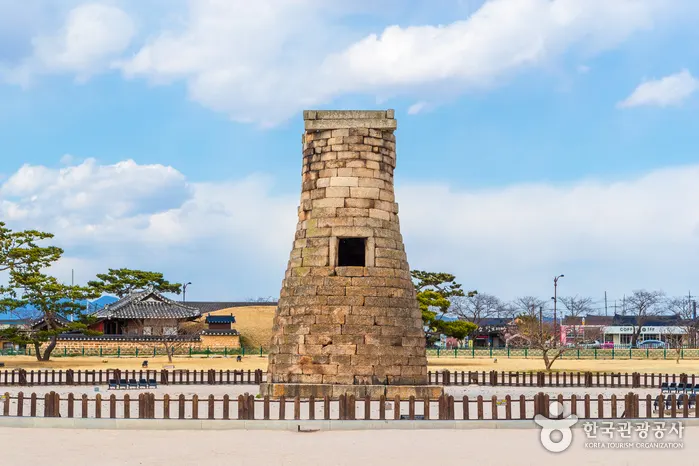
- DAY: read the stone form and put it naturally after Daereungwon or Gyerim.
- DUSK: use it as the walk between daytime sites and the evening area.
- NIGHT: see the exterior after dark, then keep enough time for Donggung Palace and Wolji.
- One day and you are far away: protect your transport direction instead of returning for a checklist photo.
It is a landmark, not “Gyeongju completed in one tower”
Cheomseongdae is widely understood as an observatory from Silla. Its value is symbolic and spatial: the low stone structure makes sense when you are already walking among tombs, trees and historic sites. A stop itself may be short. That is not a problem if it removes backtracking; it is a problem only when a guide sells it as a separate major attraction.
Official information lists free admission and year-round access, with ordinary summer and winter evening hours as planning references. Check the current notice before travel. Start with the Gyeongju one-day itinerary rather than deciding the whole day around this single landmark.
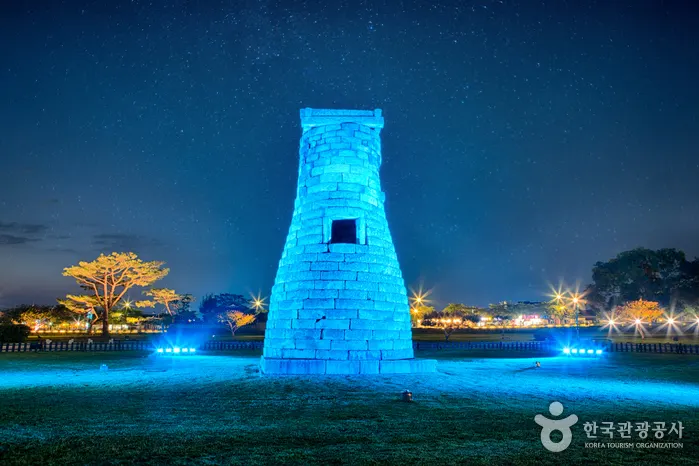
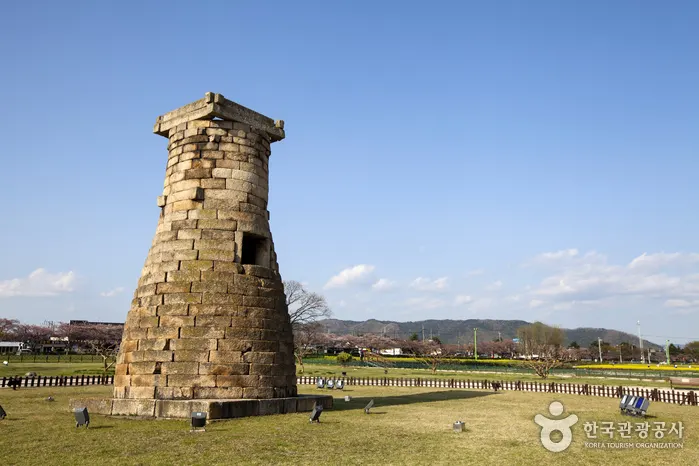
DAY is for the form and its relationship to the old town. DUSK is the most efficient transition. NIGHT is an exterior atmosphere, not a guarantee of the same lighting or flower backdrop shown in older images. Pick one window that preserves the route.
Day, dusk or night: each has a different job
Daytime works for visitors who want to understand the structure and photograph the surrounding open space. Dusk is often the best practical choice, because it lets an old-town walk become an evening plan without a new transfer. Night can be pleasant if you still have time to walk toward Donggung Palace and Wolji; use the Gyeongju evening plan before trying to rush both places.
Seasonal flowers are a bonus, not a booked experience. Bloom, maintenance and lighting change. If a particular flower field or night image is the only reason to come, leave it until the travel day rather than making it the non-negotiable centre of the route.
Put it on one old-town line, not between distant directions
Cheomseongdae is close enough to Daereungwon's main entrance to work as part of a walk; official visitor information gives roughly two minutes as a reference. Continue through the old-town area and save the evening sequence for the appropriate time. Travellers without a car should use Gyeongju without a car to protect bus and walking direction, rather than repeatedly returning from remote sights.
Bulguksa is a different direction and deserves its own decision. The Bulguksa guide explains why making a late detour back to Cheomseongdae can weaken both stops. If your whole trip is a day visit, decide day trip or overnight before assuming that every daylight and night landmark will fit.
Who can skip it?
Skip it comfortably if you would need a large cross-city detour, have only enough time for one distant direction, or do not want outdoor walking. Its free admission does not erase transport time. An overnight visitor or someone already on the old-town line should usually include it, but keep the stop proportional to its size. If hotel location decides whether the night walk works, start with where to stay in Gyeongju.
The practical question is not “is it famous?” but “does it make the next place easier?” When it does, it is one of the cleanest free additions to Gyeongju. When it does not, leave it out without treating the trip as incomplete.
Six checks before leaving
- Which window—day, dusk or night—serves today's route?
- Have current hours, lighting and weather been checked?
- Is it on the same old-town walk as your next stop?
- Are you saving enough time for Donggung Palace and Wolji if going later?
- Are seasonal flowers only a bonus, not a promise?
- Will this avoid a return trip rather than create one?
Go: you are already walking the old-town direction and can give it a daylight, dusk or night window. Keep it short: you want the emblematic landmark but have other nearby priorities. Skip for now: it requires a major detour, your one day only holds a remote direction, or you do not want outdoor walking. Cheomseongdae is free, but its best use is reducing backtracking—not adding it.
Next step: make Gyeongju old town one line
Start from the Gyeongju hub, choose the old-town direction first, then let Cheomseongdae connect the day instead of fragmenting it.
Checked for this draft: 2026-08-23. Location, free admission and planning-hour references use VISITKOREA and Gyeongju tourism sources. Check current hours, lighting, weather and seasonal conditions on the visit date.