
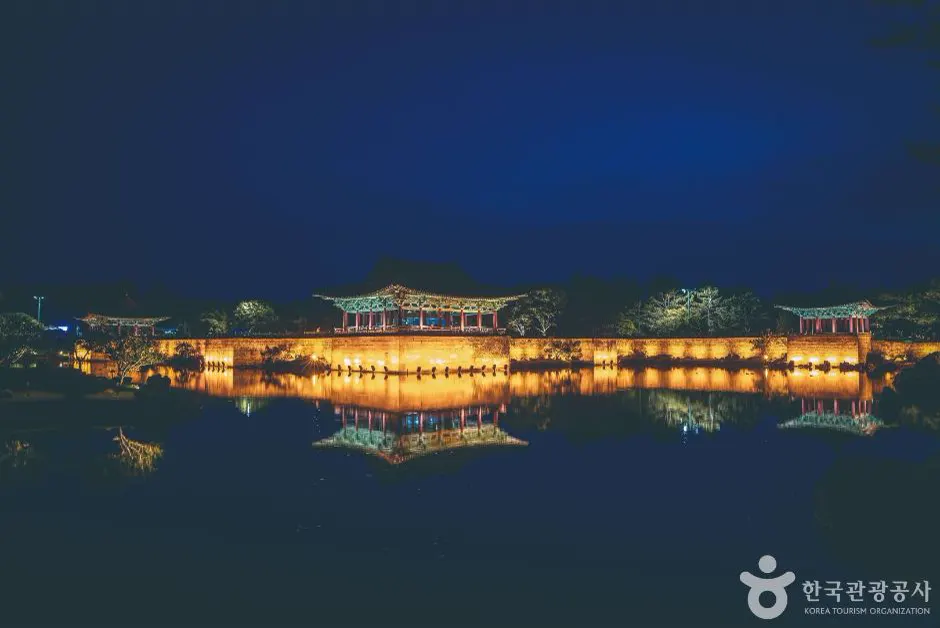
The short answer: Donggung Palace and Wolji Pond is worth visiting when you are already in central Gyeongju and can arrive before darkness. Enter while the pond edge is still readable, watch the sky turn blue, then see the lights take over. If you are returning to Seoul or Busan that night, last entry and the journey out matter more than reproducing a famous photograph.
- HISTORY: you want to see a Silla palace and designed pond, not only a night-photo background.
- MAGIC HOUR: you can arrive before full darkness and leave room for the transition into illumination.
- LAST ENTRY: you have checked today’s admission window and know how you will leave afterwards.
- If the final gate fails: do not gamble with a fixed train or bus; keep the full night visit for an overnight stay.
It is worth seeing for more than its ranking among Gyeongju night views
Donggung served the Silla crown prince, state meetings, banquets and important guests; Wolji was an artificial palace pond. Official accounts describe straight shoreline sections meeting winding edges, so the whole pond cannot be seen from one position and feels broader than its plan suggests.
“Anapji” became common after the palace fell into ruin. Archaeological finds, including an object inscribed “Wolji,” helped restore the historical names. The pavilions belong to an excavated and reconstructed palace site, not a group preserved unchanged for more than a millennium.
HISTORY decides whether the site still interests you in daylight. MAGIC HOUR gives the visit a visible transition rather than one dark scene. LAST ENTRY protects dinner and the journey home. When all three work, Donggung and Wolji becomes a satisfying end to Gyeongju rather than an anxious final task.
The best time is a transition, not one promised minute
Arrive before sunset: use daylight to read the pond edge, watch the buildings separate from the blue sky, then stay briefly after full darkness. This is more reliable than one promised lighting time because sunset, cloud, season and operations change the scene.
If the old town is already your afternoon direction, use the Gyeongju evening plan to connect daylight sites, dinner and the return to your accommodation. Its purpose is not to add every illuminated landmark. It keeps you moving in one direction so Donggung and Wolji can be the final chapter rather than another transfer.
Who should make room for it?
Make a full visit if this is your first Gyeongju trip, you have at least some interest in Silla history, you are already in the walkable heritage core, or you are staying overnight without a fixed intercity departure immediately afterwards. On a one-day Gyeongju itinerary, protect one coherent old-town line first. The pond belongs at its evening end, not as a separate attraction added from the opposite side of the city.
Shorten it or leave it for another trip if you arrive near the admission cutoff, your group is already exhausted, or the only objective is an uncrowded copy of a social-media photograph. When seeing the lights competes with reaching a fixed train or express bus safely, settle the Gyeongju day trip or overnight decision before protecting the photograph. A night view is not a test of whether you completed the city.
For a day trip, leaving is harder than entering
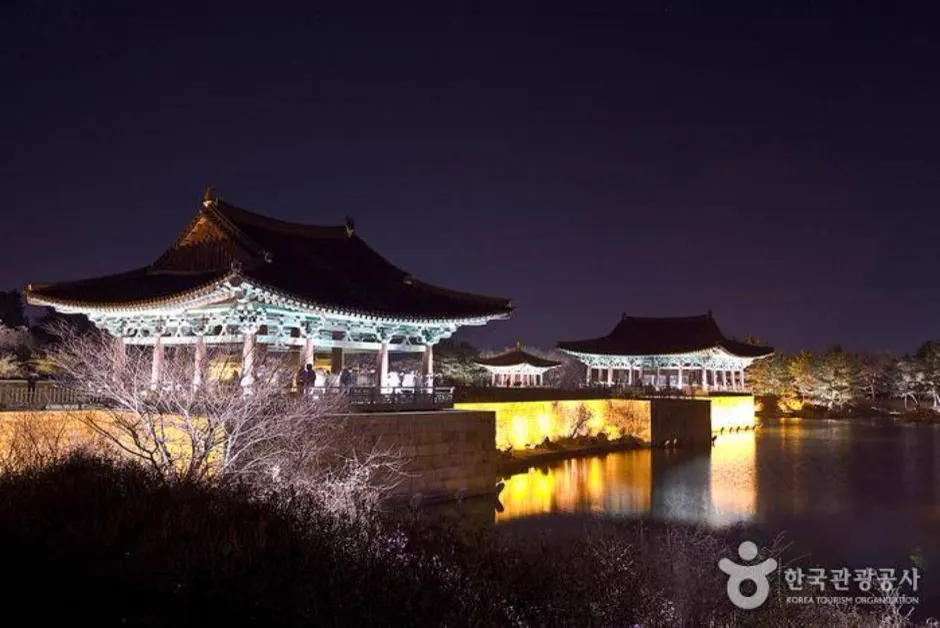
Current official planning information shows 09:00–22:00 operation, with admission ending at 21:30, and an adult fee of KRW 3,000. Treat those figures as a reference to be checked again for your date. Ticketing, temporary works, special events and operating notices can change. An open gate at 21:20 does not prove that you have enough time for the pond circuit, dinner and a connection to the station.
Overnight visitors can usually let the site determine the pace, then walk or take a short ride back to their base. Day trippers must work backwards from the last safe departure time. A Gyeongju overnight itinerary is useful when you want the dusk sequence without checking the clock at every pavilion. The extra night is valuable only when it returns the evening and next morning to the trip; it is not automatically justified by the existence of a night view.
You do not need a car, but a map line is not the journey
Gyeongju’s tourism information includes Donggung and Wolji on central sightseeing and evening routes. Official examples use stops around the Wolseong-dong Community Service Center area followed by a walk. Stop locations, intervals, final services and diversions still need same-day checking. The Gyeongju without a car guide separates walking, local buses and an occasional short taxi rather than pretending one mode will solve every part of the evening.
A transport card makes boarding easier but cannot guarantee a timetable. Prepare payment with the Korea transport card guide, then use live information for the route. Evening crowds may head to the same stops and taxi areas, so leave a buffer after the pond.
Can you combine it with Bulguksa on the same day?
Yes, but first admit that Bulguksa is outside the central heritage walking area. A morning at the temple followed by an afternoon return can work when transport, lunch and rest are given actual time. It fails when two famous names are placed on the same line and assumed to be neighbours. Use the Bulguksa decision guide to calculate the cost of leaving central Gyeongju before promising yourself a pond sunset.
Reflections, weather and crowds cannot be booked
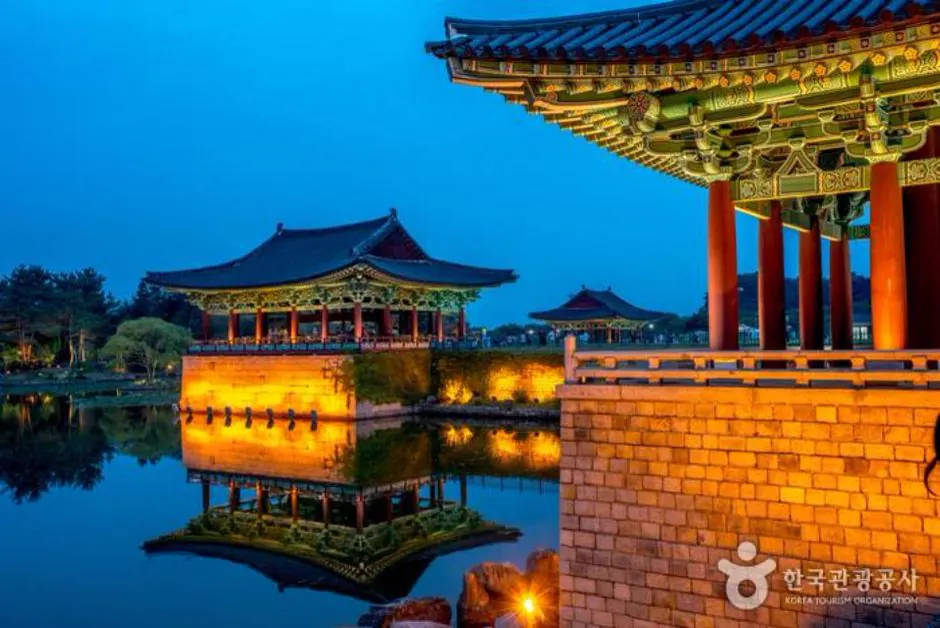
Wind, rain, water conditions and your position all affect the reflection. Popular viewpoints may already have people standing at them. Walk the pond circuit before committing the group to a long wait, pause without blocking the path and accept that an imperfect water surface does not erase the palace layout. The scale, curves and shift from dusk to night remain even when the photograph is different from the brochure.
Do not turn two nights into two copies of the same evening
With two nights in Gyeongju, choose what each evening is doing. One can hold Donggung and Wolji with an unhurried dinner; the other can protect an early departure, a quieter neighbourhood or a different old-town walk. The two-night old-town or station decision helps when the final morning is beginning to conflict with the freedom you want after dark.
Seven checks before you leave
- Have today’s official admission, last-entry and operating notices been checked?
- Can you arrive before full darkness instead of using only the final twenty minutes?
- Does the previous stop place you on the same central walking line?
- After leaving, are you eating, returning to a hotel or catching a fixed departure?
- Does everyone still have the energy for a pond walk after dark?
- Would the palace remain interesting if the water were windy and the famous viewpoint busy?
- Have weather, temporary works and any special lighting notice been checked?
Give it the full dusk window: you are in central Gyeongju before sunset and have protected the exit. Make it short: the group is tired or dinner is tight. Move it or skip it: last entry is close, a fixed departure is at risk, or the sole objective is one perfect reflection. Its value comes from the transition, not a last-minute checklist photograph.
Checked 23 August 2026. Historical context, location and real-site images follow official Gyeongju and VISITKOREA material. The currently displayed 09:00–22:00 hours, 21:30 final admission and KRW 3,000 adult fee are planning references only. Recheck admission, lighting, works, weather, buses and special-date notices for the day of travel.
VISITKOREA: Donggung Palace and Wolji Pond Gyeongju Culture and Tourism: central historic sites