
Short answer: Woljeonggyo Bridge is worth visiting, especially if you will already be in central Gyeongju near sunset. What it cannot promise is the flawless mirror image seen in edited travel photos. Plan it through three separate decisions: BRIDGE covers access and the gatehouse exhibits, LIGHT covers sunset, illumination and water conditions, and LOOP covers its place in the old-town walk. Current city information lists bridge access from 09:00 to 22:00 and the gatehouse exhibition from 10:00 to 22:00, both free. Daylight is better for the structure; arriving before sunset is better for blue hour. With only 30 minutes, choose one view rather than squeezing in another night attraction.
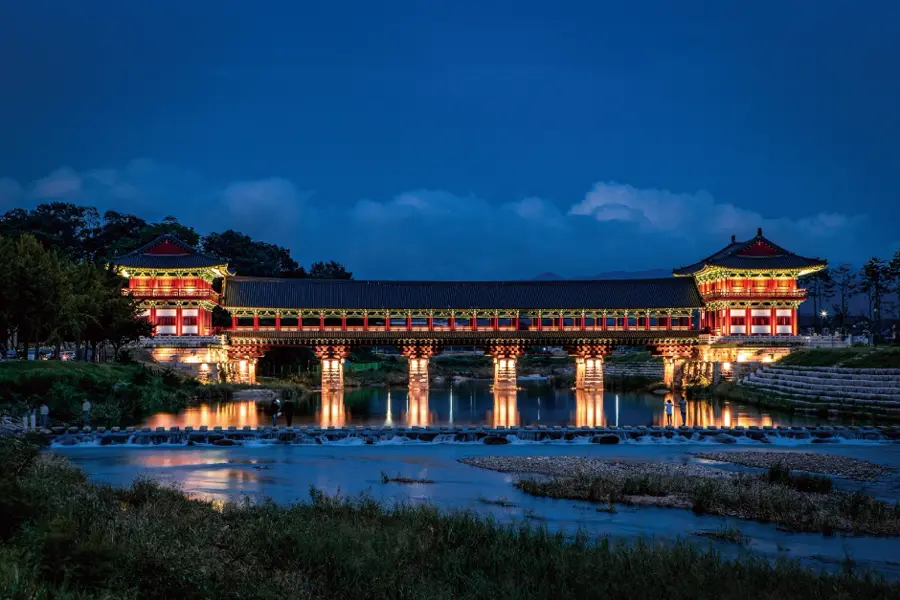
- BRIDGE: The covered crossing opens at 09:00; the gatehouse exhibition starts at 10:00, so an early visit does not include every interior space.
- LIGHT: A 22:00 closing time is not a promise of a fixed daily switch-on minute, calm water or an uninterrupted reflection.
- LOOP: The bridge fits naturally with Gyochon, Gyelim, Cheomseongdae and Daereungwon. Donggung and Wolji requires a separate walk and closing-time calculation.
- Safest first visit: Arrive 30 to 45 minutes before sunset, cross and see the exhibit in daylight, then return to the Namcheon riverbank for blue hour.
What is Woljeonggyo Bridge?
The Samguk Sagi records two bridges built across the stream south of the Silla palace in the nineteenth year of King Gyeongdeok, corresponding to 760 CE. Woljeonggyo helped connect the Wolseong palace area with the direction of Namsan. The original bridge was later lost; the covered wooden structure you see today is a modern reconstruction informed by records and archaeological evidence.
Archaeological work in 1984–1986 identified remains including stone bridge piers. Reconstruction began in 2008, the main bridge structure was completed in 2013, and the gatehouses at both ends were completed in 2018. Calling the entire visible building an untouched 1,200-year-old bridge is therefore misleading. Its interest lies in how modern reconstruction interprets an ancient crossing.
Is it worth a special trip?
If you are already walking through Daereungwon, Cheomseongdae, Gyelim or Gyochon, Woljeonggyo is an excellent finish: it is free, requires no reservation, and changes enough between daylight and evening to justify a pause. In a sensible one-day Gyeongju itinerary, 45 to 60 minutes is enough to cross, inspect the gatehouse display and take one full river view.
If you are travelling from Busan or Seoul solely for a night reflection photo, the value is weaker. The last intercity connection and transfer back to your station matter more than the bridge's closing hour. Decide whether the city deserves a night with our Gyeongju day trip versus overnight guide before making Woljeonggyo the reason for a late return.
Why does the bridge open at 09:00 but the gatehouse at 10:00?
Gyeongju City's current visitor information separates the covered bridge, listed as open 09:00–22:00, from the exhibition space in the gatehouses, listed as 10:00–22:00. Between nine and ten you can see the exterior and cross the bridge, but you should not expect the upper gatehouse display, reconstruction video and archaeological interpretation to be available.
The same distinction matters late at night. Reaching the entrance at 21:50 is not a useful way to study the exhibit. A closing time is a boundary, not an advised arrival time, and maintenance, events or bad weather can cause exceptions. If the interpretation matters to you, arrive after 10:00 and comfortably before the final hour, then verify notices on the day.
Is Woljeonggyo really free?
Current official information lists both the bridge and the gatehouse exhibition as free. There is no attraction ticket to buy and no reason to book a product merely to gain entry. Your real costs are transport, parking if arrangements change, the extra time needed for sunset and perhaps an overnight stay.
A 2025 Gyeongju City feature described the public Woljeonggyo parking lot as free, while VISITKOREA lists parking facilities without making every nearby space equivalent. Search for 월정교 공영주차장, then follow current entrance signs. Do not assume that every private or event parking area carrying the attraction name has the same conditions.
Daylight, blue hour or full darkness?
Daylight is best for reading the painted details, roofline, timber structure and relationship between the piers and stream. Blue hour is the short transition after sunset when the lights can be visible while the sky still holds blue. Full darkness makes the illuminated bridge more dominant but removes detail from faces, riverbanks and the surrounding landscape.
For a first visit, arrive 30 to 45 minutes before sunset. Cross while the structure is still easy to see, then return to the front riverbank as the light changes. That timing principle also anchors our Gyeongju evening plan: arrival before sunset gives you two versions of the bridge without requiring a second trip.
What time are the lights switched on?
The reliable published fact is that the bridge is open until 22:00, and the city's night-tour material presents it as an illuminated landmark. That does not establish one guaranteed switch-on minute for every date. Seasonal sunset, maintenance, events, weather or energy-management decisions can affect lighting.
Do not build an entire evening around a timestamp copied from an old blog. Check the day's sunset, weather and official notices, then arrive beforehand. Even if lighting is delayed or unavailable, you will already have seen the bridge interior and daylight structure rather than waiting beside a dark river with no fallback.
Is the mirror reflection guaranteed?
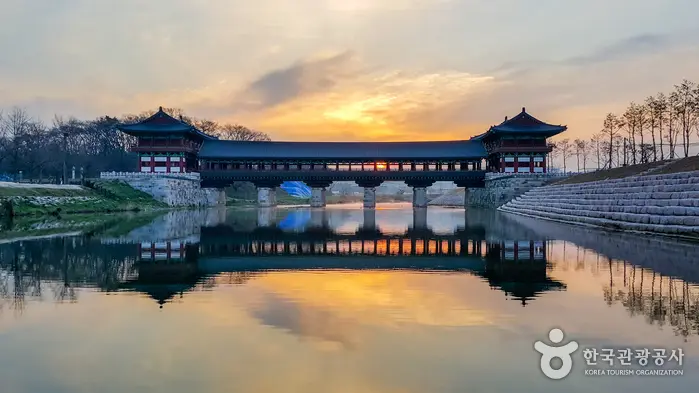
No. Water level, current, wind, recent rain, river work and season all change the Namcheon surface. A breeze can break a symmetrical reflection; heavy rain can alter the color and flow; low water can reveal more of the riverbed. Those conditions are part of an outdoor stream, not evidence that the attraction has failed.
For better odds, choose a relatively calm evening without recent heavy rain and observe the water before committing to a long wait. On a phone, clean the lens, focus on a bright section of the bridge and reduce exposure slightly. If the surface is not mirror-like, use the stepping stones, riverbank or piers as foreground instead of forcing an artificial symmetry.
Can you cross on the stepping stones?
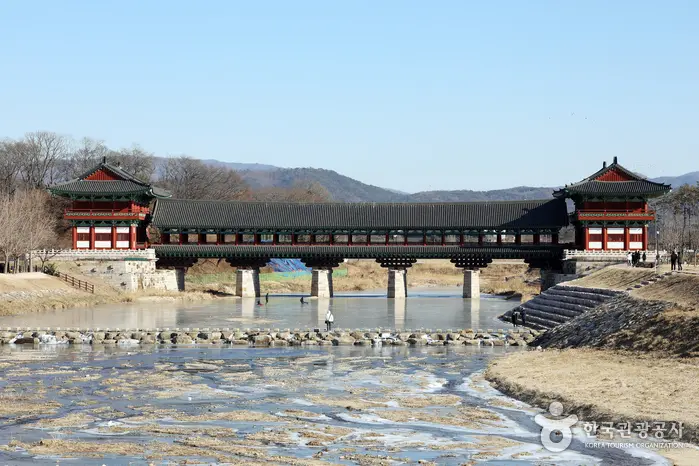
The low stepping stones in front of the bridge are one of the city's recommended viewpoints because they help frame the bridge and its reflection. They can also function as a low-level crossing when conditions permit. They are not the only way across and are not a compulsory part of visiting Woljeonggyo.
Do not step onto them after heavy rain, at elevated water levels, when surfaces are icy or visibly slick, or whenever the route is closed. Watching another person cross does not establish that it is suitable for your shoes, balance or companions. Families with young children, older visitors and anyone carrying luggage should use the covered bridge.
What is inside the bridge and gatehouses?
The covered span gives you close views of the timber work, painted decoration and framed openings. On the second floor of a gatehouse, city information describes a video about the reconstruction and displays connected with excavated material. These explain why the current bridge looks the way it does and make the word “reconstruction” meaningful.
This is not a large museum requiring half a day. For most visitors, 15 to 25 minutes is enough for the interpretive section. Access to an upper floor involves a separate mobility question; because the official page does not provide enough detail to promise a step-free route, contact a Gyeongju visitor center if lift access is essential.
How long should you allow: 30, 60 or 90 minutes?
Thirty minutes: choose either daylight or night, cross on the formal bridge and take one complete riverbank view. Sixty minutes: cross, see the gatehouse display, then inspect the stepping-stone viewpoint and full façade. This is the best-balanced visit for most itineraries.
Ninety minutes: arrive before sunset, see the bridge and exhibit in daylight, wait through blue hour, then leave along the riverbank or toward Gyochon. Do not spend the entire period defending one tripod position. Understanding the site first and photographing it second produces a fuller visit.
How does it fit a central Gyeongju walking route?
Woljeonggyo is not an isolated rural monument. It sits within a walkable historic area that includes Gyochon, Gyelim, Cheomseongdae and Daereungwon. A car is unnecessary for that central loop, but distance, night lighting, weather and your final ride still matter. Our car-free Gyeongju guide helps decide where walking should give way to a bus or taxi.
The city's suggested night route runs from Hwangridan-gil through Daereungwon, Cheomseongdae and Gyelim to Woljeonggyo. It estimates roughly 1 km and 15 walking minutes from Gyelim to the bridge. That number excludes time inside every attraction, photo stops, navigation and crossings; never add transfer estimates and call the result a complete sightseeing duration.
Can you stay for night views on a Busan day trip?
The decision is controlled by your connection back to the bus terminal or rail station, not by the bridge remaining open until 22:00. In months with a late sunset, waiting for blue hour may consume most of your transfer margin. Lock in the real return option in our Busan-to-Gyeongju transport guide, then work backward to a departure time from the bridge.
If the last service is tight, seeing Woljeonggyo by day is still worthwhile. The alternative is to stay one night and leave the following morning. A free attraction is not worth missing an intercity service and paying for an unplanned long taxi ride.
Can you wait for the lights on a Seoul day trip?
A Seoul return involves high-speed rail plus the connection between the station and central Gyeongju. If you hold a fixed train reservation, check the transfer and buffer in our Seoul-to-Gyeongju guide before promising yourself sunset. The bridge's location inside the old town does not make the station transfer disappear.
Winter sunset can make a night view compatible with an evening train. In summer, an overnight stay is usually the less stressful answer. If you cannot stay, prioritize the daytime bridge and gatehouse display rather than spending the afternoon waiting for darkness and then rushing the interpretation.
On an overnight trip, should it be the first evening or next morning?
For illumination, use your first evening for Woljeonggyo and leave a distant site for the next morning. To avoid night crowds and study the structure, visit after 10:00 the next day. Our overnight Gyeongju itinerary keeps the central sunset walk together instead of bouncing between Bulguksa and downtown.
The point of staying is flexibility rather than paying for the bridge. If rain or strong wind spoils the evening, you can switch to a daylight visit the next day. A day-tripper has no equivalent recovery window.
Can Daereungwon, Cheomseongdae, Gyelim and Woljeonggyo fit in one evening?
They can form one route, but “fit” does not mean giving each place ten minutes. Daereungwon involves a sizeable park and an interior tomb visit, Cheomseongdae can be a shorter outdoor stop, Gyelim is a wooded passage, and Woljeonggyo benefits from spanning sunset. Starting at Daereungwon and moving south normally creates less backtracking.
With children, a slower walker or a dinner reservation, remove one stop instead of compressing all four. Woljeonggyo has no long ticket queue and works as the flexible final point: stay 90 minutes if light and energy are good, or use a 30-minute bridge-and-façade version if they are not.
Can you go from Woljeonggyo to Donggung and Wolji afterward?
The city's night route estimates about 2.7 km and 30 walking minutes between Woljeonggyo and Donggung and Wolji. That does not include finding the correct exit, waiting at roads, taking photographs or entering the attraction. Donggung and Wolji is a separately managed, ticketed site with its own last-entry conditions; two night views are not automatically neighbors.
If both are priorities on your only evening, confirm Donggung and Wolji's current last entry and keep Woljeonggyo to a 45-minute version, or reverse the order according to your arrival direction. When either site is close to closing, do not turn heritage sightseeing into a run between gates.
Should Bulguksa be added to the same sunset route?
No. Bulguksa lies outside the central walking area and needs its own opening-hours, bus and return calculation. It is principally a daylight visit, while Woljeonggyo is strongest as a central-Gyeongju sunset stop. Use our Bulguksa Temple guide to give that visit a proper half-day instead of leaving the temple at closing time and racing back for blue hour.
The coherent walk is Daereungwon–Cheomseongdae–Gyelim–Gyochon–Woljeonggyo. Bulguksa and Seokguram form a different southeastern route. Treating every place inside the same city as walkably adjacent is one of the fastest ways to overload a Gyeongju plan.
Where should you stand for photographs?
Front riverbank: the most recognizable complete bridge and reflection. Near the stepping stones: the stones can form foreground, but only from an open, stable and safe position. Oblique riverbank: a diagonal view gives the gatehouses and roofline depth and works better than forced symmetry when the water is disturbed.
The interior is useful for timber details and framed views, but the passage is not a private studio. Do not block the bridge or stepping-stone landing with a tripod. In a crowd, a phone's night mode or a stable hand position is usually enough. Take the frame, move aside and avoid firing bright flash at visitors or displays.
What changes in rain, summer heat or winter cold?
Light rain can create attractive reflections on surfaces, but it also makes timber, stones and riverbanks slippery. After heavy rain or any rise in stream level, skip the stepping stones. During thunderstorms, strong wind or an official closure, use the formal route and obey staff or barriers. A roof over the bridge does not cover the approach from parking or the riverbank.
A sunset visit reduces summer heat but still requires water and insect protection. In winter, the stream corridor can feel colder than the headline temperature; a windproof layer and gloves are more useful than bulky clothing that does not stop wind. If low stones are icy, cross only on the covered bridge.
What should wheelchair users, families and older visitors know?
Parts of the bridge and riverside appear relatively level, but the gatehouse's upper exhibition, individual entrance changes, stepping stones and different parking approaches cannot all be treated as step-free. Available official information is insufficient for this article to promise an end-to-end accessible route. Ask a Gyeongju tourist information center about the current entrance and lift arrangements if these are essential.
Families with a stroller and older visitors can choose the 30- or 60-minute version using only the formal bridge and main bank. Skip the stepping stones and upper floor where appropriate. Splitting briefly and meeting at a clear landmark is safer than lifting a stroller through stairs or guiding an uncertain walker over wet stones.
How should drivers handle parking?
Search a Korean map for 월정교 공영주차장 and verify that the entrance matches the bank where you plan to start. Do not type only an English attraction name and accept the first private marker. Weekends, cherry-blossom season, festivals and the evening peak can fill spaces, so allow time to enter, park and leave.
City material has listed the public lot as free, but pricing and access control can change; current signs take precedence. Record the lot or section before walking away. Riverbanks can look similar after dark, and a low phone battery makes finding the wrong parking area unnecessarily stressful.
Address, restrooms and practical details
The city's location is 274 Gyo-dong, Gyeongju. Cross-check it with the Korean attraction or public-parking name rather than relying on one romanized pin. VISITKOREA lists parking and restroom facilities, but their precise operating state and event-day layout can change. Families and older travelers should not postpone restroom needs until the closing minutes.
The published regular schedule is 09:00–22:00 for the bridge and 10:00–22:00 for the gatehouse exhibition, with free entry and year-round visitation. Temporary maintenance, stream conditions, severe weather and major events can supersede regular information. A same-day city notice and weather check is the final verification.
A reliable 90-minute first-visit plan
Reach the public parking area or arrive from Gyelim about 45 minutes before sunset. Inspect the stream and stepping-stone conditions in daylight, then cross on the covered bridge. Watch the reconstruction material and examine the displays before returning; there is no need to photograph every window opening.
After sunset, move to the front riverbank for blue hour, then decide whether deeper darkness will add anything. If wind breaks the reflection or lights are delayed, use an oblique composition and timber details instead. Leave at your planned time rather than sacrificing the next connection while waiting for a “perfect” image.
15 checks before you go
- Check the day's sunset, not only the bridge closing time.
- Remember that bridge access begins at 09:00 and gatehouse exhibits at 10:00.
- Look for temporary maintenance, events or lighting notices.
- Check rain, wind, apparent temperature and stream conditions.
- Assume the stepping stones are unsuitable after heavy rain.
- Cross-check 월정교 공영주차장 in a Korean map.
- Read current parking and closing signs on arrival.
- Lock in the return connection before a Busan or Seoul day trip.
- Do not count attraction time as part of a walking estimate.
- Treat Donggung and Wolji as a separate ticketed attraction.
- Reserve phone or camera battery for navigation after dark.
- Bring a windproof layer beside the stream in winter.
- Do not assume the gatehouse upper floor is step-free.
- Use official crossings and never pass a closure barrier.
- Leave on schedule even if the reflection is imperfect.
Final verdict: who should visit Woljeonggyo?
Highly worthwhile: you are staying in Gyeongju, walking the historic center, enjoy architecture and can arrive before sunset. Worth a short stop: you have only 30 minutes but are already near Gyochon or Gyelim; choose daylight or night rather than both. Do not force it: you must rush an intercity connection, heavy rain makes the stepping stones your only reason to go, or the same evening already contains several fixed-closing attractions.
Woljeonggyo works best as the point where daylight archaeology becomes an evening cityscape. It should not let one heavily edited symmetrical photo take control of your night. Separate BRIDGE, LIGHT and LOOP, and this free landmark becomes a coherent part of the day rather than one more pin squeezed in at closing time.
Sources and update limits
History, reconstruction stages, regular access, free admission, gatehouse content, address and city night-route estimates were checked against Gyeongju City's official English tourism pages and VISITKOREA material. Official sources vary between roughly 61 m and 66.15 m for the bridge length, so this guide does not turn a disputed precision into a visitor decision. The historical year follows the nineteenth year of King Gyeongdeok in the Samguk Sagi, corresponding to 760 CE.
Opening, illumination, stream level, stepping-stone access, parking, transport and events can change temporarily. This guide provides a decision framework rather than replacing current signs; any safety closure on site takes priority.
Gyeongju City | Woljeonggyo Bridge Gyeongju City | Nightscape route VISITKOREA | Woljeonggyo details