
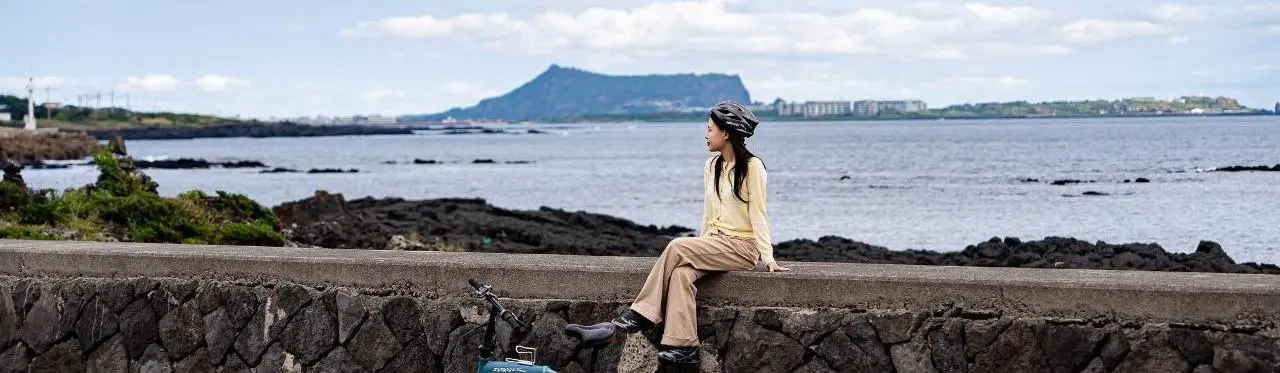
30-second answer: the official Jeju Circular Bicycle Path is currently listed at 234 km with an estimated riding time of 15 hours 30 minutes, but that number is not a hotel-splitting formula. Wind, meals, photos, punctures, traffic lights, road conditions, rider fitness and how much you carry all change the useful end point of a day. Bike.go.kr also currently recommends riding counterclockwise from the airport toward Iho Tewoo Beach, partly because riders can face the coast more naturally and reduce crossings where coastal roads reconnect with the round-island road. For accommodation, that means you should first identify a safe stopping node and tomorrow’s clean restart—not decide in advance that every 58 km deserves a new room key.
Bike.go.kr currently warns that the city sections around Sarabong–Yongduam–Hagwi 2-ri and Beophwan–Jeongbang Falls carry relatively heavy vehicle traffic. That matters to hotel planning because “another 8 km to a cheaper room” is not always a bargain at the end of a tired day. If those extra kilometers push a rider into busier roads after concentration has dropped, the hotel is creating risk rather than removing cost.
Each additional hotel should answer at least two of these questions with a clear yes: Does it let today finish before an unpleasant or high-attention segment? Does it let tomorrow rejoin the main direction without backtracking? Does it reduce luggage, bike-bag or support-logistics handling? A hotel that only makes one of those slightly easier often fails to pay back the packing, checkout, navigation and bike-storage uncertainty it creates. In a cycling trip, your physical energy is the transport budget.
The official 234 km and 15:30 estimate give scale, not a nightly mileage target
The current Bike.go.kr English route describes Jeju’s circular bicycle path through major nodes including Yongduam, Darak Shelter, Haegeoreum Park, Songaksan, Beophwan, Soesokkak, Pyoseon Beach, Seongsan Ilchulbong, Gimnyeong Seongsegi Beach and Hamdeok Seoubong Beach. That is useful because it tells you the route is a real island circuit with repeated coastal and town transitions. It does not tell you that a particular hotel night belongs exactly halfway between two stamps.
A solo road-bike rider carrying only a small saddle bag has a very different stage limit from two travelers on rental bikes who stop for cafes and photos. A rider who is comfortable in urban traffic has a different last-hour cost from someone who becomes tense around buses and turning cars. Even the same rider can have a different answer on Day 2 if a headwind has been constant since lunch. A hotel schedule should therefore be built around a latest comfortable stop time, not a compulsory number on the odometer.
That distinction also prevents a common booking error: overestimating the value of a “perfectly placed” resort because a routing app says it completes an elegant distance. The real trip continues after you stop the bike. You still need food, a shower, charging, clothes management, possibly a repair, and a secure place for the bicycle. If the room is beautiful but adds a long deviation from the route or uncertain storage, the stage is less efficient than the map suggests.
Use certification points as route nodes—not automatic hotel anchors
Visit Jeju’s current Fantasy Bicycle Path feature describes the red mailbox-shaped certification centers used along the route. They are useful for tracking progress and deciding how far you actually reached. They are not a hotel-booking system. A certification point can be a good place to stop riding for the day without being a good place to sleep, and a good hotel can sit a short distance away without being exactly beside a stamp box.
The more useful question in late afternoon is: How much safe riding margin remains after this node? If the next segment enters heavier city traffic, light is fading, crosswind has increased or one rider is clearly slowing, stopping earlier can be the rational stage decision even if the original spreadsheet says another 10 km. If you arrive early with stable weather and tomorrow continues in the same direction, moving farther may make sense. The certification node is the checkpoint where you reassess the day; it is not an instruction to check in.
The counterclockwise recommendation changes the first hotel question more than it changes the sightseeing list
Bike.go.kr’s current recommendation is counterclockwise from Jeju Airport toward Iho Tewoo Beach. The reason is functional: coastal orientation and fewer crossings at some road connections. For accommodation, the practical consequence is that the first “real” stage decision usually appears on the west side, not at Seongsan simply because Seongsan is famous.
If arrival day still involves assembling a bike, collecting a rental, sorting a bike box, buying water or recovering from a flight, do not force a heroic westward stage just to make the itinerary feel like it has started. Current Visit Jeju cycling information also shows that bicycle logistics can be handled separately from accommodation: bicycle-tour services around Yongduam/airport-side Jeju currently advertise rental, support and—in at least one current listing—bike carrying-bag storage. That means the hotel does not have to solve every equipment problem by itself.
A short north-side first night can therefore be useful when it buys a clean launch the next morning. It becomes poor value if you actually ride far into the west, then reverse direction all the way back to Jeju City just because the room was prepaid. Once you are genuinely on the route, the accommodation should move with the stage logic—not with an old booking that no longer matches the ride.
Hotel Leo: useful as a start/finish reset, not because it is a “cycling hotel”
Hotel Leo Jeju can make sense around the first or final night because Yeondong solves dinner, city services and flight-side logistics, while some current room products include an LG Styler that may be useful for travel clothes. But KoriNavi does not have verified evidence that Hotel Leo is a dedicated rider hotel, that bicycles are allowed in rooms, or that it provides secure indoor bicycle storage.
That distinction matters. If your first night is simply “land, sort equipment, eat, sleep,” Hotel Leo can be a normal city-hotel candidate. If Day 1 already carries you deep into West Jeju, returning to Yeondong breaks the route logic. First decide whether Jeju City should only handle the start and finish; only then decide whether Hotel Leo is the right property inside that role.
Stanford Hotel & Resort Jeju: Aewol can fit the west stage, but the no-elevator condition matters even more after a ride
Stanford Hotel & Resort Jeju sits on the Aewol coast, so its geography can line up with a west-side cycling stage. But its most important property-level constraint is not the ocean view: the hotel building has no elevator, with Garden View on 1F and Ocean View on upper floors. After a full riding day, stairs plus a helmet, camera, bags or tired legs can matter more than they do on an ordinary sightseeing stay.
This is a good example of why “coastal hotel” is not the same thing as “bike-friendly hotel.” Before paying, ask the property directly what happens to the bicycle: can a complete bike be stored indoors, is there a locked room, can it enter the guest room, must wheels be removed, is an exterior rack the only option, and how early can you retrieve it? KoriNavi’s existing Stanford evidence does not prove any of those bicycle-storage rights, so this page does not invent them.
If Aewol is only a scenic pause and tomorrow’s route continues much farther southwest, an Aewol overnight may or may not earn its move. Use the West Jeju base guide to understand the difference between an airport-edge west base, Aewol proper and deeper southwest Jeju. The same geography matters to cyclists, but your decision threshold is stricter because every hotel switch also has a bicycle attached.

South Jeju: protect the final hour around Beophwan and Seogwipo from becoming the hardest hour
The official route warning about the Beophwan–Jeongbang Falls city section should change how you think about a south-side hotel. If a long southwest stage puts you near Seogwipo when your concentration is already low, “the room is only another few kilometers away” can be a poor argument. The final city segment should be planned while you are still fresh enough to choose, not when the day has already gone wrong.
That is where the Seogwipo accommodation guide becomes useful. A south-side overnight should reduce tomorrow’s restart friction and tonight’s city-traffic exposure. It should not simply be the cheapest room somewhere inside a large administrative area called Seogwipo.
Park Sunshine Jeju: for cyclists, access and current renovation status matter more than resort-style extras
Park Sunshine Jeju can enter a Seogwipo-stage shortlist, but August 2026 requires a fresh construction check. KoriNavi’s property page records a current renovation window that had been announced through August 2026, covering guest-room work and facility additions, with possible noise and access restrictions.
A cyclist who leaves early and returns late may care less about daytime room noise than a family with a child’s nap. But access becomes more important. Can the bicycle be moved through the property without the renovation route interfering? Is there a verified secure storage arrangement? Can you retrieve the bike at the time you plan to depart? Those are not answered by a normal “parking available” field, and this article does not infer bicycle storage from car parking.
“Parking available” and “secure bicycle storage” are completely different fields
This is the rule most likely to prevent a bad cycling booking. Hotel websites and OTAs routinely describe private parking, valet parking, off-site parking or a No Parking rate. Those are car rights. They do not tell you whether a road bike can be taken into the lobby, whether an e-bike can be stored indoors, whether the property has a locked bicycle room, or whether outdoor parking is the only option.
The same caution applies to laundry. A hotel may advertise coin laundry, a renovation may be adding laundry, or a room may have a clothing-care appliance. None of that guarantees that your stay date, operating hours and clothing load fit your recovery plan. If clean kit is a hard requirement, confirm the actual facility and hours directly. Do not build a four-day cycling schedule around an old amenities table.
- Can a complete bicycle be stored indoors overnight?
- Is that space locked or staff-controlled?
- Can the bike enter the guest room, or is that prohibited?
- If a bag is required, must wheels or pedals be removed?
- What is the earliest retrieval time?
- Does the answer change for e-bikes?
- Can the hotel confirm the arrangement in writing for your date?
If the property cannot give a clear answer and the bicycle is valuable, treat storage as unresolved—not as “probably fine.”
East Jeju is not one overnight: Pyoseon, Seongsan, Gimnyeong and Hamdeok serve different next mornings
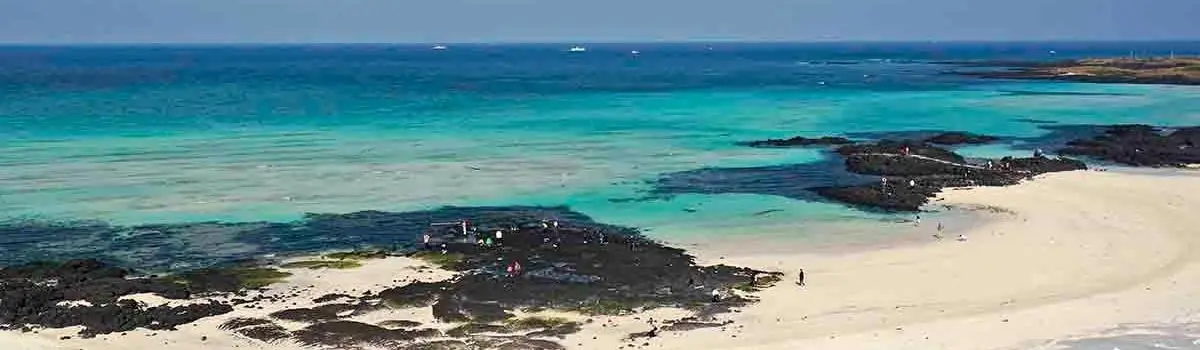
After the south/east turn, the route passes a series of strong landmarks that tempt travelers to book by fame: Pyoseon Beach, Seongsan Ilchulbong, Gimnyeong and Hamdeok. They are all “east,” but the stage question is different. Are you stopping because the body is done, because tomorrow starts with a Seongsan sunrise detour, because the group wants an easy coastal morning, or because you are continuing north as efficiently as possible?
The current Visit Jeju Fantasy Bicycle Path feature specifically highlights an easy eastern cycling stretch around Gimnyeong–Seongsan–Pyoseon, showing how naturally those points form a riding sequence. Accommodation should respect that sequence. If you finish early at Pyoseon and tomorrow’s plan is to ride through Seongsan toward Gimnyeong, a Pyoseon night can make sense. If you are already strong enough to finish at Seongsan and want to restart north, moving again purely for a more famous hotel name adds friction.
Co-op City Hotel Seongsan: on a cycling stage, private view should come after tomorrow’s restart
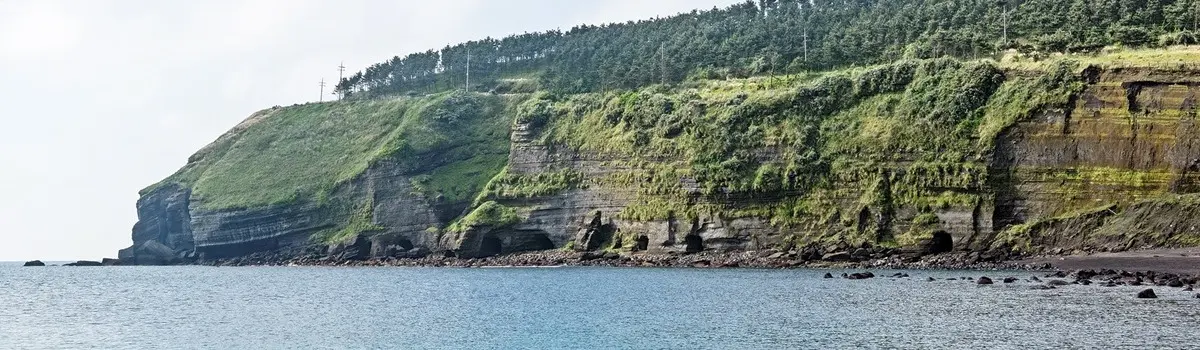
Co-op City Hotel Seongsan makes sense only after Seongsan is already the correct east-stage finish. Its property-level decision is normally whether to pay for a private Sea/Mountain View or rely on a shared rooftop view. For a rider continuing north the next day, that should be secondary to sleep, breakfast timing, route re-entry and confirmed bicycle storage.
If an early Seongsan Ilchulbong visit is part of the trip, a view room may have more personal value. If you are simply sleeping before riding toward Gimnyeong and Hamdeok, the premium can be much harder to recover. Use the East Jeju stay guide once you know whether the east stage is really Seongsan-centered or whether another micro-zone fits the next morning better.
Three stages or four? Split the day that would otherwise end with the worst riding, not the day that makes the map look uneven
Some cyclists will prefer three major overnights; others will need four or more. KoriNavi does not set one mileage target because the rider, weather and bike make the threshold move. A more useful exercise is to mark three kinds of segment you least want when tired: heavy urban traffic, long exposed headwind and unfamiliar roads after dark.
If a three-stage plan forces one of those onto the last hour of a long day, splitting that day may be valuable. If a four-stage plan only creates a prettier average while adding another checkout, storage negotiation and repack, the fourth hotel may be the less efficient choice. Every extra key card has to pass the same Stage Payback test.
The same principle applies if the trip is short enough that cycling is only one part of Jeju. Do not force the whole island loop into a three-night holiday just because the official pure riding estimate sounds possible. The three-night one-base-or-two-hotels guide is a useful reality check for how quickly extra check-ins consume a short stay.
Keep large luggage and bike bags out of the daily stage whenever you can
A round-island ride becomes much easier when the rider moves but nonessential luggage does not. If a north-side start/finish arrangement can hold a large suitcase or bike case while you ride with panniers or a day-sized load, that can be more valuable than a slightly cheaper hotel on every stage. Current Visit Jeju listings for bicycle-tour services around Yongduam show that equipment logistics such as rentals, support and carrying-bag storage can exist separately from the hotel itself.
This is also where the logic overlaps with the large-luggage, no-car accommodation guide: count handling events. A suitcase that is unpacked once at the beginning and collected once at the end may be a better system than forcing it to accompany every bicycle stage. The bike should already be enough luggage.
Rain and wind should be allowed to change the hotel plan’s meaning, not force the ride to defend a prepaid spreadsheet
Jeju’s coast is exposed. A route that looks straightforward on a calm planning day can become a different ride when wind and rain arrive. A good accommodation plan leaves enough flexibility that you can stop earlier, shorten a day, or swap a non-cycling block without making every subsequent hotel unusable.
That does not mean booking everything at the last minute. It means valuing flexible cancellation where it matters and avoiding “I have to reach that hotel tonight because otherwise the whole trip collapses.” If weather becomes poor, use the Jeju rainy-day plan as a route-reset tool rather than treating the room location as a reason to keep riding unsafely.
The most important hotel hour is the hour after you stop pedaling
While planning, riders often focus on the 50 or 70 km they will cover. The accommodation cost is usually felt after the ride: finding the property, negotiating where the bicycle goes, carrying bags, showering, finding dinner, charging devices, drying clothing and deciding what tomorrow needs. A hotel that reduces those decisions can be more valuable than one that looks marginally closer to a landmark on the map.
Before you book, imagine the worst realistic version of arrival: you are wet, one rider is hungry, it is darker than expected, and the bike storage answer is still “ask the front desk.” If that scenario feels fragile, the hotel has not solved the stage. A good stage hotel turns the evening into food, wash, repair if needed, sleep—then a direct restart.
Eight questions to answer before the first hotel payment
- Are you actually riding the full circuit? A one- or two-section coastal ride does not need full round-island hotel logic.
- Will you follow the official counterclockwise recommendation? If yes, the first serious overnight decision usually develops on the west side.
- Where is today’s last safe stopping node? Do not let an ideal mileage target overrule light, wind, traffic or a slowing rider.
- Can tomorrow start in the same direction without backtracking? A hotel that requires a reverse ride before you can continue has not fully paid back its location.
- Is bicycle storage explicitly confirmed? Car parking, valet parking and No Parking rate labels do not answer this.
- What luggage can stay at the start/finish base? Bike bags and large suitcases do not need to tour the island just because you do.
- Does the second or third hotel remove at least two frictions? Saving one small morning transfer may not justify another checkout and storage negotiation.
- If wind or rain changes the stage, does the booking still work? A route plan should be flexible enough that safety can override symmetry.
Jeju cycling accommodation should not be created by dividing 234 km into equal hotel nights. The official route length, estimated riding time and certification points provide the skeleton. The actual overnight stages should be decided by safe finish timing, tomorrow’s clean restart, traffic-heavy city sections, weather, luggage and verified bicycle storage. Use the north side to solve flights and equipment only when it truly belongs at the start or finish. Add west, south and east hotels only when each move clearly removes the next stage’s friction. Most important: no hotel becomes “bike-friendly” because it has a car park, sits beside the coast, or sells a No Parking room. If secure bicycle storage has not been confirmed, it is not a booking entitlement.
Next decisions
Facts rechecked on 20 Aug 2026. Bike.go.kr currently lists the Jeju Circular Bicycle Path at 234 km with an estimated riding time of 15 hr 30 min, recommends counterclockwise travel from Jeju Airport toward Iho Tewoo Beach, and warns of heavier traffic on Sarabong–Yongduam–Hagwi 2-ri and Beophwan–Jeongbang Falls city sections. Visit Jeju’s current Fantasy Bicycle Path feature confirms the route as part of Korea’s Cross-Country Bicycle Tour network, describes the red certification centers and highlights the Gimnyeong–Seongsan–Pyoseon eastern cycling sequence.
Bike.go.kr|Jeju Circular Bicycle Path · Visit Jeju|Fantasy Bicycle Path · Visit Jeju|Gimnyeong Beach · Visit Jeju|Pyoseon Beach
Road conditions, detours, weather, certification facilities, bicycle-rental services and hotel bicycle-storage policies can change. Recheck the route operator, current weather/road notices and the hotel directly before riding or paying.