
30-second answer: if you have at least two full west-side days and genuinely want to keep the coast until sunset, dinner and a slow evening, an Aewol- or Hallim-side base can earn its keep. If western Jeju appears only once, or most of your other days are east or south, staying in Jeju City and accepting one return drive is usually cleaner than adding another hotel transfer. The easiest mistake is seeing “Aewol” in a property name and assuming Handam, Gwakji, Aewol Port and every café you saved are all on the same walkable strip. They are not.
KoriNavi already has a broader West Jeju base guide. This article handles a narrower, later-stage decision: your west-coast days keep running until sunset, and you do not want the driver's final task to be a long return after everyone else has mentally finished the day. If you are still deciding whether western Jeju deserves one day or several, settle the route before the hotel. Accommodation should solve repeated movement, not create a route just because a hotel photo looked good.
The expensive part of a West Jeju sunset is not the sunset; it is where “today is over” happens afterward
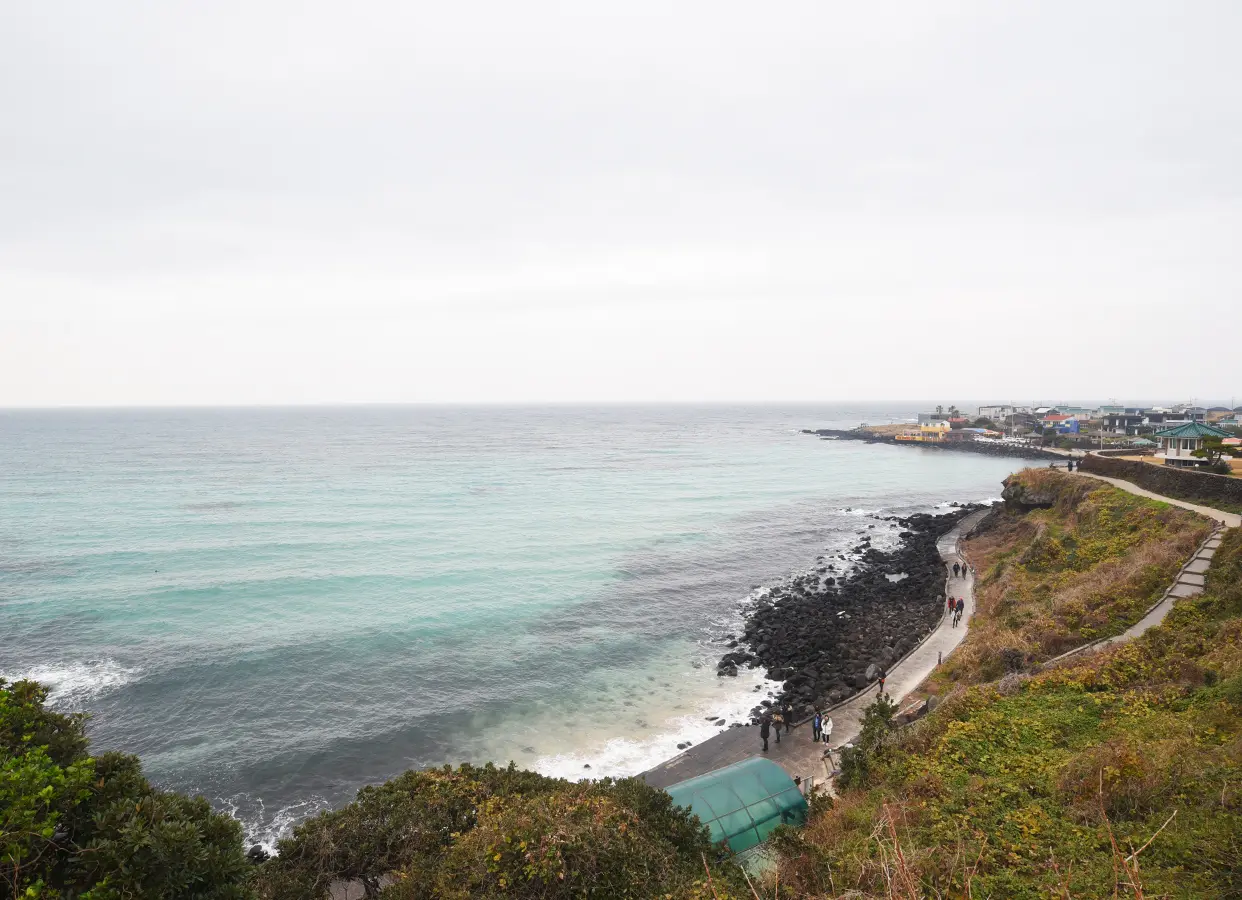
Visit Jeju currently describes Handam Coastal Trail as a seaside route of about 1.2 km that runs from the Aewol side toward Gwakji Gwamul Beach. The tourism authority also explicitly notes that its western location makes it attractive for sunsets. That sounds like a sightseeing fact, but it creates a practical hotel consequence: if sunset is your planned final activity, you are deliberately pushing the return leg into darker hours.
That is not an argument that night driving in Jeju is inherently dangerous, nor is it a reason to turn an ordinary road trip into a fear story. The point is more mundane. After a full day of attractions, cafés, parking, walking and dinner decisions, the driver is often the only person whose job is not finished. Everyone else can switch into “we are done for today” mode. The driver still has navigation, unfamiliar roads, concentration and parking at the hotel. A west-side hotel is valuable when it repeatedly shortens that last job.
The phrase “we have a rental car anyway” hides this cost especially well. A rental car can save waiting and make west-coast stops easier to connect, but it does not make the driver's attention free. KoriNavi's Jeju rental-car decision guide makes the same distinction: the final hour behind the wheel can matter more than the day's total mileage. If the car is useful all day but annoying after dinner, choose the hotel so the car can stop being useful earlier.
“Aewol” is not one compact neighborhood: pin the exact stretch of coast you plan to use after 6 p.m.
This is where West Jeju requires more geographic discipline than a hotel search page suggests. Handam Coastal Trail sits on the Aewol side and runs toward Gwakji. Hyeopjae Beach is farther west in Hallim-eup. Both are “western Jeju,” but they do not function as one evening neighborhood. A hotel that is well placed for an Aewol-coast evening may be a weaker choice if your repeated late stops are Hyeopjae, Geumneung or the Hallim side.
Visit Jeju currently lists Hyeopjae Beach at 2497-1 Hyeopjae-ri, Hallim-eup and describes it as one of western Jeju's major beaches, connected with the Geumneung side. That is enough to expose the category problem: “west” is a region, not a single hotel zone. If your day ends around Handam and Gwakji, solve that stretch. If it ends around Hyeopjae and Hallim, solve that stretch instead.
Do this before looking at room photos. Open your saved map and identify the last real stop for each west-side day, not the attraction you visit at noon. Then mark the dinner area. Your hotel should sit close enough to the repeated evening cluster that moving there changes the day. If the proposed hotel saves nothing after sunset, the fact that it appears under an “Aewol hotels” search result is not enough.
One west-side day usually does not justify paying the sunset cost twice
Suppose your trip has only one full western day. Starting from Jeju City, you can drive west, spend the day around Aewol or Hallim, watch the sunset and return north. The return may be the least attractive part of that day, but changing hotels to avoid one drive adds a different set of costs: packing, checking out, putting luggage somewhere, learning another parking layout, waiting for check-in and then moving again when the itinerary changes direction.
That is why “I want to see a Jeju sunset” is not, by itself, a reason to sleep on the west coast. The hotel move has to pay you back more than once. Two west-side days mean two evenings, two last drives and often two mornings that can start closer to the same area. Repetition is what changes the economics.
On a three-night trip, the threshold should be even higher. KoriNavi's one-hotel-or-two guide for three nights treats a second key card as something that must earn its keep. You usually have only two full days once arrival and departure are accounted for. If the west-side hotel serves only one sunset and one sleep, the transfer can consume too much of a short trip. If both full days are west-heavy, the case becomes much stronger.
With five days, a split is easier to justify but still not automatic. The five-day split-stay guide uses the same rule: the second base should remove at least two pieces of repeated backtracking or serve a coherent block of the itinerary. More nights create room for a second base; they do not create an obligation to use one.
Do not choose a West Jeju hotel until you know what kind of evening you are buying
Some travelers want a hotel that lets the day end almost immediately after the coast. Others still want a proper dinner outside, a convenience store stop, time for children to swim, or a room where the ocean view is part of the evening. These are different products even if the addresses all sit inside the western half of the island.
If dinner matters, search the restaurant area before you search the hotel. A property can be attractive in daylight and still force another drive for dinner. If you plan to drink, settle the transport rule before booking: the rental car should not be the fallback after alcohol. Either stay close enough for the evening to work without driving or use a taxi and treat the car as finished for the day.
If the hotel itself is part of the evening, ask when you will realistically return. This is especially important for families. A pool, spa or lounge has no value if sunset, dinner and the drive bring you back after the useful window has passed. The point of moving west is to make the evening simpler, not to create a schedule in which the resort facilities become another attraction you have to rush toward.
Four existing English hotel pages solve four different versions of the west-side problem
The English site does not need a copied list of every Chinese hotel route. Language isolation matters: English readers should land on English hotel decision pages, not Chinese articles. That changes the shortlist slightly while preserving the same decision logic.
A sunset-focused base can still be wrong if the next morning immediately sends you east or south
Hotel geography should solve both ends of a night: where you finish today and where you start tomorrow. A west-side hotel that perfectly removes tonight's return drive can still create a poor morning if the next two days move to Seongsan, eastern Jeju or the south coast. This is why the decision should be made as a two-day block rather than one Instagram moment.
Write the last stop of Day 2 and the first stop of Day 3 on the same line. If both remain west, the hotel is working twice. If Day 3 immediately requires a long move away from the west, decide whether the move can be folded into the sightseeing direction. A transfer is much easier to justify when checkout already points the same way as the next itinerary rather than becoming a separate luggage errand.
This is also why the generic West Jeju stay guide sits above this persona page. That guide decides whether Iho, Aewol or deeper west should be the zone at all. This page only adds one more filter: how much of the day you intend to keep after the light starts fading.
The same driver doing every day makes the hotel decision more valuable
A group often says “we are self-driving” as if the car belongs to everyone equally. In practice, one person may be the only comfortable or legal driver, the only person willing to navigate unfamiliar roads, or simply the person who ends up behind the wheel every evening. That makes hotel placement a group decision with a very uneven cost.
If one person drives every day, save that person's hardest kilometers rather than the group's easiest ones. Cutting a midday drive when everyone is alert is less valuable than cutting the last drive after dinner, rain or a long coastal afternoon. This is not a mileage optimization problem. It is a fatigue and recoverability problem.
Friends and couples should settle drinking plans at the same time. If dinner includes alcohol, nobody should be planning to drive afterward. A hotel that lets you park before dinner can therefore be worth more than a theoretically faster location that still requires moving the car at 9 p.m. If nobody drinks and the driver genuinely enjoys night driving, the value of a west-side base drops. That is a valid opposite answer.
Bad weather is the strongest red-team test for a sunset hotel strategy
Sunset is weather-dependent. Clouds, rain and strong wind can erase the very experience that made a west-side room feel necessary. That does not mean the hotel choice was wrong. It means the base needs a second reason to survive the weather test.
Ask what happens if the sunset disappears. Do you still have dinner nearby? Does the hotel give the group a useful evening? Does the next morning still start in western Jeju? If yes, the base has structural value. If the only reason to move was “we want one perfect sunset photo,” the move is fragile because the weather can remove its only payoff.
KoriNavi's Jeju rainy-day guide uses the same principle: protect the direction of the day instead of crossing the island to rescue every lost outdoor plan. A west-side hotel is useful in poor weather when it still gives you a coherent western day and an easy retreat. It is much less useful if bad weather leaves you stranded far from everything else you planned.

Your first and last nights should not be forced into the sunset logic
Arrival and departure nights carry different costs: baggage, rental-car collection or return, airline timing, hotel check-in and the possibility that the day is only partly usable. A west-side base may be excellent for the middle of the trip and still be the wrong first or final night.
If you land late, use the late-arrival first-night guide before deciding whether you should drive west immediately. The question is not whether a west hotel is attractive; it is whether the actual arrival, car handover and hotel access are confirmed. One uncertain first-night process should not be allowed to break the whole trip.
If you have an early flight, use the early-flight final-night decision. A move back toward Jeju City only makes sense when it removes a confirmed morning bottleneck such as car return, shuttle or airline timing. The final sunset can be emotionally attractive, but an early departure may have a higher operational priority.
This means a four- or five-night trip does not need a neat all-or-nothing answer. You can keep an arrival night in Jeju City, spend two nights farther west, then return north only if the departure process actually requires it. The correct pattern is the one in which each hotel has a job. “Every hotel must be in the prettiest area” is not a useful design rule.
Do not confuse staying west with paying for an ocean-view room
The base decision and the room decision are separate. You may correctly decide to sleep in Aewol because it removes repeated evening driving and still conclude that the cheapest non-ocean room is enough. Conversely, a sea view can be worth paying for if the room itself is part of the evening and weather, floor access and actual room category all line up.
Make the base earn its price first. Then compare the room. At Stanford, floor access can change the Ocean View decision. At Dyne Oceano, the usable family pool window can change the value of returning early. At Shilla Stay Plus Iho Tewoo, the Plus premium depends on whether you actually use the leisure layers. None of those property-level decisions should be smuggled into the earlier question of which part of Jeju deserves your nights.
This separation also protects you from hotel-search sorting. OTA results often lead with a low headline rate or an attractive photo, but the exact room, legal occupancy, view, breakfast, cancellation and tax-inclusive total can be a different product. Persona pages should narrow the geography first; the single-hotel page should then finish the room and price decision.
Use this six-question filter before moving a single suitcase west
- How many full west-side days do you actually have? One day usually favors staying put. Two or more make a west base much easier to justify.
- Where is the last real stop on those days? Handam/Gwakji and Hyeopjae/Hallim are not one evening zone.
- Where will you eat? If dinner is elsewhere every night, the hotel may not eliminate as much movement as the map suggests.
- Who drives after sunset? If the answer is always the same person, reduce repeated late driving before optimizing pretty daytime routes.
- What happens if weather kills the sunset? Keep the west hotel only if the dinner, next morning or hotel experience still gives the location value.
- What does the following morning do? A west hotel that sends you immediately across the island may only solve half of one night.
If you cannot answer these yet, do not lock a non-refundable west-coast rate. Finish the route first. The fact that cancellation terms and prices change by date is another reason to keep the hotel decision recoverable until the direction of the trip is stable.
Choose a deeper West Jeju base more readily when at least two full days end around Aewol, Gwakji, Hallim or Hyeopjae; you want dinner to stay west; and the same driver would otherwise repeat the final return after dark. Stay in Jeju City or keep one base when the west appears only once, the other days point in different directions, or the luggage cost of another hotel is larger than the one return you are avoiding. Do not let “Aewol” in a hotel name settle the micro-location. First pin the exact beach, trail, dinner area and next-morning route.
The next step is not an OTA search; it is narrowing the West Jeju product to one or two hotel pages
Once the base is settled, move into the single-hotel decision that matches your actual trade-off. Use Stanford Hotel & Resort Jeju if Aewol is already correct and floor/view access is the key issue. Use Dyne Oceano Hotel Jeju if family pool timing and a west-coast hotel evening matter. Use Shilla Stay Plus Iho Tewoo if you want a northwest edge rather than a deep-west base. Use Camphortree Hotel & Resort when a car-first group values resort living space more than a walk-out sunset neighborhood.
Only after you have reduced the choice to one or two properties should you compare exact room names, legal occupancy, breakfast, view, parking, cancellation and the current OTA total for your dates. Prices, room availability, facility schedules and operating policies can change by date or season, so recheck the hotel and booking platform before payment.
- Visit Jeju, Handam Coastal Trail: approximately 1.2 km, running from the Aewol side toward Gwakji Gwamul Beach; western location noted for sunset appeal. Rechecked 2026-08-20.
- Visit Jeju, Hyeopjae Beach: official Hallim-eup location and current attraction information. Rechecked 2026-08-20.
- KoriNavi English hotel decision pages for Stanford Hotel & Resort Jeju, Dyne Oceano Hotel Jeju, Shilla Stay Plus Iho Tewoo and Camphortree Hotel & Resort Jeju. This persona page routes readers inward; it does not duplicate OTA conversion work.
- Transport, hotel facilities, room availability, operating schedules and booking conditions can change by date, season and property policy. Reconfirm official and booking-platform details before payment.