
Short answer: N Seoul Tower is usually worth one evening on a first Seoul trip, especially when you want to understand the city’s mountains, river, and scale from one place. But visiting the tower does not require an observatory ticket. Separate the trip into BASE, the free summit area; T5, the paid indoor observatory; and ROUTE, the complete journey up and down. The free version can take 60–90 minutes. A sunset-to-night visit with T5 needs two to three hours. Trying to fit both a cable-car queue and an observatory queue into a tiny gap is the version most likely to fail.
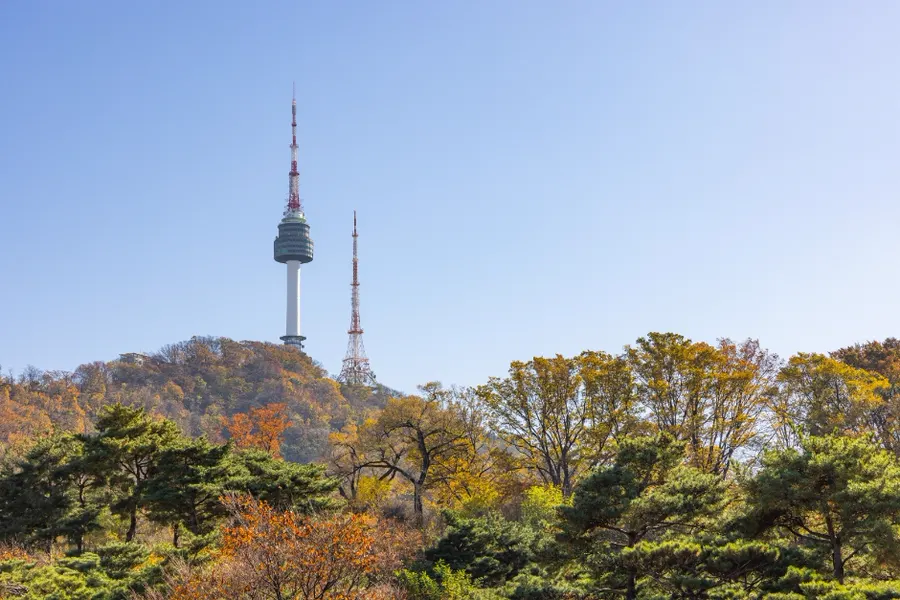
- BASE: Namsan Park, the summit plaza, Palgakjeong Pavilion, and partial outdoor views can form a free visit. Shops, food, and indoor facilities keep their own hours.
- T5: The paid indoor observatory gives a higher and more continuous panorama, but visibility, glass reflections, admission, and elevator waits control its value.
- ROUTE: The 01A/01B loop buses, Namsan Cable Car, and walking are three different systems. The subway does not reach the summit, and the lower cable-car station is not beside a Myeongdong Station exit.
- Lowest-risk version: Reach the summit 60–90 minutes before sunset, inspect the free views, buy T5 only when visibility and queues are reasonable, and decide the descent before going up.
Are N Seoul Tower, Namsan Seoul Tower, and Namsan Tower the same place?
In ordinary travel use, all three names usually mean N Seoul Tower on the upper part of Namsan. It is a combined broadcasting and visitor tower at 105 Namsangongwon-gil, Yongsan-gu. Around it are Namsan Park, Palgakjeong Pavilion, love-lock railings, food, shops, and several approaches up the mountain.
“Going to Namsan Tower” may therefore mean reaching the summit plaza, or it may mean paying to ascend to the T5 observatory. The height, view, queue, time, and cost are different. Define the visit before choosing transport or buying anything.
Is it worth including on a first Seoul trip?
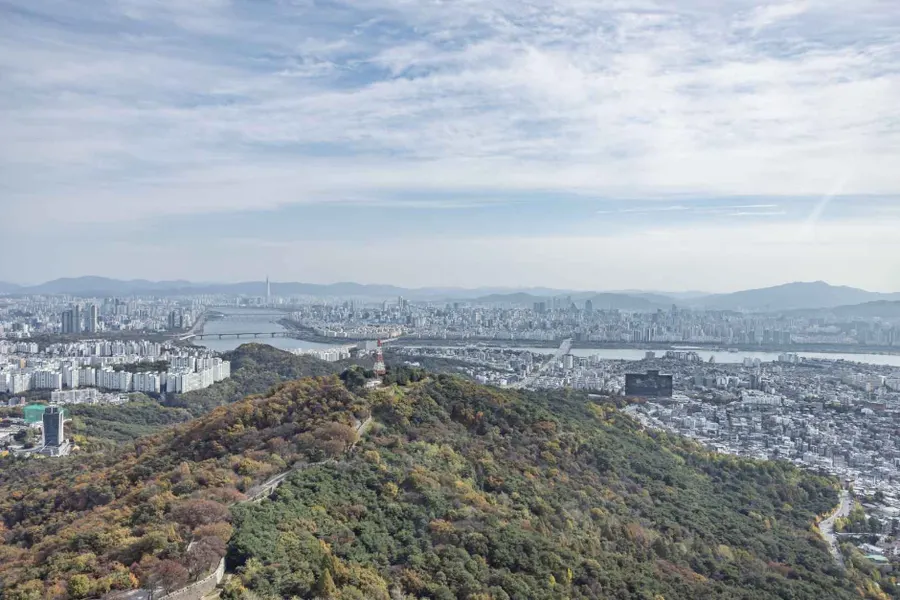
Usually yes if you want one view that explains the Han River, surrounding ridges, dense central neighbourhoods, and the city spreading outward. Place it in one evening of a four-day Seoul itinerary, connecting the daytime streets with one city panorama rather than adding it as a fifth night attraction.
It is easier to skip the paid part if you dislike heights, the visibility is poor, only 45 minutes remain, or your trip already includes Seoul Sky or another high observatory. You can still use the free summit or remove Namsan completely without making the trip incomplete.
What is free, and where does the paid visit begin?
Namsan Park and the public summit area can make a complete free visit: see the tower exterior, walk near Palgakjeong, notice the lock displays, and use partial city views. The official tower material also identifies some lower public viewing or leisure spaces, although individual shops, exhibitions, and indoor levels follow current operating conditions.
The higher T5 indoor observatory needs a separate ticket. Reaching the base does not include it, and an observatory ticket does not include the cable car. The climb up Namsan and the climb inside the tower are separate purchases and separate queues.
Is the T5 observatory worth KRW 29,000?
When checked in August 2026, the official tower information and VISITKOREA listed KRW 29,000 for adults and KRW 23,000 for children ages 3–12 and seniors 65 or older. Recheck the current official price before purchase. The ticket buys a higher indoor 360-degree city view and tower experience; it does not buy clear weather.
Value is strongest on a first visit with good visibility when you can watch late daylight become night. It is weaker when the sky is opaque, indoor reflections are strong, the group only wants the tower exterior, or the free level has already answered the need. “We came this far” is not a reason to pay.
What are the current observatory hours?
At the August 2026 check, official information listed 10:30–22:30 on weekdays and 10:00–23:00 on weekends. Last admission, elevator boarding, restaurants, and individual floors may end earlier than the building’s headline closing time. Holidays, maintenance, events, and operations can change the schedule.
A late visitor should ask, “What is the latest time I can complete entry and still get down?” rather than only, “When does the tower close?” If the remaining window covers little more than ticketing and elevators, the free summit will feel more complete.
How much time do 60, 90, 120 minutes, and half a day buy?
Sixty minutes: use the loop bus, see the summit public area, and leave. Ninety minutes: add Palgakjeong, the lock displays, and part of sunset. Two hours: add T5 when visibility is good. Half a day: make a walk or Namsan trail part of the attraction and add one nearby district or meal.
Count from the transport starting point, not from the first sight of the tower. Walking from Myeongdong to the cable car, ticketing, boarding, the upper-station approach, observatory admission, and the descent all consume time. “One hour at the tower” often hides another hour around it.
Your hotel location changes the best route
Myeongdong, Hoehyeon, and Seoul Station can make the cable-car side or some walking approaches intuitive. Chungmuro, Dongguk University, and the eastern side can favour loop buses. Hongdae or Gangnam first require a longer approach to the correct foothill. Use the Seoul accommodation decision to identify the most tiring return before choosing the scenic ascent.
Do not compare only straight-line distance from a subway station. Elevation, slope, entrance placement, and one-way bus patterns turn a nearby point into an uphill route. At night, the number of transfers back to the hotel matters more than the photograph taken on the way up.
Does Myeongdong Station put you beside the cable car?
No. The lower Namsan Cable Car station is at 83 Sopa-ro. From Myeongdong, visitors still walk uphill or use the Namsan Oreumi inclined elevator to help with one section toward the lower station. Oreumi does not climb to N Seoul Tower; it only assists the foothill approach.
If you stay nearby, check which side of the district your property occupies in the Myeongdong accommodation guide. A hotel marketed as central Myeongdong can still be awkward for luggage, a stroller, rain, or an older traveller heading toward the cable car.
Is Namsan Cable Car worth riding?
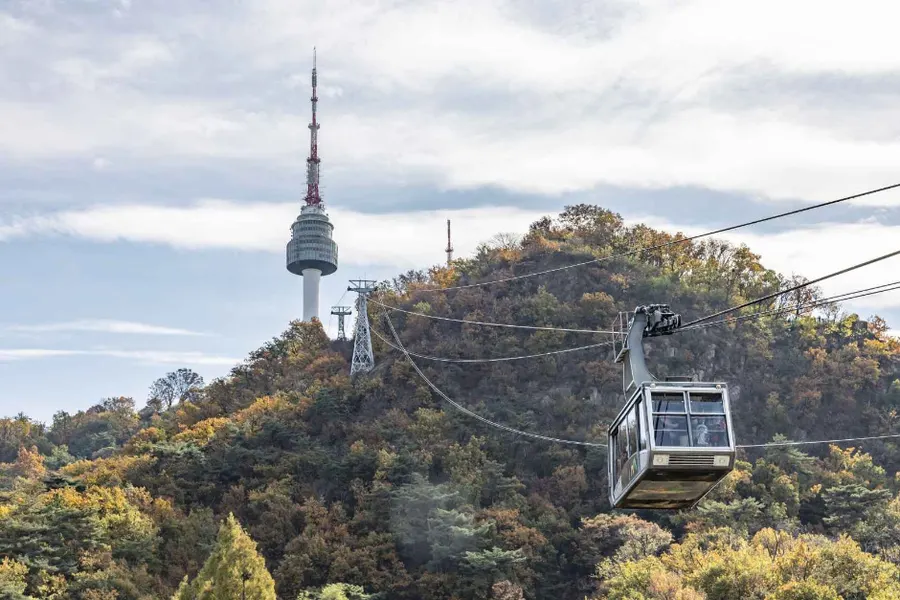
Its value is the short aerial ride, reduced uphill effort, and a view over Namsan—not the removal of every travel step. The current official information lists daily operation from 10:00 to 23:00, but weather, maintenance, and operating conditions can suspend it. Sunset and busy weekends can bring a queue.
Quoting only the roughly three-minute onboard ride is misleading. Add the subway-to-station walk, ticket purchase, waiting, boarding, and upper approach. It is enjoyable when the cable car itself matters and time is flexible. With a long line and a narrow evening, a loop bus may be more reliable.
Should you buy a one-way or return cable-car ticket?
A one-way ascent followed by a walk or bus descent can avoid a second cable-car queue and show another side of Namsan. It works only when the descent route, weather, lighting, and group mobility are already suitable. Do not buy one way and search for an unfamiliar path after dark.
A return ticket is simpler, but downhill demand can concentrate after sunset. Check the current final ticketing and queue before purchase. One way has real route value when dinner or the hotel naturally sits on another side; otherwise simplicity may be worth more.
How do the 01A and 01B Namsan loop buses work?
Current Seoul information in 2026 still directs visitors to the 01A and 01B services from areas including Chungmuro and Dongguk University. Their loops and stop patterns differ, with 01B generally making a shorter Namsan circuit. Routes, intervals, and stop positions can change, so verify them in a live Seoul bus or map service on the day.
Municipal information also treats them as cashless buses requiring an accepted transport card. Read the Korea transport-card guide before boarding. Cash, an observatory QR code, and a cable-car ticket do not substitute for the bus fare.
Which is faster: loop bus or cable car?
The bus can remove part of the uphill walk to the lower cable-car station but is affected by waiting, crowding, and road conditions. The cable-car cabin is quick and scenic, but the approach and ticket queue can be longer. Compare the whole journey from your current location to the summit, not minutes inside the vehicle.
From Chungmuro or Dongguk University, or with an older companion who does not want the Myeongdong slope, the bus often makes more sense. From Myeongdong, when the ride itself is wanted and the live queue is acceptable, use the cable car. You can use one up and the other down.
Can a taxi or private car drive to the tower entrance?
Core Namsan roads restrict ordinary private-vehicle access. Current 2026 municipal notices remind visitors that buses and specifically permitted vehicles are treated differently. A taxi can follow only the lawful drop-off point and route available at that moment; entering the tower address in an app does not create door access.
Drivers should find legal foothill parking and connect by bus, cable car, or walking. Registered accessible vehicles and other permitted categories may have specific arrangements, which must be checked under current official rules rather than assumed from ordinary parking information.
How hard is the walk up Namsan?
Namsan has approaches with different lengths, stairs, slopes, and scenery. It is not a technical mountain hike, but sustained climbing becomes real work in unsuitable shoes, summer humidity, winter ice, or after a full sightseeing day. The word “park” does not make it flat.
If walking is the attraction, allocate ascent, rest, summit, and descent energy as one block. Do not walk through palaces, Bukchon, and shopping first, then treat Namsan as a free shortcut. Travellers who only want night views can use a bus and keep the walking around the summit.
Does the northern circulation trail provide step-free access to the summit?
Seoul promotes parts of the northern circulation road as broad, gently graded paths suitable for wheelchairs and strollers. That does not mean every subway exit connects to the tower without slope, distance, or barriers. The route to its entrance, toilets, and the final section still need separate checking.
For a wheelchair, stroller, or slower companion, the simplest base version is often a loop bus to the summit followed by current elevator and observatory arrangements. If the northern path itself is wanted, begin in daylight and preserve the return. A trail map is not proof that every adjacent facility is accessible.
Daylight, sunset, blue hour, or night?
Daylight: easiest for identifying mountains, the river, roads, and districts. Sunset: dependent on western cloud and the busiest queue window. Blue hour: keeps colour in the sky while city lights appear. Night: gives strong points of light but more glass reflection, concentrated descent traffic, and harder landmark identification.
The reliable first visit reaches the summit 60–90 minutes before sunset, checks the free view, and then decides on T5. This follows the same principle as the Seoul night-experience decision: the best night is not the one with the most viewpoints, but the one that still has a clean way home.
Is the observatory still worth it in poor visibility?
Low cloud, haze, rain, fine dust, and backlight can shorten the view. Higher elevation does not rise above every cloud layer. Tower lighting or city air-quality indicators also cannot replace the live view through a window. Before buying, look for clear distant ridges, the Han River, and building outlines from the summit.
If the scene is flat grey, see the exterior and public area for free, then leave. An indoor observatory may stay open in rain, but its visual return falls. Use the Seoul rainy-day plan for a nearby indoor fallback instead of treating physical arrival as an obligation to pay.
Will glass reflections spoil night photographs?
They can. Interior lighting, phone screens, pale clothing, and people behind you all appear in the glass. Place the lens close without striking the window, disable flash, and shade side light with a hand or dark clothing. These actions usually help more than aggressive filters.
A tripod may be unsuitable in a crowded indoor space and must not block circulation. For an unobstructed tower exterior and summit atmosphere, photograph outside. T5’s advantage is height and directional coverage, not a promise of reflection-free glass.
Are the love locks compulsory?
No. The lock railings are one of the area’s best-known symbols, but looking and taking a photograph are enough. If you choose to add one, use a designated structure. Do not attach it to trees, safety equipment, or an unrelated railing.
Never throw the key down the mountain. A romantic gesture should not become litter or a hazard. Solo visitors, families, and friends who buy no lock still have a complete Namsan visit.
Are the free summit views enough at night?
That depends on whether you want atmosphere or a full panorama. Outside, you can see the illuminated tower, Palgakjeong, lock displays, and selected city directions without an observatory ticket. Trees, buildings, terrain, and crowds block some angles.
T5 offers greater height and more continuous direction. If the outside view already satisfies you, there is no need to follow a standard itinerary into the observatory. If identifying the Han River, major city axes, and distant ridges matters, T5 adds more on a clear day.
How should you budget for cable-car and observatory queues?
They are separate lines. Waiting for the cable car does not reserve tower entry; entering the tower can still involve admission and elevator waits. Weekends, sunset, holidays, cherry blossom, and autumn foliage periods can stack the two delays.
Set a maximum acceptable wait before arrival. If the cable-car line exceeds it, change to bus or walking. If the observatory queue is still too long at the summit, use the free version. Without a switch condition, one purchased ticket can expand indefinitely across the evening.
Does an advance observatory ticket remove the wait?
Advance purchase can reduce time spent selecting or paying, but may not remove security, redemption, timed-entry, admission, or elevator waits. Read the valid date, entry window, QR requirements, child ages, refund rules, and whether a physical exchange is needed.
This guide does not force a ticket CTA because weather and schedule come first. A non-refundable ticket transfers visibility risk to the traveller. If same-day purchase is possible, seeing the summit conditions before committing can be the better decision.
What is the easiest version with children or older travellers?
Use a loop bus to the summit, enjoy the public area, and enter the observatory only when visibility is good. The cable car is short, but the walk from Myeongdong and the waiting area still count. Three minutes in a cabin is not enough evidence that it is the easiest route.
Plan seated breaks, toilets, indoor warming or cooling, and an earlier return. When the post-sunset crowd descends together, a stroller or slower walker benefits from avoiding a last-service mindset.
How do summer, winter, cherry blossom, and foliage seasons differ?
Summer: hot uphill walking, humidity, thunderstorms, and a late sunset. Winter: stronger wind chill, possible ice, and early darkness. Cherry blossom and autumn colour: a richer walking landscape but longer weekend waits for buses and the cable car.
The season changes more than the colour of the image. It changes departure time, clothing, walking safety, and descent. Start a foliage walk in daylight; for a winter night view, shorten stationary outdoor time and do not wait in an exposed area simply to see one more lighting phase.
What should you do in rain, strong wind, or a thunderstorm?
The tower may remain open in light rain while the view becomes weak. The cable-car operator explicitly notes that bad weather can suspend service, and wet trails add slip risk. Lightning, strong wind, or heavy rain are reasons not to force the ascent because a ticket already exists.
Check the tower, cable car, Seoul weather, and bus operation together. One “open” status does not prove the entire journey works. If the cable car stops but buses run, change routes only when outdoor conditions remain safe. When both visibility and access are poor, moving the visit to another day is cleaner.
The descent matters more than the final ten minutes of night view
Choose a primary and backup descent before going up. Loop bus, cable car, and walking use different stops, last-service conditions, and transfers. A path visible in an app is not necessarily suitable in darkness, rain, ice, or the group’s remaining energy.
On a densely scheduled trip, use the packed-itinerary hotel test to protect the ride home. If the next morning starts early, leaving before the final rush is more useful than keeping ten extra minutes of skyline.
Should you add a late Myeongdong meal afterward?
You can, but the descent direction and final kitchen orders matter more than straight-line distance. A cable-car descent naturally connects toward Myeongdong; a loop bus may travel around another side first. Select transport before choosing a restaurant rather than searching across districts from the summit.
If hotel noise, sleep, or next-day energy is already a concern, the Seoul hotel sleep-quality check matters more than one extra night stop. Sunset through night at Namsan is already a complete evening; dinner can remain simple.
Pair it with Myeongdong, Namdaemun, or Namsangol Hanok Village?
Myeongdong: useful for an early meal or post-descent shopping. Namdaemun: suits a daytime market and Hoehyeon-side approach, but its busiest hours are not automatically late. Namsangol Hanok Village: connects more naturally with Chungmuro and the loop-bus side, placing culture in daylight and the tower at dusk.
Choose one pre-summit district. Myeongdong shopping, Namdaemun, the hanok village, a full hike, sunset, and T5 do not all need the same day. Namsan should close a route rather than start a second checklist.
Does a Seoul sightseeing bus let you leave whenever you want?
Different sightseeing-bus products have different boarding rules. Some night routes allow only a short photo stop at Namsan and no independent hop-on or hop-off; daytime loops have their own frequencies and tickets. Do not confuse them with the public 01A and 01B Namsan buses.
If you already hold a sightseeing-bus ticket, check whether you may leave and take a later vehicle. A 30-minute stop normally covers summit photographs, not an observatory queue. It is one attraction on a route, not necessarily a tool for a deep Namsan visit.
Can you bring luggage up the mountain?
It is a poor idea. Crowded buses, cable-car queues, slopes, stairs, and observatory traffic do not suit a large suitcase. Current lower cable-car facilities mention storage such as lockers, but size, availability, and operating hours need a live check. They are not an airport baggage service.
On arrival or departure day, leave bags at the hotel, station, or a reliable storage point first. Saving one hotel return rarely compensates for turning the whole evening into an uphill suitcase trip.
What should you prepare for data, battery, and electronic tickets?
Before ascending, save bus stops, the descent, tower admission, and cable-car details. Night photography, maps, transport checks, and QR tickets use the same battery. If one device carries every group ticket, separation creates an avoidable problem.
Mobile data is valuable for live buses, weather, and the hotel route, not because every image must upload from the summit. Keep key information offline, carry a small power bank, and agree on one downhill meeting point that does not depend on signal.
A low-risk sunset-to-night schedule
Ninety minutes before sunset: reach the chosen foothill transport. Sixty minutes before: arrive at the summit and inspect free views and visibility. Thirty minutes before: enter T5 only if the queue still works. Thirty to forty-five minutes after nightfall: finish the city lights and take the planned descent.
If one step is already 30 minutes late, do not transfer the entire delay to the descent. Remove the lock stop, food, or T5—whichever matters least—and protect the ride home. This schedule is a congestion guard, not a demand to move by stopwatch.
Fifteen checks before leaving
- Decide whether the goal is the summit base or T5.
- Check the visit-date observatory hours and last admission.
- Check current price, age categories, and refund rules.
- Review visibility, rain, wind, and fine dust.
- Budget cable-car and observatory tickets separately.
- Remember that Myeongdong Station still requires a walk to the lower cable-car station.
- Do not treat the Oreumi inclined lift as a summit ride.
- Recheck 01A/01B routes and stop positions live.
- Prepare a transport card for cashless loop buses.
- Do not assume an ordinary vehicle can reach the tower door.
- Count uphill effort and descent energy when walking.
- Set maximum waits for the cable car and T5.
- Choose primary and backup night descents.
- Leave large luggage at reliable storage.
- Save tickets, stops, and the hotel route on the phone.
Final verdict: which version is worth it?
Best value: a first Seoul visit with good visibility, summit arrival before sunset, and a free-view check before deciding on T5. Complete for free: tower exterior, lock displays, summit atmosphere, and partial night views. Do not force it: heavy rain or wind, a tiny time slot, two long queues, or no reliable descent.
N Seoul Tower is not a place where paying proves you visited. The smooth trip buys only the layer it needs from BASE, T5, and ROUTE—and leaves while the city lights are still beautiful rather than after the route has broken down.
Sources and update note
Checked August 23, 2026. Recheck observatory and cable-car hours, prices, final admission, loop-bus routes, maintenance, weather, and vehicle restrictions for the visit date.