
Short answer: Seonyudo Park is worth visiting, but not simply because it has grass and a Han River view. Its real value is seeing how a disused water-treatment plant kept its basins, concrete columns and traces of purification, then turned them into ecological gardens. The park is free and currently opens from 06:00 to 24:00. Allow 60–90 minutes for a first visit. It is particularly sensible from Hongdae, Yeongdeungpo or another western Seoul base; crossing the city just for a generic picnic lawn is harder to justify.
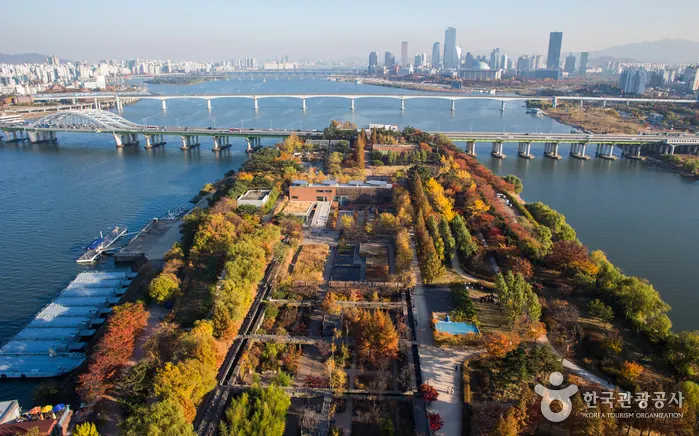
- PLANT: read the old basins, green columns and water-treatment spaces before treating them as photo backdrops.
- PARK: add aquatic plants, woodland and seasonal paths, accepting that blooms and open sections change.
- BRIDGE: reaching the island still involves walking; the station exit, bridge, sunset departure and last train belong in one calculation.
- Best fit: industrial reuse, quiet walking, plants or a route already in western Seoul.
What is Seonyudo Park? It was not designed as an Instagram garden
Seonyudo is an island in the Han River with a park of roughly 110,400 square metres. It was formerly a water-treatment facility, which ceased operating in 2000 before the structures were reused as a park centred on water and ecology. Its aquatic garden, Garden of Time, Green Column Garden, Han River exhibition space and Seonyujeong pavilion are not unrelated decorations. They are different answers to the same question: what can a city do with obsolete infrastructure?
That history explains why rough concrete, regular tanks and dense planting sit together. The pleasure is following spaces once used to process water and seeing how people and plants occupy them now, not finding one compulsory sculpture. In a four-day Seoul itinerary, treat Seonyudo as urban regeneration plus a riverside walk, rather than as another theme park that must fill half a day.
The park is free, but the exhibition hall does not share every hour
Current VISITKOREA and Seoul Metropolitan Government information lists the park as open daily from 06:00 to 24:00, year-round and free to enter; individual programmes may charge separately. Visit Seoul currently lists the exhibition hall from 09:00 to 18:00, shortened to 17:00 in winter and closed on Mondays. An open park does not guarantee an open hall, greenhouse, service desk or every facility.
Arrive in daytime if an indoor exhibition or staffed service matters. For sunset, complete the indoor layer first and leave the outdoor walk for later. A slower five-day Seoul itinerary can place Seonyudo in the late afternoon, but a midnight park closure does not mean the complete visitor experience continues until midnight. Recheck seasonal programmes, maintenance and restricted paths on the day.
Seonyudo Station or Dangsan Station? The exit is not the entrance
The most direct approach is usually Line 9 to Seonyudo Station and the Exit 3 direction. Visit Seoul gives the station-to-park distance as about 782 metres; the official map simplifies it to roughly ten minutes. That still includes streets and a river or bridge approach. Luggage, a stroller, an older companion or summer heat can make the real walk longer.
Dangsan Station serves Lines 2 and 9, and the official map estimates about 15 minutes on foot. It can make sense if the rest of your day is already on Line 2 and a longer walk is acceptable. Neither station opens directly into the park, and seeing the island across the water does not prove that the entrance is beside you. A Korea transport card handles the fare, but you must still verify the open entrance, bridge works and return route in your map app.
Read the former waterworks first, or this becomes an ordinary park
At the entrance, find the official map and locate the former treatment spaces, Garden of Time, Green Column Garden, aquatic plant area and Seonyujeong. The columns reuse an old structure while plants grow around hard concrete; the tanks and gardens recast purification as an ecological display. Look at the spaces before the flowers and the site gains a clear narrative.
A 2025 Seoul Metropolitan Government feature also describes more than 200 plant species in the greenhouse, but species, flowering seasons and indoor access are not daily guarantees. A closed basin or weak bloom does not erase the industrial-reuse story. If that story holds no interest, Seonyudo may honestly feel like a pleasant park that did not require a special journey.
Should you allow 30, 60, 90 or 120 minutes?
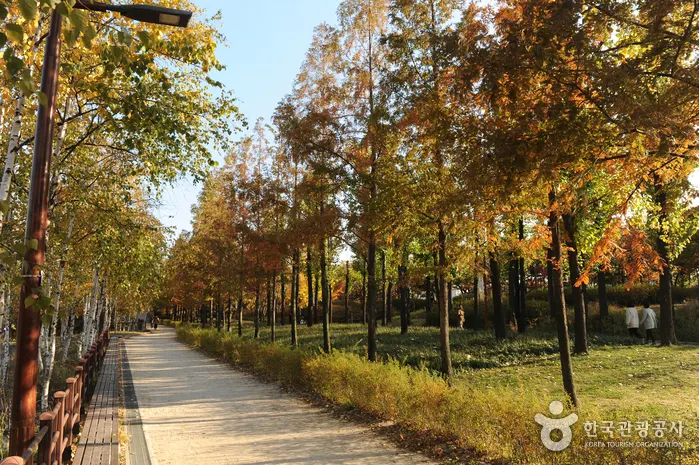
30–45 minutes: walk from the main entrance to one or two core structures and return; this is a compressed version. 60–90 minutes: combine the old works, plant areas, paths and one Han River viewpoint; this is the balanced first visit. Two hours or more: worthwhile only for sunset, slow photography, children’s rest breaks or an exhibition you have confirmed.
Transport is additional. Do not turn “one hour inside” into a one-hour total plan. From a Hongdae accommodation base, the island can connect with Hapjeong, Mangwon or a western Seoul meal. From Gangnam or eastern Seoul, the round trip may exceed your time inside. Ask whether you want PLANT, PARK or BRIDGE; if the answer is merely “a lawn,” compare somewhere closer.
Is sunset or night worth it? Plan the exit, not just closing time
Seonyujeong and waterside points can reveal the Han River, Yanghwadaegyo and a distant urban skyline. Sunset gives the island and bridges clearer silhouettes. Official aerial photographs are useful for understanding the geography, but visitors at ground level will not reproduce the same viewpoint. Trees, haze, works and season alter the view.
A park open until midnight does not mean every small path is brightly lit, every indoor space remains open or every entrance is equally comfortable late at night. After sunset, allow time to cross the bridge, walk to the station, transfer and catch the last train. If the same date contains another evening attraction, use a Seoul evening experience decision to keep one main event instead of chasing sunset twice in different river districts.
Rain, summer heat and river wind: this is not an indoor fallback
The core visit is outdoors: paths, plants, basins and a bridge. Light rain can deepen the colour of concrete and foliage, but heavy rain makes bridges, stone edges and timber surfaces slippery. Summer sun, humidity and insects reduce comfortable dwell time. On a windy day, the bridge and waterfront can feel much colder than nearby streets.
The exhibition hall adds shelter but is too limited in size and hours to carry an all-day wet-weather plan. Protect genuinely indoor options with a Seoul rainy-day plan, then use Seonyudo during a lighter interval. Persistent thunderstorms or strong winds are reasons to reschedule. Because admission is free, cancelling does not waste a ticket.
Families, older visitors and accessibility: a main path is not every path
Visit Seoul lists accessible toilets, paths, information services and wheelchair rental, while official information reserves parking within the park mainly for eligible accessible vehicles. General drivers are advised to consider the Yanghwa Hangang Park car park and must then calculate the real distance from the space to the island.
Several main paths are relatively level, but bridge gradient, turns, individual garden areas, wet surfaces and total distance still matter for wheelchairs, strollers and sore knees. In a four-day Seoul family itinerary, make one or two core areas the success condition rather than requiring children to complete the island. Confirm wheelchair availability, the current accessible entrance, toilets and temporary works directly before travelling.
Bicycles, scooters, pets and food: follow current signs
The official park map asks visitors not to ride bicycles or electric scooters inside for safety. If you arrive by shared bike, park it in an authorised place before the restricted path rather than assuming it can cross every section. Pets should be leashed and their waste collected. Current entrance signs take priority over an old travel post.
The same map asks visitors to avoid bringing food. That wording should not be exaggerated into a legal claim that every bite is banned, but Seonyudo should not be planned as a guaranteed full picnic venue either. Check the entrance and on-site signs before carrying a meal. If eating on grass is the purpose, a nearby Han River park area with clearer picnic rules may be more suitable. Remove or sort all rubbish correctly.
Spring, summer, autumn or winter?
Spring: new growth and flowers return, with cool mornings and evenings. Summer: aquatic plants match the site’s theme, but heat, storms and insects are significant. Autumn: foliage, concrete and river layers photograph well while sunset moves earlier quickly. Winter: structural lines may be clearer and crowds lower, but river wind bites and the exhibition hall closes earlier.
The best season depends on whether you prioritise plants, architecture, temperature or quiet. Do not build a cross-city date around one promotional bloom. Check current conditions if flowers are the only reason. During peak heat, a midday hotel-rest base in Seoul may protect the morning and evening better than forcing two exposed hours on the island.
Seonyugyo is part of the attraction and part of the transport cost
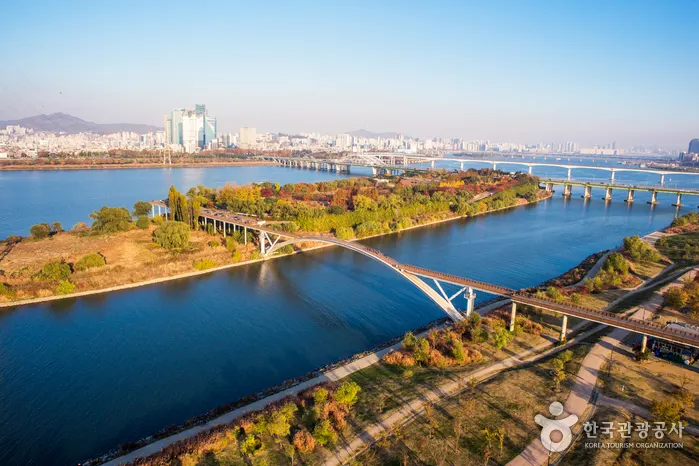
Seonyugyo links the riverbank to the island. Its arch and open water create a stronger sense of entering an island than an ordinary park gate. Looking back from the bridge also helps explain why a water-treatment plant occupied this site. However, the exposed crossing offers little long-term shade. Wind, summer heat or winter ice can alter the visit before you reach the gardens.
Do not block the path for photographs or stray into a cycling line. After dark, waiting for an empty bridge image is not worth missing the train. From a nearby base, bridge and park can fit within 90 minutes. From far away, calculate station walk, crossing and park route separately. Your transport does not end when the train reaches Seonyudo Station.
Seonyudo, Seoul Forest, Cheonggyecheon or Oil Tank Culture Park?
Seonyudo: strongest for a reused water-treatment plant, island scale and bridge approach. Seoul Forest: larger park time and more surrounding food options, useful for families. Cheonggyecheon: centrally placed and easiest to insert between palaces or shopping. Oil Tank Culture Park: also industrial reuse, but centred on large oil tanks, performance spaces and a hillside setting.
A short first Seoul visit does not need all four. Seonyudo fits travellers staying west, interested in water infrastructure or seeking a quiet river walk. If your hotel and every other attraction are east, the park nearer your route will usually be the better decision. Free admission does not make cross-city time free.
Ten checks before you leave
- Do you want to understand the waterworks, or only find grass?
- Have you checked park, exhibition hall and greenhouse hours separately?
- Does Seonyudo Station or Dangsan Station fit the surrounding route?
- Have you allowed a real walk from the subway exit to the island?
- Is this a 45-minute loop, a 90-minute visit or a sunset wait?
- If flowers are weak or one area is closed, is industrial reuse still enough?
- Will rain, heat, wind or the bridge trouble anyone in the group?
- Have you confirmed the needed wheelchair, stroller or rest route?
- Will bicycles, food, pets and photography follow current signs?
- After sunset, is there time to cross, reach the station and transfer?
Worth a dedicated visit: you enjoy industrial heritage, aquatic planting, quiet walking and can spend 60–90 minutes reading the former works. Best as a convenient stop: you stay around Hongdae or Yeongdeungpo and want a free river section in the afternoon. Skip this time: a first Seoul trip has only three or four days, the park is across the city, you only want a picnic, or weather removes the value of the bridge and outdoor paths. Seonyudo matters not because it is a free park, but because Seoul allowed water, plants and people to reuse infrastructure rather than erasing it.
Checked 23 August 2026. VISITKOREA, Seoul Metropolitan Government, Visit Seoul and the official Seoul park map were used for the waterworks history, area, main spaces, address, 06:00–24:00 park hours, exhibition hours, free entry, station distances, parking, accessibility and park rules. Recheck exhibitions, greenhouse access, programmes, plants, works, bridge conditions, entrances and night routes on the visit date.
VISITKOREA | Seonyudo Park Visit Seoul | Seonyudo Park Seoul Metropolitan Government | May Seonyudo Park Seoul Parks | Official Seonyudo map