
Short answer: Seokguram Grotto is worth visiting when Silla Buddhist art, engineered stone architecture or World Heritage matters to you. It is not automatically worthwhile merely because admission is free. The principal Buddha is viewed through protective glass and the interior viewing area is compact; the real cost is travelling beyond Bulguksa up Mount Tohamsan, matching Bus 12 or parking, walking from the car park and returning. Decide through three layers: STONE, GLASS and MOUNTAIN.
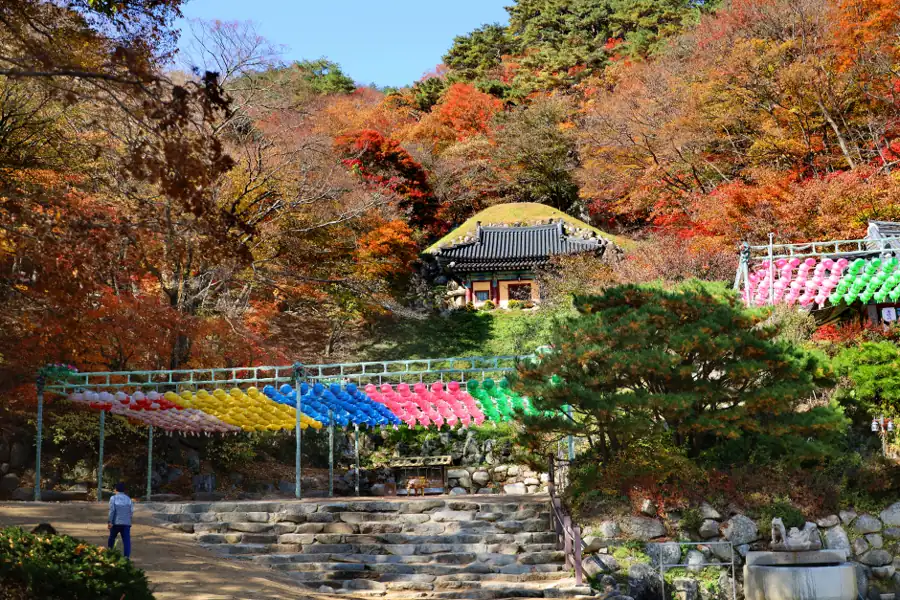
- STONE: this is not a Buddha placed inside a natural cave; it is an eighth-century artificial grotto assembled from precisely worked granite.
- GLASS: the Buddha, bodhisattvas, disciples and guardians are viewed beyond a protective barrier; an official close-up is not the normal visitor angle.
- MOUNTAIN: Bulguksa and Seokguram are about nine kilometres apart by road or three kilometres by hiking trail, before the final walk.
- Best fit: travellers willing to spend roughly 1.5 to three hours for a small space with unusually high historical, artistic and engineering density.
What is Seokguram? It is not a statue inside a natural cave
Seokguram stands on Mount Tohamsan in Gyeongju. Traditional records associate its beginning with Kim Dae-seong in 751 during the reign of Silla’s King Gyeongdeok, with completion in 774; it was then known as Seokbulsa. It entered the UNESCO World Heritage List with Bulguksa in 1995, among Korea’s first World Heritage properties. The two form one historical and religious complex but not one visitor entrance.
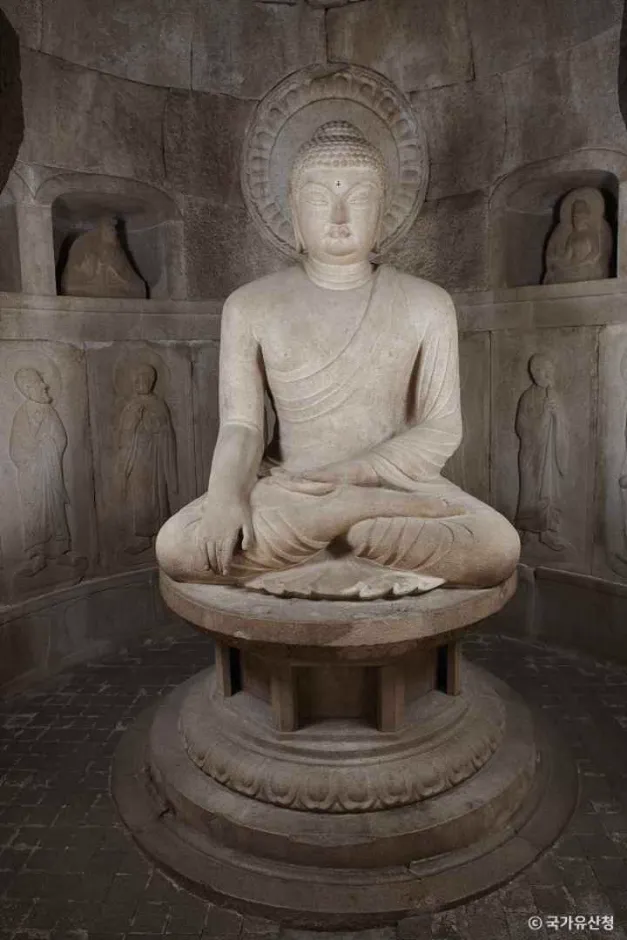
UNESCO describes an artificial granite grotto made from an antechamber, corridor and circular main rotunda, using more than 360 stone slabs. A monumental Sakyamuni Buddha sits at the centre, surrounded by carved devas, bodhisattvas, the Ten Disciples and guardians. In a one-day Gyeongju itinerary, treat it as one concentrated work that requires context, not another temple building to photograph.
If the glass view lasts only a few minutes, why can it still be worthwhile?
Measured only by floor area and time inside, Seokguram can feel inefficient. You reach a fixed viewing position and look into the rotunda through glass; you cannot circulate from sculpture to sculpture like a museum gallery. Yet the density of the work comes from combining sculptural proportion, a Buddhist spatial order, a stone dome and the mountain’s eastward orientation inside a deliberately compressed sequence.
Look beyond “how large is the Buddha?” Notice the calm expression, the earth-touching right hand, the circular halo aligned behind the head, and the way figures encircle the centre. If none of that interests you and you mainly want monumental exterior architecture, the historic centre may be a stronger use of time. Use Gyeongju day trip versus overnight to decide whether this mountain detour belongs in the available daylight.
STONE: what makes the artificial grotto an engineering work?
Many cave sanctuaries in Asia used existing caverns or were cut directly into rock. Seokguram was built on granite terrain from shaped blocks to create an antechamber, narrow passage and circular chamber. Its dome depends on precise placement, wedge-like components and horizontal stone pins to balance weight. It is not merely a conventional masonry room hidden below an earthen mound.
UNESCO recognises it both as a masterpiece of human creative genius and as an exceptional material expression of Buddhist religious architecture. At the site, read the outer mound before entering, then notice the sequence from front room to passage to rotunda. Do not focus so narrowly on the Buddha’s face that the curved chamber, surrounding figures and controlled opening of space disappear.
GLASS: why is the Buddha behind a protective barrier?
UNESCO identifies moisture, condensation, mould, moss and stone weathering among Seokguram’s major conservation threats. Early twentieth-century dismantling and a concrete dome complicated airflow and water behaviour. A second dome and air gap were added in the 1960s, followed by ventilation management, a wooden antechamber and the glass wall that reduces temperature and humidity changes caused by visitors.
The glass is therefore not an arbitrary display case designed to make the experience worse. It is part of the compromise that keeps the sculpture stable enough to survive. The cost is reflection, distance, a fixed angle and crowd pressure. Visit after accepting that constraint; expecting to enter the rotunda, approach the Buddha or reproduce official conservation photography will almost certainly disappoint.
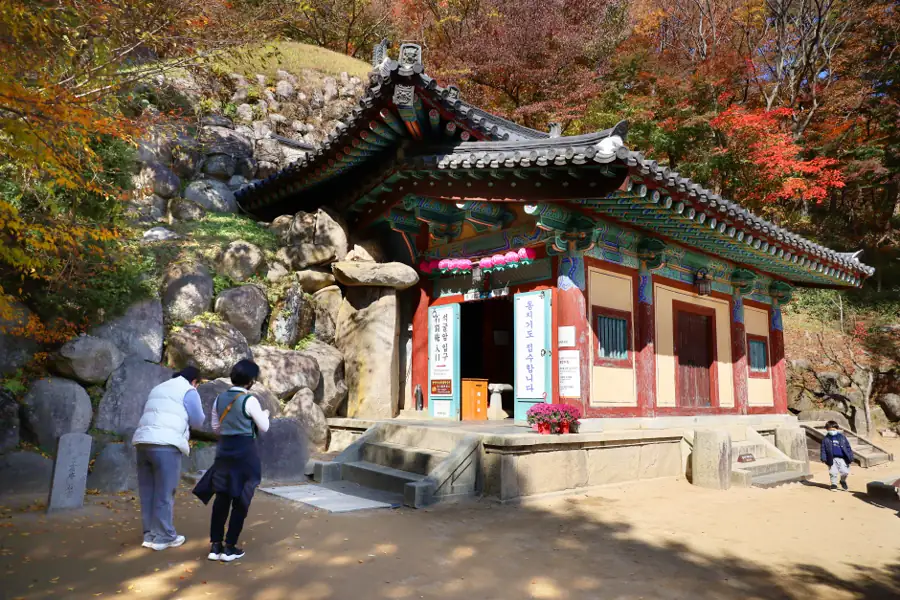
Admission is free now, but old official prices remain online
The live Seokguram visitor page states that admission became free on 4 May 2023 following a revision to Korea’s cultural-heritage law. Some older foreign-language pages from Gyeongju still show an adult price of KRW 5,000. This guide follows Seokguram’s operating page rather than the unsynchronised old listing. Free entry does not include mountain transport or parking, and it does not make every optional service free.
The same live page currently lists parking at KRW 2,000 for small and medium vehicles and KRW 4,000 for large buses. Other tourism pages divide vehicle classes and peak seasons differently, so read the sign on arrival. When using Bulguksa admission and transport, keep each site’s bus, parking and timing separate rather than imagining one combined ticket.
Which opening hours should you trust?
Seokguram’s own visitor page currently gives last entry as 09:00–17:00 from November through January, 09:00–17:30 in February and October, and 09:00–18:00 from March through September. It states that weekdays, weekends and public holidays use the same schedule, the site is open year-round, and pets are not admitted.
VISITKOREA, Gyeongju Tourism and national-park pages presently show hours that do not fully agree, and one distinguishes operating from viewing time. Do not use “18:00” in a search snippet as permission to arrive at 17:55. Maintenance, ceremonies, severe weather and visitor control can also alter access. Check Seokguram’s notice page or call +82-54-746-9933 on the visit date.
Bulguksa and Seokguram form one heritage property, not adjacent entrances
UNESCO and the Kim Dae-seong narrative pair the sites: tradition says Bulguksa was created for his parents in his present life and Seokguram for parents from a previous life. Physical access is different. VISITKOREA puts the mountain trail between them at about three kilometres and the driving route at about nine kilometres. Straight-line mapping hides height and hairpin road distance.
The usual sequence is Bulguksa first, then Bus 12 or a car to Seokguram, followed by a return toward Bulguksa and central Gyeongju. The reverse can work only after solving the early transport. Do not finish Bulguksa and ask whether Seokguram is a ten-minute stroll. Without the next bus already identified, this segment can derail a car-free Gyeongju plan.
How does Bus 12 work?
Seokguram’s access page instructs visitors from central Gyeongju or the terminals to take buses 10, 11 or 700 to Bulguksa and transfer to Bus 12. It says return buses from Seokguram to Bulguksa generally leave on the hour. Recent 2026 public transport data also show the principal daytime service at roughly hourly intervals, with seasonal final departures and a school-day variation.
The useful method is not memorising an annual table. Before getting off at Bulguksa, check the Gyeongju traffic centre or a Korean map for live vehicle position, then save the outbound and return times. Missing a bus can cost an hour, not ten minutes. On reaching the mountain, locate the return stop and verify the last departure before beginning the approach.
Driving up: the twenty-minute winding road is not the final approach
Seokguram’s own directions estimate about twenty minutes by car from Bulguksa up Mount Tohamsan to the car park. Hairpins, tour buses, autumn traffic, fog and road conditions can lengthen that. Motion-sensitive passengers feel the same bends in a taxi or bus; sit forward and plan food or medication if needed.
From the car park, the operating site still estimates about ten minutes on foot to the precinct, with wooded path, incline and some steps. Parking is not step-free arrival at the glass. The return requires walking back, leaving the car park and descending the mountain. If an evening in Gyeongju follows, protect it with a buffer for downhill traffic and the hotel journey.
Is the three-kilometre trail from Bulguksa worth hiking?
VISITKOREA describes a hiking trail of about three kilometres between Bulguksa and Seokguram. This is not a level pavement connecting two ticket gates. It has elevation, seasonal surface conditions and weather exposure. In dry conditions, with hiking shoes, daylight and suitable fitness, it can turn two heritage components into a genuine Mount Tohamsan route.
Do not use it merely to save one bus when wearing city shoes, carrying luggage, accompanying a young child or dealing with knee pain. Check national-park closure, maintenance, fire restrictions and sunset. After the climb you still need to view the grotto and arrange a return. The trail has value as a hike, not as a shortcut.
Allow sixty minutes, ninety minutes or three hours?
Sixty minutes on the mountain: start at the car park, walk both ways, view the core and avoid a long queue. Ninety minutes to two hours from Bulguksa: Bus 12 aligns and you complete the return without missing a service. Two and a half to three hours or more: lose a bus interval, meet peak crowds, walk slowly, hike the three-kilometre trail or add detailed interpretation.
The grotto is compact; the trip is not necessarily short. The largest hidden costs are “the last bus has just left” and the final walk beyond parking. On a one-day visit, do not simultaneously make Seokguram, every central tomb, the museum, Hwangnidan-gil and all night views mandatory. Movement will consume time before the protected interior does.
What should you look for in the principal Buddha?
The Buddha sits on a lotus pedestal, the right hand lowered in the earth-touching gesture and the left resting before the abdomen. The stone halo on the rear wall aligns visually with the head. This is not a detached statue: the passage guardians, Four Heavenly Kings, Vajrapanis, Eight Divine Guardians, bodhisattvas and disciples lead the viewer toward an enlightened centre.
From outside the glass, every figure may not be legible, especially with people in front. Remember three layers—central Buddha, dome, encircling figures—so the encounter does not collapse into a distant statue. Follow the site’s current photography, flash and circulation rules. Do not block the narrow shared view or press equipment against the barrier.
How should you view it when crowded?
Tour groups, weekends and autumn foliage can make the viewing point far busier than the surrounding forest. Read the introduction before entering and decide on three or four elements you genuinely want to recognise. When the sightline opens, look rather than searching a long article on your phone, then move aside instead of occupying the centre indefinitely.
Near opening time is usually calmer than a midday cluster of coaches, but transport becomes the trade-off: Bus 12 may not match the earliest entry, while taxi or car makes it easier. With a one-night Gyeongju itinerary, use Seokguram early on the second day and preserve the evening for the historic centre instead of visiting both at their busiest.
Rain, fog, winter ice and autumn leaves amplify the mountain cost
The interior value does not depend on a distant panorama, but the route does. Dense fog reduces driving visibility, heavy rain makes path and steps slippery, and winter snow or ice can affect buses, cars and the hiking trail. Autumn colour adds beauty while increasing parking and return queues. Normal weather in central Gyeongju does not guarantee the same road surface on Mount Tohamsan.
Bad weather does not erase the Buddha, but it can make the MOUNTAIN cost larger than the STONE reward. Check Seokguram notices, live Gyeongju traffic, national-park routes and a mountain forecast together. If the bus is suspended or the road unsafe, free admission is not a reason to force the ascent.
What should families, older visitors, wheelchair users and pet owners know?
The roughly ten-minute walk after parking, incline, some steps, peak crowds and controlled viewing position create friction for a wheelchair, stroller or painful knees. Ask the site directly about an available accessible route, assistance, wheelchair service and the nearest suitable toilet. A car park does not prove that every metre to the Buddha is level.
Children can engage with a simple task—find the artificial dome, central Buddha and guardian figures—more easily than with a long historical lecture. The current visitor page states that pets are not admitted; ask separately about legally recognised assistance animals. For an older companion, car or bus, a slow core visit and no three-kilometre trail is a complete version.
Where does Seokguram fit on a day trip from Busan or Seoul?
From Busan, first complete the intercity journey to central Gyeongju or Bulguksa, then add the mountain segment. If Busan to Gyeongju transport leaves your first complete attraction near midday, pair Bulguksa and Seokguram as one choice rather than adding every historic-centre sight and night view. A taxi or tour mainly removes hourly bus waiting; it does not buy a closer view of the Buddha.
A same-day return from Seoul needs more restraint. After Seoul to Gyeongju by KTX or bus and the station transfer, one remaining daylight block makes Bulguksa plus Seokguram a deliberate alternative to the central core. Stay at least one night if Daereungwon, Cheomseongdae and Donggung Palace and Wolji Pond are also important.
Twelve checks before leaving
- Do you care about artificial stone architecture and Buddhist art, or only the UNESCO label?
- Will you accept a fixed view of the Buddha through glass?
- Have you rechecked that day’s last entry and any temporary notice?
- Beyond free admission, what will bus, taxi or parking cost?
- Will Bulguksa to Seokguram use Bus 12, a car or the three-kilometre trail?
- Have you saved both outbound and return Bus 12 times?
- Can every companion handle the walk after the car park?
- Will rain, fog, snow, ice or autumn traffic change the mountain road?
- Will you follow the current interior photography and circulation rules?
- What support is needed for children, older visitors, wheelchairs or motion sickness?
- If one bus is missed, does the central itinerary still work?
- After Bulguksa and Seokguram, which single historic or evening block remains?
Worth the special journey: you want to understand how Silla combined granite, sculpture, dome engineering and Buddhist order inside an artificial grotto, and you accept glass viewing. Pair it with Bulguksa: you have 2.5 to four hours for both and have solved Bus 12 or driving. Skip this time: you only want a grand exterior photograph, have no interest in Buddhist art, have one hour left, or mountain conditions are unsafe. Seokguram is small, but understanding STONE, GLASS and MOUNTAIN together is what makes the ascent worthwhile.
Checked 23 August 2026. Seokguram’s live visitor and access pages were used for free admission since 2023, seasonal last entry, year-round opening, pet restriction, parking, Bus 12 and the walk from the car park. VISITKOREA supplied the three-kilometre trail, nine-kilometre road distance and images. Gyeongju Tourism and UNESCO supplied construction history, artificial-grotto structure, protective glass and conservation context. Official pages do not fully agree on hours and parking classification, so recheck admission, buses, parking, maintenance, religious events and photography rules on the visit date.
Seokguram | Hours and fees Seokguram | Access VISITKOREA | Seokguram Grotto UNESCO | Seokguram and Bulguksa