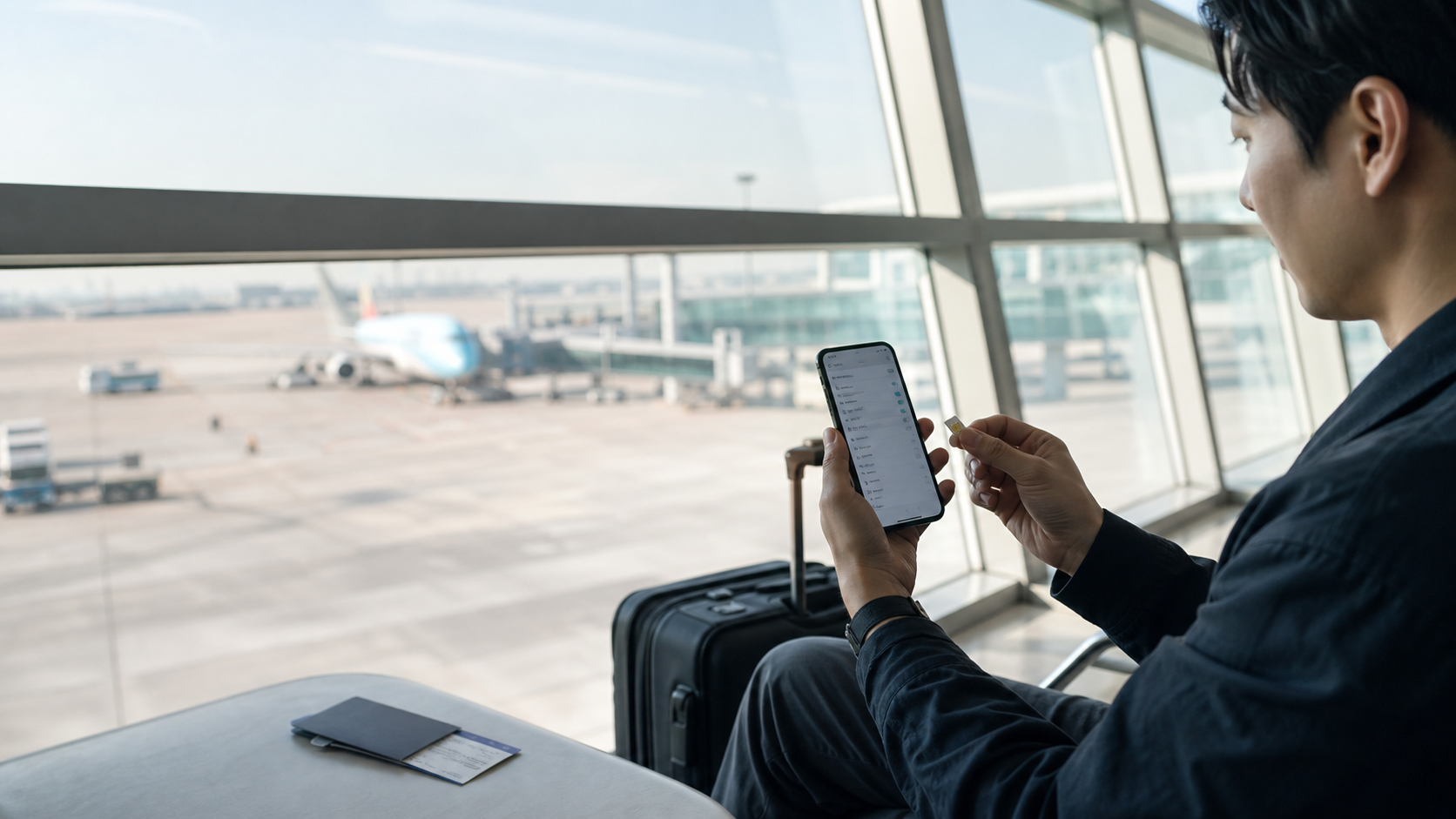
Start with one question: do you really need to keep your original number active? If you need bank OTPs, airline messages, or work calls, usually yes. If you only use internet messaging and do not need emergency account verification, you can keep the original card at a minimum setting. This article is not about whether a Korean phone number is necessary. It is about how to keep two SIMs from interfering with each other once you have decided to keep the original card.
Write down the four roles clearly, and the settings won’t end up as just “on” and “off”
The first role is mobile data: the Korea eSIM. The second is SMS on your existing number: the Taiwan SIM. The third is the default voice line, which is usually best left as your original number. The fourth is data roaming, which the original card must keep off. This seemingly simple setup lets maps, ride-hailing, and messaging run through the eSIM while still preserving the text messages you actually need. Every time you switch cards or restart your phone, it is worth checking the data source again, because system updates, poor signal, or accidental taps can change the setting.
Do not mistake “the original card still has signal” for “it is providing internet.” Signal bars only show that the phone is connected to the number; they do not tell you where data is going. The most reliable check is to take a screenshot of the settings screen before you fly: which SIM is mobile data, which one only receives SMS, and whether roaming on the original card is off. After landing, open maps, send a message, then check usage again. That will reveal problems earlier than guessing.
Once the dual-SIM roles are set, just confirm the activation terms for your Korea data plan.
The most common mistake is turning on your original card’s data just to receive a text
Some travelers see a verification code delayed and immediately turn on mobile data and roaming for the original SIM. That may not solve the SMS issue, but it can start background sync, app updates, and photo backups on roaming data. SMS and data are two different routes. First confirm whether the bank allows overseas SMS receipt and whether the number has international roaming SMS reception enabled, then handle it according to the official rules of the original number. Do not use the data switch as if it were a text-receiving button.
Another situation is the phone’s “allow mobile data switching” feature. It is meant to keep you connected when the primary line’s signal is weak, but while traveling it may switch data back to the original card. If your goal is to control costs, it is better to turn off this automatic switching and keep the Korea eSIM fixed as the data source. If the signal briefly drops, wait a few seconds, manually search for a network again, or follow the troubleshooting order for no signal instead of letting the system make a decision you only discover later.
Different travelers need different safety nets
If you need OTPs, test whether the original number can receive them first. If you use a laptop often, first check whether the eSIM supports hotspot sharing and whether your phone battery can handle it. If you are traveling together but may split up, make sure each person has at least a minimal data connection. These functions do not replace one another. Putting every setting on one phone, one card, or one traveling companion only turns a small problem into a bigger one at night, during transfers, or when venues close.
If this is your first time using dual SIM, rename each card before departure so it is easy to recognize, such as “Taiwan SMS” and “Korea Data.” That is more reliable than remembering the system’s default labels. Also remember to turn off data roaming on the original card, set data roaming for the Korea eSIM according to the product instructions, and save screenshots. Menu placement differs by brand, so follow your phone manufacturer’s official guidance. If compatibility has not been confirmed, go back to the eSIM phone compatibility check first.
If you want to keep your original number for messages, now you only need to check the Korea eSIM’s validity period and data details.
The first three minutes after landing are more effective than resetting every network setting on the spot
After arriving in Korea, first check whether the Korea eSIM is active and whether it is set as the mobile data line, then open maps to test it. Next, confirm that the original card can still receive messages, but data roaming remains off. If you have signal but cannot get online, do not delete the eSIM first; follow the sequence in signal but no data to check the data source, roaming, APN, and network selection. After deletion, you often need to retrieve the installation information again, which makes a reversible mistake much harder to fix.
Also think through the return trip in advance: before or after boarding, switch mobile data back to your Taiwan number and confirm whether the Korea eSIM should be kept or turned off. This is not about managing your phone constantly during the trip. It is about giving the settings a clear beginning and ending. For a full OTP plan, continue to what to do when a bank verification code does not arrive overseas. If the issue is whether you need a local phone number, go back to does a Korea eSIM include a phone number.
Once the setup sequence is clear, go straight to the named product pages instead of letting original-number functions make the data plan harder to choose.
Decide your settings based on the travel timeline, not just by opening every screenshot you find online
The night before departure, finish installation, rename both SIMs, turn off data roaming on the original card, and save the QR code plus screenshots of the original card settings. At the airport or on the plane, there is no need to keep switching data sources. Only after arriving in Korea should the eSIM become the data card, and then test maps, messages, and websites. On the first night, check again that the original card is still only receiving SMS. This timeline separates the times when you need internet from the settings most likely to go wrong, so you are not trying to read unfamiliar menus while carrying luggage.
If you are transiting, do not mix installation and activation. Some plans start their validity period when they connect to the destination network, while other terms differ. Read the product page first, then decide when to turn it on. During a layover, if all you need is the hotel address and the next flight details, there is no need to rush and turn on every data switch. What really matters is knowing which card is currently providing data and which page to check if there is no connection.
Dual SIM is not a premium setting everyone has to use
If your phone does not support eSIM, if your original number does not need to receive messages, or if you know you will only use Wi‑Fi and a simple data card, dual SIM is not necessarily worth the added complexity. The people best suited to dual SIM are those who need Korea data but cannot lose their existing verification codes. Honestly excluding unsuitable settings reduces the chance of a setup that looks more complete but is harder to fix during the trip.
Before splitting up with your travel companions, confirm meeting details and the hotel address with each other. If only one person’s original card can receive important messages, do not make that person the entire group’s only hotspot. Use hotspot sharing limits to decide whether everyone should keep their own data. What dual SIM really gives you is choice: keep important texts on the original number and use the eSIM for travel data, rather than forcing any single card to do everything at once.
Switch back to the right card before and after returning home to finish the setup properly
The easiest part of dual SIM to overlook is not arrival, but the return home. After the plane lands, switch mobile data back to your Taiwan number first, then confirm that the Korea eSIM will no longer be used for data. If you keep the eSIM, label its purpose and validity period so you do not delete it later just because the card name looks unfamiliar. Many reset problems happen because users forget which QR code belongs to which card, or remove settings too early while everything was still working.
If you never received the expected message during the trip, first confirm that the issue is not a bank-side overseas restriction, the app’s verification priority, or a service problem with the original card. Turning every option off and on again only adds variables. Record the failure message, time, original-card signal, and data source, then go back to the OTP troubleshooting page and handle each item in order. That is usually faster than buying a new plan.
Finally, do one minimal test: the original number can receive necessary messages, the Korea eSIM opens maps, and the original card has no data roaming. If all three are true, there is no need to make the setup more complicated for every other hypothetical situation. What travel needs is predictable connectivity, not the highest number of cards shown on your phone.
After setup, do not judge success by the signal bars on the home screen alone. Test once outside the airport, once in the subway, and once with hotel Wi‑Fi turned off to know whether the data card is stable. These short tests save more time than discovering the mistake only when you actually need a ride or need to contact your travel companion.
You do not need to remember every menu name. Before each switch, just ask yourself: what is this card responsible for right now — data, SMS, or nothing at all?
The answer is enough.
More reading
Reduce the risks beyond dual SIM, one by one
Sources and checks
- Apple Support: Dual SIM and eSIM
- Samsung Taiwan: eSIM guide
- Actual menu names and roaming behavior vary by phone model, operating system, and carrier; before departure, follow the official instructions for your device and number.