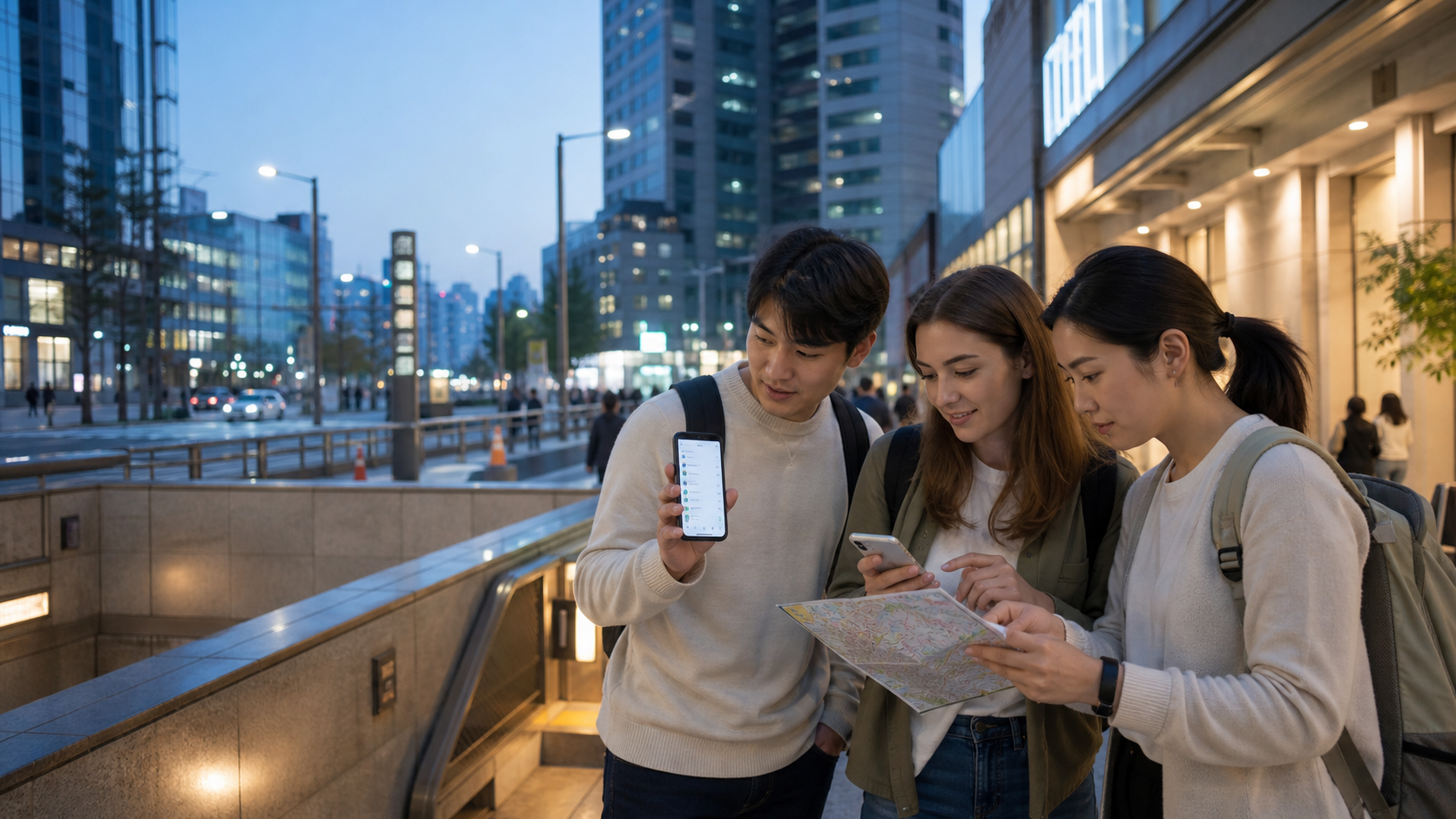
This article will not treat hotspot sharing as a universal fix. It deals with a more practical question: are you really willing to let one phone handle navigation, payment verification, photos, ride-hailing, and everyone else’s internet at the same time? If the answer is “not really,” then separate each traveler’s connection needs first instead of hesitating over the settings screen only after you arrive in Korea.
First, separate three things: the phone feature, the eSIM product terms, and what your trip actually needs
Just because an iPhone or Android phone has a “Personal Hotspot” or “Mobile Hotspot” option does not mean the eSIM you bought automatically allows sharing. Some products explicitly support tethering, some limit it or slow it down, and some do not put the conditions in a very visible place. Before you buy, read the named product page rather than focusing only on the words “unlimited data.” Especially on unlimited plans, fair-use rules, daily high-speed caps, and hotspot policies often matter more than the headline allowance.
The second issue is the phone itself. You can set a Korea eSIM as the mobile data source and turn on hotspot while still keeping your original number active for text messages only. That dual-SIM setup can work, but only if you know which card is handling data and you do not accidentally trigger roaming on your Taiwan number. If you have not sorted that out yet, start with how a Korea eSIM and your original number can coexist; if you cannot miss bank or airline texts, finish the settings for keeping your Taiwan number active first.
If you plan to share data, check the product terms first for hotspot and data restrictions.
Once one person becomes the network hub, the problem is usually not data volume — it’s that the person leaves
Handing the hotspot to one travel companion only makes sense in a fairly narrow set of cases: you move together almost all day, there are only one or two people sharing, everyone’s phone is usually charged, and no one needs to leave early or return late on their own. For example, families leaving the hotel together, a chartered car with everyone in the same vehicle, or short-term tablet connectivity can all reduce the number of SIMs and settings you need.
By contrast, if some people are going to a concert, friends are shopping separately, or different travelers want different cafés, the hotspot becomes a case of “wherever the holder is, the internet is there.” The twenty minutes after a show, when crowds are thickest and subway exits are busiest, is exactly when everyone needs maps, messages, and ride-hailing the most. If one person has already gone into the station while another is still waiting outside, sharing data has no value at all. That is not a cooperation problem; it is simply how trips naturally split up.
So before you decide to make one eSIM the group’s main connection, ask three questions: Who might travel alone? Whose phone runs out of battery most often? Who would lose network access in a way that affects meeting up or safety? If any one of those questions has a clear answer, do not tie that person’s connection to someone else’s phone. For group travel planning, you can next use network division for traveling companions so you do not mistake “we are traveling together” for “we will never split up.”
Hotspot battery drain and heat can turn an otherwise fine phone into a nighttime risk
Turning on hotspot does more than light up another icon. It keeps both the mobile network and Wi‑Fi transmission running at the same time; once other devices start downloading photos, syncing to the cloud, or updating automatically, the sharing phone’s battery and temperature rise faster. You may still look at sixty percent battery during the day, but by dinner time navigation, the camera, and hotspot use together can drain it quickly. A power bank can help, but that also means managing another cable, another battery, and another charging gap.
This matters especially for concerts, winter outdoor queues, and self-driving in Jeju. The first two involve crowds and instant messaging; the last may not need much data until you are already outside the city. If your trip will enter mountain areas, handle battery, meeting points, and return transfers first according to low-temperature connectivity planning for Korea ski resorts. If the phone’s battery health is already poor, do not assume that “buying more data” solves the problem. More data only encourages more devices to use it; it will not add power to your phone. If you are comparing fixed data against high-usage needs, read the real trade-offs of unlimited-data eSIMs first, then decide whether hotspot access is actually necessary.
If you only plan to let a companion check maps occasionally, compare the plan length and terms for a small-data option first.
Laptops, tablets, and a second phone: what you may need is not “everyone has internet”
Writing hotspot needs as “travel companions need internet” is too vague. If the goal is to let a child use a tablet in the car, let someone handle one work email, or occasionally transfer files from a camera, short-term sharing can make perfect sense. But if the plan is hours of video calls every day, uploading content, livestreaming, or using a laptop as the main workstation, a phone hotspot should not be treated as a guarantee. Beyond data consumption, there is also battery life, heat, signal location, and the product’s usage rules; any one of them can leave you forced to find Wi‑Fi right when stability matters most.
If your trip includes video calls, VPN use, or work deadlines that cannot be interrupted, instead look at dual-network setup for laptop work while traveling in Korea and test hotel Wi‑Fi and the phone hotspot first before setting a fallback threshold.
Likewise, do not connect everyone to the hotspot just because they might use it. First list the devices and time periods that truly need internet: evenings in a hotel with Wi‑Fi do not count, and waiting time at the airport with internet available does not count either. What should be counted is the need during movement, outside attractions, and last-minute itinerary changes. That is much closer to reality than simply multiplying your trip length by a rough data estimate. If you have not estimated daily usage yet, start with how much data maps, short videos, and cloud sync actually use.
The backup worth preparing is one that still lets anyone complete the first leg after leaving the hotspot
Even if you eventually decide to share data, do not leave the other travelers with no way to function once they are away from the hotspot. At minimum, save the hotel address, meeting point, next stop name, and emergency contact as offline screenshots; also download offline maps and agree that if the group gets separated, no one has to rely on live messages to find the next meeting place. The point is not to turn everyone into a leader, but to avoid one dead phone bringing the whole group to a halt.
If you only want to provide short-term backup for one travel companion, hotspot sharing is fine. If everyone will move independently, giving each person their own eSIM is often simpler. It does not need to be the highest-data or most expensive version, only enough for navigation, messaging, and occasional ride-hailing. For the full order of choices for Korea eSIMs, go back to the KoriNavi eSIM guide; if you already know the trip length, use the validity calculator to avoid buying too much or too little.
Use hotspot as a temporary tool, not a way to concentrate every risk on one person
The most practical approach often sits between “everyone buys their own” and “the whole group uses only one.” If two people are traveling together and the daytime schedule overlaps closely, one person can use their own eSIM and share it with a tablet. But if each phone has its own basic plan, then when people split up to shop, visit different attractions, or one returns to the hotel early, no one has to find the other person first. That avoids waste from over-committing to absolute independence, while also avoiding the mistake of putting meeting points, transportation, and emergency messages on the same device just to save a little money.
If you want to save data, start with behavior: download offline maps in advance, turn off automatic photo backup, keep streaming for hotel Wi‑Fi, and remind everyone not to auto-update while sharing. These steps are more controllable than forcing a bigger plan, and they do not sacrifice the communication ability you actually need. On the other hand, if you already know you will shoot a lot of short videos, upload work files, or help a child use a tablet for long periods, be honest and count that need into your plan. Data is not being “used up by someone”; your itinerary simply requires it.
Also, before turning on hotspot, set the network name and password on the phone first so you are not entering them in a rush on a platform, in a crowd, or beside a taxi. Do not reuse a password from your accommodation lock or bank account; you can also turn off automatic join afterward to keep unknown devices from connecting. These are small steps, but they keep sharing within a controllable range: it serves a specific leg of the trip instead of quietly becoming the only lifeline for everyone’s entire journey.
If you have already decided that everyone will connect separately, check the Korea product page for validity and data conditions now.
Do one final reverse check: if the phone holding the hotspot suddenly powers off, can everyone else still know the next stop, the hotel, and the meeting time? If the answer is no, add offline information or an independent plan now. That is not extra worry; it is closing the gap that is hardest to fix once you are already on the road.
Further reading
Break “sharing” into the next practical decision
Sources and checks
- Apple Support: Set up Personal Hotspot
- Samsung Taiwan: Galaxy Mobile Hotspot setup
- Whether an eSIM can share a hotspot, and its data and speed limits, depends on the plan; always use the current terms on the named product page before paying.
If a travel companion has children, a stroller, or may need to handle luggage separately, hotspot sharing should not be the only setup. See how to divide eSIM use for family travel in Korea to split meeting points, navigation, and backup contact duties among different people.