
Short answer: Bukchon Hanok Village is worth visiting if you treat it as a neighbourhood where people still live, not an all-day outdoor photo studio. Separate three ideas before you go: VILLAGE, RED ZONE and ROUTE. Bukchon is the wider historic district; the Red Zone around Bukchon-ro 11-gil has a visitor window of 10:00-17:00 and prohibits tourist entry from 17:00 until 10:00 the next morning; your route should cover only what you can walk quietly within that window. A first visit works best after 10:00 with 60-90 minutes for rooflines, alleys and one legitimately open hanok. Trying to collect every famous view usually adds crowding without adding much understanding.
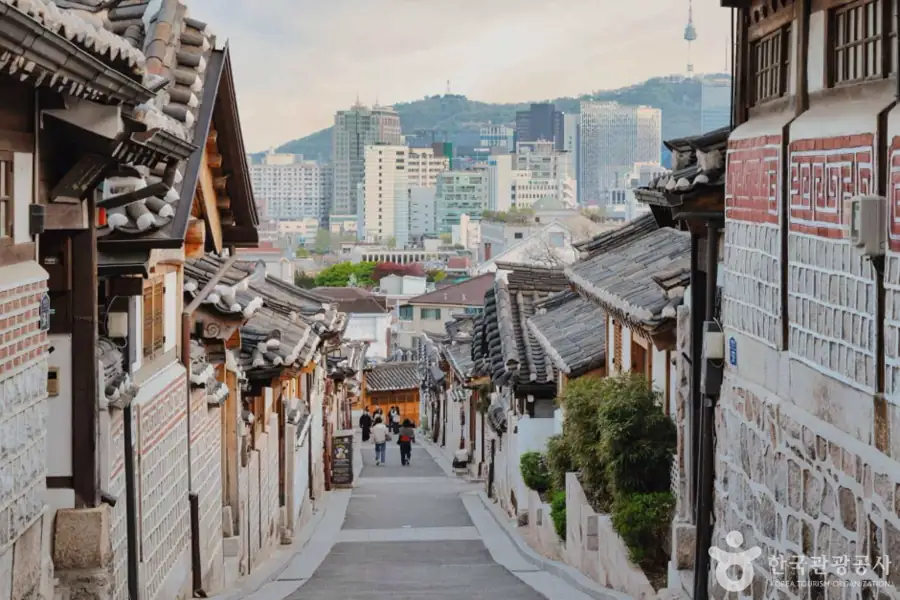
- VILLAGE: a mixed living district between Gyeongbokgung and Changdeokgung, with homes, workshops, cultural spaces, cafés and newer buildings.
- RED ZONE: the high-pressure residential area around Bukchon-ro 11-gil; tourist access is 10:00-17:00, with entry prohibited outside those hours.
- ROUTE: allow 60 minutes for one main line, 90 minutes for a public hanok as well, or two to three hours for interpretation, craft and one adjoining district.
- Best for: visitors willing to walk hills and observe architecture quietly, rather than stage a loud or equipment-heavy shoot.
What is Bukchon Hanok Village? It is not a relocated period set
Bukchon sits in Seoul's old urban core between Gyeongbokgung, Changdeokgung and Jongmyo. Its name refers to the “northern village” above Cheonggyecheon and Jongno. The district contains hundreds of hanok, but what you see today is not one museum collection from a single date. Private homes, public cultural buildings, workshops, guesthouses, restaurants, tea rooms and renovated properties coexist along ordinary streets.
That mixture is the point. Bukchon shows how urban hanok continue to function inside a contemporary capital, rather than how a preserved palace compound looked at one moment in history. When placing it in a four-day Seoul itinerary, reserve a quiet walking block and choose one interior that explicitly welcomes visitors. An open residential door is not an invitation, and the absence of a ticket booth does not make every courtyard public.
How does the Bukchon Red Zone restriction actually work?
Seoul designated parts of Bukchon as a Special Management Area in response to the effect of heavy tourism on residents. The Red Zone covers roughly 34,000 square metres around Bukchon-ro 11-gil. Tourist entry is prohibited from 17:00 until 10:00 the following morning, which makes 10:00-17:00 the practical visitor window for this specific zone. Guidance began in November 2024, and enforcement with a KRW 100,000 fine began on 1 March 2025.
This does not mean that “all of Bukchon closes at 17:00,” nor is there one park gate that locks. The restriction concerns visitor entry into a defined residential zone. Residents, essential access and the operating rules of businesses are separate matters. If your walk is approaching 17:00, do not hurry deeper into the zone for one final photograph. Turn towards Samcheong-dong, Anguk or another clearly unrestricted public street with enough time to leave before the visitor window ends.
Red, orange and yellow: why the whole district does not have one rule
The official management map uses red, orange and yellow areas, but the colours do not impose identical controls. Red identifies the most heavily affected residential area and carries the defined visitor-hour restriction. Orange receives more intensive visitor guidance, while yellow is subject to closer monitoring. A headline saying “Bukchon has restricted hours” is therefore not a reliable substitute for reading the current map.
Businesses, cultural facilities and streets outside the Red Zone may have their own opening hours and access conditions. Do not copy the 10:00-17:00 window onto every museum, café or alley in the wider district, and do not assume an evening business reservation authorises a walk through a restricted residential lane. Treat the zone boundary and each venue's hours as two different checks.
How will you know when you are inside the restricted area?
Look for current signs, ground markings, visitor-management staff and the official map at junctions around Bukchon-ro 11-gil. A navigation app can lead you to an address but may not warn you at the exact management boundary, especially if an older blog route sends you through a small side lane. Save the official English map before leaving your hotel rather than saving only the pin for a popular photograph.
When signs and an old itinerary disagree, follow the signs. If you are uncertain after 17:00, remain on a clearly public outer street and ask at a staffed facility instead of testing how far you can enter. The fine is not the only reason to turn around: the restriction exists because residents were dealing with tourist noise and traffic at the beginning and end of their day.
What is the best time to visit Bukchon?
If the dense hanok lanes around Bukchon-ro 11-gil are your main purpose, a weekday from 10:00 to about 11:00 is the most useful compromise. It is inside the legal visitor window but often precedes larger midday groups. Arriving at 09:00 for an empty photograph does not create an exception. You may eat breakfast outside the zone, review the map or visit a facility with separate early hours, but you should wait until 10:00 before entering the defined Red Zone.
From late morning, narrow viewpoints and junctions become busier. The afternoon is convenient for combining a tea room, workshop or palace, but your route should already be moving outwards rather than deeper into the residential area. Weekends, public holidays, blossom season, autumn foliage and special hanok events can all increase pressure. On those dates, one clean one-way route is better than repeatedly walking back through the same lane.
Getting there from Anguk Station: the exit is only the beginning
Official visitor information lists Bukchon Hanok Village at 37 Gyedong-gil, Jongno-gu. Anguk Station on Line 3 is the normal public-transport approach, and Visit Seoul places the reference point about 516 metres from Exit 3. That number reaches the neighbourhood reference area; it does not mean you are already standing at the highest roofline view when the distance counter ends.
The walk includes crossings, inclines, stone surfaces and different possible entrances. A sensible first stop is the area around Bukchon Cultural Center, where you can orient yourself before choosing Gyedong, Gahoe-dong or the Samcheong-dong side. Start measuring your walking time when you leave Anguk, not when you finally reach the first photogenic eave. A route described as “one hour in Bukchon” can easily take longer if it excludes the climb and station approach.
A 60-minute route: do one thing well
With only an hour, use a one-way line: Anguk Station, the Bukchon Cultural Center area, one principal Gahoe-dong hanok lane, then exit towards Samcheong-dong or back towards Anguk without retracing every branch. This version excludes a long café queue, an unreserved workshop and a hunt for every former “Eight Views” marker. Its advantage is that you can leave the Red Zone calmly instead of still heading uphill near 17:00.
If you are wearing hanbok, the 60 minutes should not include choosing clothes, hairstyling, the return walk to the rental shop and changing back. Use the Seoul hanbok experience guide to budget the rental process separately. Count the Bukchon walk only after you are dressed and ready. A long skirt, unfamiliar shoes and repeated photo stops will make the same map slower than it looks.
A 90-minute route: add one hanok that is genuinely open
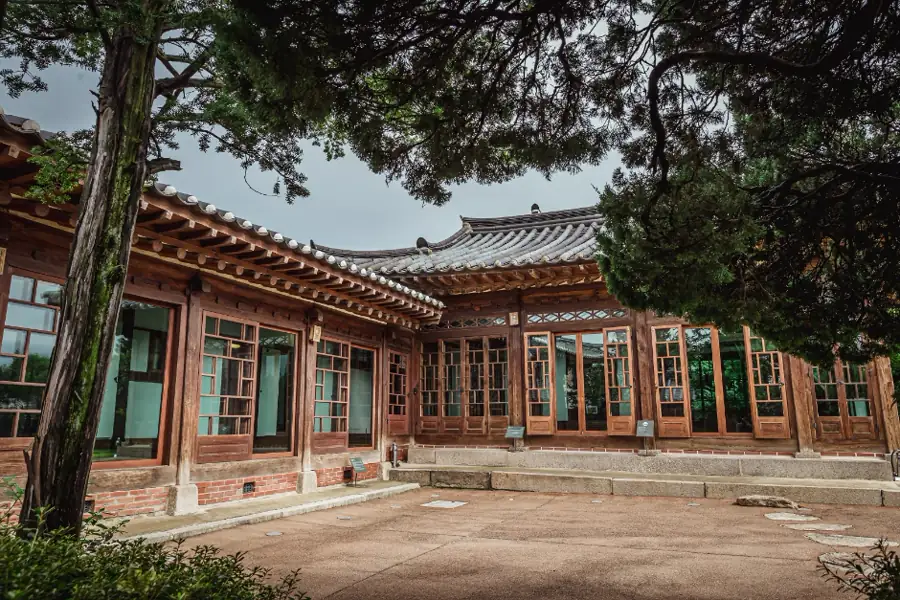
The most balanced first visit combines a main residential walking line with an explicitly public property such as Baek In-je House. First observe eaves, walls, gradients and the relationship between low roofs and the city skyline. Then use a public house to see how courtyards, rooms and circulation work without peering through a resident's doorway.
Baek In-je House is at 16 Bukchon-ro 7-gil. VISITKOREA currently lists 09:00-18:00, last entry at 17:30, closure on Mondays and 1 January, and free admission. Exterior access and reserved interior interpretation may follow different procedures, so confirm the current official schedule and reservation requirement. Do not treat an old travel post as proof that a specific indoor tour still accepts walk-ins on your date.
A two- to three-hour route: add interpretation, not more doorways
With a half day, an official-style walking line can connect Unhyeongung, Bukchon Cultural Center, Gyedong and Gahoe-dong, then continue towards Jeongdok Library, Baek In-je House or Samcheong-dong. Two to three hours should include reading, a public interior and perhaps one craft or tea stop. It should not mean lingering in the same residential lane for three hours while successive groups stage photographs.
Choose one theme to deepen: urban architecture, traditional craft, tea culture or one palace. If you enter every shop simply because it has a hanok façade, most of your visit becomes retail browsing and the neighbourhood itself disappears. A single interpreted interior often explains more than five similar-looking exterior lanes.
Photography and “silent tourism”: quiet is more than lowering your voice
Visit Seoul describes Bukchon as a residential area and asks visitors to keep noise down, avoid microphones, megaphones and speakers, travel in small groups of no more than ten, and not litter. It also specifically warns against photographing or filming the inside of homes, even when a door happens to be open. A resident opening a gate to enter does not temporarily turn the interior into a public exhibit.
Do not extend a phone, camera or selfie stick over a wall. Do not lean on gates, sit on doorsteps, ring bells, block garage access or ask a resident to wait until your shoot finishes. Large tripods, outfit changes, repeated takes and amplified instructions belong in a location that has agreed to host a shoot. In a narrow living lane, take a brief photograph from a lawful public position and keep moving.
What should you look for in a hanok streetscape?
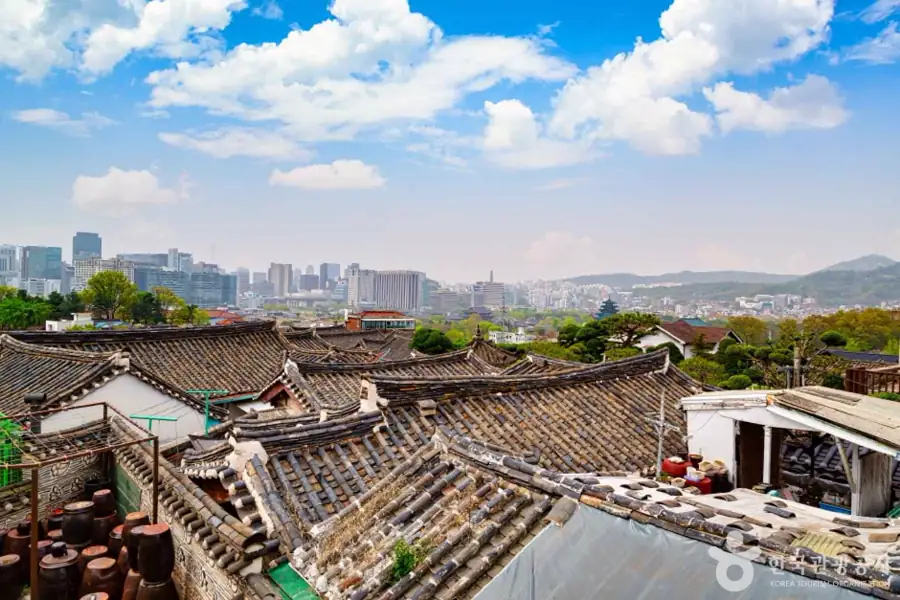
On the climb, notice layers of curved tiled eaves, the way walls and gates protect courtyards, and how roof heights follow the slope. From higher points, low hanok roofs sit against Namsan, towers and contemporary apartment or office buildings. That contrast between inherited urban form and the present-day capital explains Bukchon better than trying to identify “the oldest house” by its exterior.
Do not estimate a building's age or the resident's identity from its façade. Many Bukchon properties have been repaired, reconstructed, adapted or converted in modern times. A traditional-looking elevation does not guarantee an untouched historical interior. If architectural history matters to you, spend time in a cultural centre, museum or interpreted public hanok where evidence is available.
Is Bukchon a good place to wear hanbok?
Hanbok and hanok can make a coherent picture, but Bukchon has more slopes, uneven stone and narrow residential lanes than a palace courtyard. Long hems, raised shoes, summer heat, rain and winter ice all change your pace. If photography is the priority, shorten the walking line rather than trying to lift a skirt, manage a bag and complete every viewpoint.
Use the which Seoul palace works best with hanbok guide to choose the main setting first. If free palace admission, the rental return deadline and a palace shoot already fill the day, give Bukchon one 60-minute one-way segment. Hanbok does not grant access to private homes and does not exempt anyone from the Red Zone hours.
Families, older travellers, wheelchairs and strollers: where should you shorten?
Bukchon is not a level pedestrian mall. The most familiar views require uphill and downhill walking, while side routes may include steps, uneven paving, narrow turns and traffic. A stroller being technically usable on one main road does not make every branch comfortable. Wheelchair users should plan around gradient, pushing assistance, accessible toilets and verified entrances rather than assuming the whole named district has one accessibility level.
A family version can be Cultural Center area, one main lane and a seated tea room or public hanok. Older visitors should put the climb in the cooler, higher-energy part of the day and preserve a downhill exit. In a four-day Seoul family itinerary, Bukchon works best as a cultural walk that can be shortened immediately, not as a locked three-hour hill assignment.
Rain, heat and snow: is Bukchon still worth it?
Bukchon is primarily an outdoor street district. Hanok roofs do not turn it into an indoor attraction. Slopes, stone steps and drainage edges can be slippery in rain, while umbrellas collide easily in narrow lanes. Wet roofs can look beautiful, but a resident's porch is not a public rain shelter and a doorway should remain clear.
In summer, the Red Zone visitor window overlaps with the hottest part of the day, so reduce climbing, carry water and use one legitimate indoor cultural stop. In winter, early darkness, wind and ice justify a shorter line. During sustained heavy rain, switch through the Seoul rainy-day plan to a museum or reserved indoor experience. Keeping an original photo schedule is not worth a fall or a crowded lane of umbrellas.
Food, toilets and luggage: residential lanes are not a service concourse
Anguk, Gyedong, Samcheong-dong and Insadong contain cafés, tea rooms and restaurants, but each has its own opening days, queue, seating and toilet policy. The central residential lanes should not be treated like a park furnished with public benches, water stations and toilets at every turn. Plan a staffed facility or paying venue for your rest rather than improvising on somebody's wall or doorstep.
Leave large luggage at your hotel or a verified station facility before climbing. Dragging a suitcase through narrow lanes is uncomfortable, noisy and obstructive. Eat, reorganise camera equipment and repack purchases in a business that permits it or a clearly public space. Fire access, garage doors, stairs and resident entrances must remain open even when a viewpoint is crowded.
Taxi, car and charter bus: not every vehicle rule is the same
Bukchon's roads are narrow, steep and limited in waiting space. For a first visit, Anguk Station and walking provide the clearest route. A taxi can drop a traveller with mobility needs at an appropriate outer road, but it should not be asked to wait in a residential turn or squeeze into a small lane. Driving adds parking and one-way-road decisions without removing the core walking requirement.
The Seoul notice also defines a roughly 2.3-kilometre charter-bus restricted area along Bukchon-ro, Bukchon-ro 5-gil and Changdeokgung 1-gil. Enforcement began on 1 January 2026, with fines starting at KRW 300,000 and increasing for repeat offences. This rule concerns charter buses; it should not be rewritten as a ban on every city bus, taxi or private car. It does, however, mean that large groups should not expect a coach to deliver them directly to a residential photo lane.
Should you combine Bukchon with a palace, Insadong or Samcheong-dong?
Bukchon lies between Gyeongbokgung and Changdeokgung, which tempts visitors to add both palaces, Insadong, Samcheong-dong and every hanok lane to one day. Choose one main palace. Changdeokgung connects naturally with Gyedong and craft stops; Gyeongbokgung connects naturally with Samcheong-dong and the Jeongdok Library side. Bukchon then becomes an afternoon transition rather than a third full monument.
Insadong is useful after the residential walk for food, shopping or bad-weather flexibility. If you are wearing hanbok, check the actual conditions in the hanbok free palace entry guide before assuming one outfit creates free access everywhere. Finish one coherent palace-and-neighbourhood line instead of zigzagging across Jongno to collect benefits and photographs.
What should you do after 17:00?
When the Red Zone visitor window ends, leave the defined residential area. Do not keep circling nearby lanes because a café somewhere in the wider district remains open. Continue to Insadong's main streets, a clearly operating Samcheong-dong business, a palace with a separately scheduled evening opening, or return to your accommodation.
Choose a genuinely evening-appropriate destination through the Seoul night experience decision guide and keep Bukchon in the daytime. “Fewer people after dark” is precisely the logic the restriction is designed to prevent. An empty-looking lane can still contain residents who are eating, resting, returning home or preparing for the next day.
Are a craft class, tea session or guided walk worth adding?
If you genuinely want to understand hanok or traditional craft, one hosted indoor activity can add more than five extra exterior lanes. Workshops may require reservations and can differ in language, minimum age, duration, collection time and whether the finished object can travel. A hanok café is a business, not automatic permission to explore every room or photograph other guests.
For a guided walk, choose a small group that understands the current boundary, uses no amplification and does not promise access to private homes. Compare guided, craft and self-guided options in the Seoul experiences guide. The neighbourhood itself is free, so visitors who do not want a paid activity can still have a complete visit by walking one route respectfully.
A 15-point checklist before you leave
- Is your main purpose streetscape, a public hanok, craft, tea or photography?
- Have you separated the Red Zone around Bukchon-ro 11-gil from the wider district?
- Will you enter the Red Zone only between 10:00 and 17:00?
- Have you saved the current official zone map rather than only a photo pin?
- Are you choosing 60, 90 or 120-plus minutes?
- Did you include the uphill walk from Anguk Station in that time?
- Is Baek In-je House or another interior actually open, and is a reservation required?
- Will your group remain small, quiet and free of amplified sound?
- Will you avoid filming inside homes, crossing walls, leaning on gates and blocking doors?
- Do your hanbok shoes, return deadline and walking pace match the hills?
- Can a stroller, wheelchair user or older traveller exit early on the chosen route?
- Is there an indoor alternative for heavy rain, heat or ice?
- Have you left large luggage at a verified facility?
- Are you combining only one palace or one adjoining district rather than all of them?
- Is your after-17:00 destination outside the restricted residential area?
Make a dedicated visit: if you want to understand how hanok remain part of a modern city, can walk for 60-90 minutes quietly and will add one formally open interior. Visit while nearby: if you are already going to Changdeokgung, Gyeongbokgung, Insadong or Samcheong-dong and can use one one-way route within 10:00-17:00. Skip it this time: if you can arrive only after 17:00, cannot manage hills and have not identified an accessible line, or want an equipment-heavy shoot that occupies a residential lane. Bukchon is free and requires no compulsory ticket. Its real cost is time, legwork and respect for the people who live there.
Sources and date-sensitive details
The Special Management Area, enforcement dates, fine and charter-bus control come from Seoul Metropolitan Government. Residential etiquette, small-group guidance, amplification ban and home-interior photography warning come from Visit Seoul. Address, access, free neighbourhood entry and Baek In-je House details come from VISITKOREA. Zone boundaries, management measures, venue opening, interior reservations and business hours can change; recheck them on the visit date.
Seoul Metropolitan Government | Bukchon Special Management Area Visit Seoul | Bukchon Hanok Village VISITKOREA | Bukchon Hanok Village VISITKOREA | Baek In-je House