
Short answer: when you search for a Seoul family room, the biggest mistake is treating the word Family as if it were a standardized room type. It is not. One hotel can use Family Twin for a three-person room with one large bed and one smaller bed; another can use Family Queen Queen for two larger beds; a Residence Family can add a living area, kitchenette and washing machine. Before paying any family-room premium, translate the label into six concrete facts: maximum occupancy, exact bed sizes, the children’s real ages, extra-bed or crib rules, whether there is genuine separation inside the room, and whether one bathroom will bottleneck the whole family in the morning. If the Family room gives you no extra bed, no extra separation and no practical ability you will use every day, the name alone is not worth paying for. If your real question is specifically how two adults and two children should sleep—four singles, two larger beds, bunks or a Residence—go straight to the Seoul family room for four. S023 handles the earlier decision: how to decode the room label before you compare hotels.
30-second decoder: when you see “Family,” ask which family product it actually is
| Common room label | First thing to verify | Most common wrong assumption |
|---|---|---|
| Family Twin | One large + one small bed? Three singles? Another layout? What is the real occupancy? | Assuming “Family” automatically means 2 adults + 2 children |
| Family Queen Queen | Actual queen-bed dimensions, children’s ages and the current occupancy rule | Assuming two large beds work for four just because the booking system accepts four |
| Family Room | Exact room name, beds, floor area, bathroom and any extra living space | Treating a marketing category as a standardized room type |
| Residence Family | Whether this exact room really includes living area, kitchenette, washing machine and separated sleeping space | Assuming every room in a Hotels & Residences property has Residence equipment |
| Family Suite | What “Suite” actually adds: living room, second bedroom, or only extra floor area | Paying a suite premium without gaining usable separation |
This is not an official hotel-industry dictionary. It is a practical conclusion from how real Seoul hotels currently use these labels: Family Room does not carry one definition that you can transfer from property to property. Even inside the same hotel, Family can sit on very different products. The safest habit is not to memorize what a label “usually” means. Build your own six-column decoder and fill it again for every exact room.
This matters especially for three travelers. A Family Room can look more reassuring than a Triple Room, but a three-person stay succeeds or fails on the third sleeping place, luggage and bathroom flow. Use the Seoul triple-room checklist first if the group is really three people, then come back and ask whether the Family Twin premium buys anything useful.
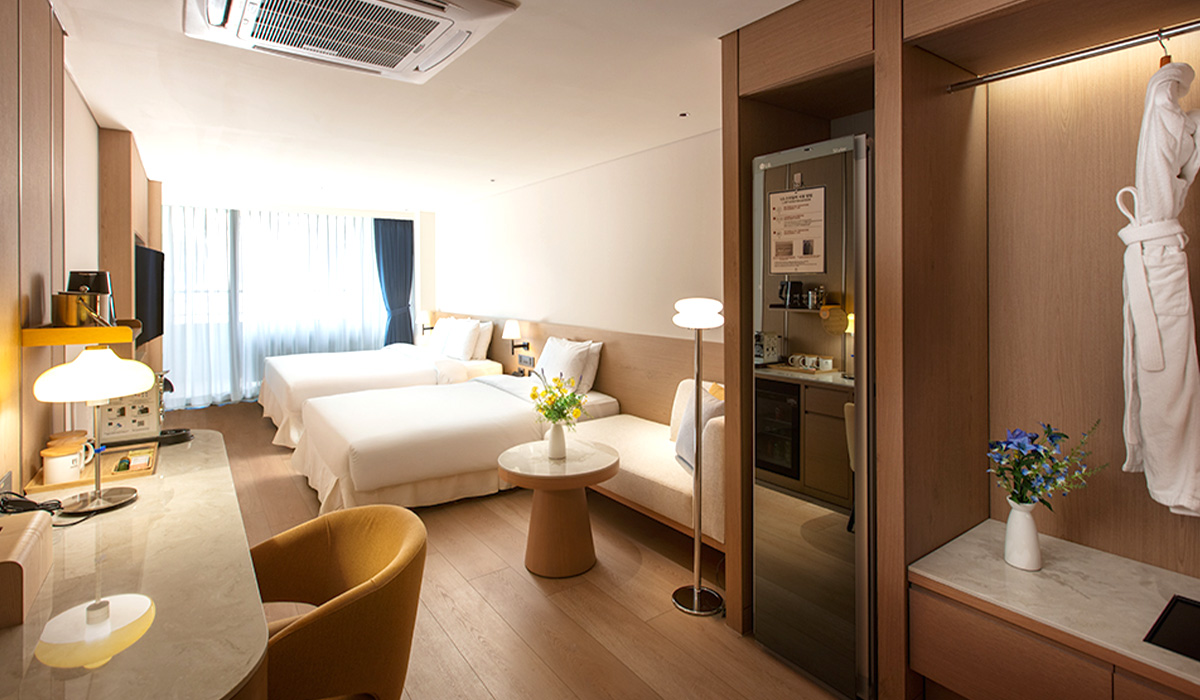
Hotel PJ exposes the first myth: a Family Twin can simply be a three-person room
Hotel PJ Myeongdong currently lists its PJ Signature Family Twin at 39 m² with one 200×200 cm bed plus one 120×200 cm bed, and a capacity of three people. The hotel also lists a Deluxe Family Twin at 39 m² with one 200×200 cm bed plus one 100×200 cm bed, again with capacity for three.
The point is not that “Family Twin means three people.” Other hotels can—and do—use the label differently. The useful lesson is the opposite: the word Family has not done the occupancy work for you. For two adults and one child, a large bed plus a smaller proper bed can be a very clean arrangement. For two adults and two children, booking from the Family Twin name alone would be a mistake because the label does not create a fourth approved sleeping position.
If your group is genuinely three people and Hotel PJ’s bed structure looks right, continue to the Hotel PJ Myeongdong decision page to check Euljiro 4-ga, Gwangjang Market, luggage and how the hotel fits your evening route. If four people must stay behind one door, return to the family-room-for-four decision instead. Those are different search intents and should not be solved by the same label.
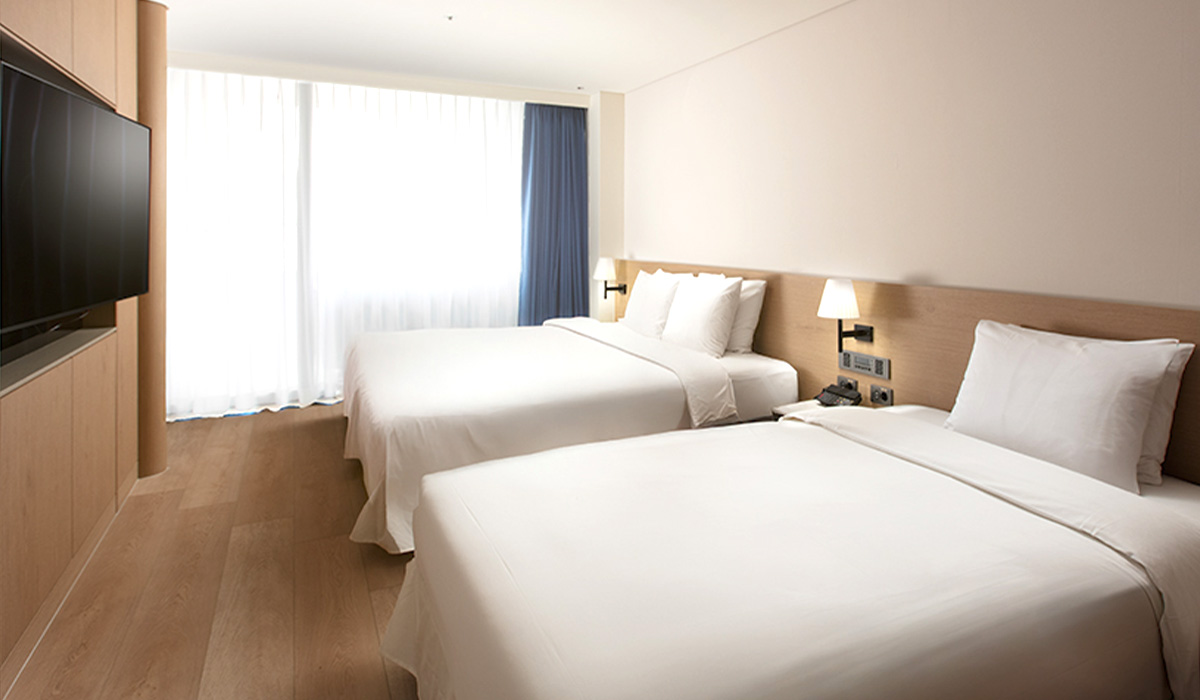
Novotel is even more useful: “Family” can mean 28.6 m² or an 80.9 m² Residence in the same hotel
Novotel Ambassador Seoul Dongdaemun currently sells a hotel-room product called Family Twin. Its official information lists 28.6 m² and describes double-bed plus single-bed configurations. The current room page also says an extra bed can be added for a fee, while a baby crib is listed as complimentary for children up to 24 months when requested at reservation. That is a familiar Family Room logic: solve the extra sleeping position inside a normal hotel-room footprint.
The same property also lists Residence Premier Family 1 Bedroom – 1 Double Bed & 1 Bunk Bed at 80.9 m². The official room information adds a separate living area, kitchenette, washing machine and dedicated workspace. Both names contain Family, but they are not the same product tier and they do not solve the same problem. The Family Twin mainly solves the bed layout; the Residence Family also buys separation, longer-stay infrastructure and room-based living time.
That gives you a much better question than “is this a family-friendly room?” Ask instead: do I need a third proper sleeping place, or do I need somewhere to keep the lights on, sort clothes and eat after one child has gone to sleep? If three people are staying briefly and will barely return during the day, a large Residence may be expensive unused space. If a child naps, the stay lasts five or six nights, laundry matters, or the family needs simple food preparation, the separation can become a real daily benefit. Only after Dongdaemun already fits the itinerary should you move down to the Novotel Ambassador Seoul Dongdaemun review.
Moxy gives a third answer: sometimes “Family” simply describes two large beds
Moxy Seoul Myeongdong’s current official rooms page explicitly talks about a family room in Myeongdong and also mentions its Four Quad Bunk product. Marriott’s official gallery lists Family Queen Queen, Double Double, Queen and Single Loft and Quad Bunk among the room images. The hotel is a useful reminder that even after the property and neighborhood are fixed, the phrase “family room” can still lead to very different sleeping structures.
A Family Queen Queen can be efficient for a family that already sleeps comfortably as two pairs. You avoid four separate bed footprints and may preserve more useful floor space. But if the children are older and do not want to share, two queen beds do not become four independent beds because the word Family is in the room name. The official gallery proves that the room label and room imagery exist; it does not prove that a particular 2+2 party with specific child ages will be accepted on your dates. Run the final search using the exact ages and exact room product.
If your evenings will repeatedly use Myeongdong, continue to Moxy Seoul Myeongdong and evaluate its location, room use and sleep trade-offs. Do not reverse the process and move the entire trip to Myeongdong merely because one Family room looks appealing.

Is the Family Room upgrade worth it? Name the new ability you are actually buying
The room label becomes most persuasive when a Standard room and a Family room are only a little different in price. Booking pages make the upgrade feel obvious: you are traveling with family, therefore the room called Family must be the safer choice. That logic is too weak. A useful upgrade normally adds something concrete: one proper bed, a real third sleeping surface instead of a sofa bed, a door that separates sleeping and living areas, enough floor to open luggage, a second sink or bathroom, or a living area that lets a nap coexist with the rest of the family.
If the Family Room is only a little larger but keeps the same bed structure, same bathroom and same one-room bedtime problem, the price difference buys comfort margin rather than a new capability. That can still be worth paying for, but call it what it is. This is also why one family room versus two rooms remains a separate decision. If the real problem is a second bathroom or a door that lets one person sleep while another stays awake, a larger single Family Room may never solve it.
A useful rule is to complete the sentence: “I am paying extra because this room lets us ______ every day.” If the blank stays vague—“feel more family-friendly,” “have a nicer category,” “maybe be more comfortable”—do not let the label rush the upgrade.
Put the child’s real age into the booking flow; “one child” is not enough information
Family-room rules often change meaning when child age is added. The same two adults plus one child can describe a baby using a crib, a school-age child who needs a proper bed, or an older child who may be counted differently under a property’s rules. Hotels, room types and booking channels do not use one universal child policy. A review saying “2 adults + 1 child was fine” cannot be copied into your booking unless the age, room and terms match.
If the child is still in the baby or toddler stage, layer in the Seoul hotel guide for babies and toddlers. Crib confirmation, nap returns, feeding-prep infrastructure and nighttime care can change whether a Family Room upgrade is useful. The word Family is not a substitute for those operational details.
This is also why a baby crib should be treated as a request or room-specific condition unless the hotel explicitly confirms it for your reservation. A room can be marketed to families while still requiring advance crib confirmation or having only a limited number available.
The bathroom and luggage are the two bottlenecks most easily hidden by bed photos
Room marketing naturally emphasizes beds because they photograph well. The harder part to see is how three or four people move during the morning. If there is one bathroom and one sink, everyone may need the same space for showers, toilet use, teeth, hair and getting dressed. Ten extra square metres of floor area may not help much if the whole family still queues at the same door.
Luggage creates the second bottleneck. A Family Twin can add a proper extra bed while taking away the patch of floor where a suitcase would otherwise open. Queen Queen uses two larger beds efficiently, but you still need somewhere for two large cases. A Residence has more room, yet you may be paying for kitchen infrastructure you will never use. The useful question is not simply “how many square metres?” It is where do the suitcases go after all required beds are in position?
If early sleepers, noise or different routines are a hard constraint, add the Seoul hotel sleep-quality check. A Family Room can solve bed allocation and still fail on corridor noise, HVAC, room orientation or what the other people in the room do after lights-out.
Do not let a rare Family Room choose the neighborhood for you
Family inventory is usually more limited than ordinary double rooms, which can create a reverse decision. You finally find a room that appears to hold everybody, then start convincing yourself that its district must also be convenient. That is backwards. First make the room pass the occupancy, bed, age, bathroom and luggage tests. Then put the hotel back onto the map and see whether the location serves the repeated parts of your itinerary.
If the district is still open, return to the Seoul family hotels decision hub. If the family is specifically stuck between Hongdae and Myeongdong, use the Hongdae vs Myeongdong family-base test to decide where the likely hotel return happens. A brilliant Family Room in the wrong base can make the whole group commute an extra segment every day.
Named-hotel examples should come after that decision. Hotel PJ, Moxy and Novotel solve different combinations of beds, room time and location. None of them should become the default simply because its website uses the word Family.
When comparing prices, do not treat different Family labels as the same product
The same hotel can show different translated room names across Booking.com, Agoda, Trip.com and the official site. More importantly, Family Twin, Triple, Family Queen Queen and Residence Family are not interchangeable even when the prices happen to sit close together. Keep the dates, adult count, children’s exact ages, breakfast inclusion and cancellation deadline constant, then compare the precise beds and occupancy for each product. If one column differs, you are not comparing the same room.
If dates or travelers may still change, use the Seoul hotel cancellation and payment guide to decide where flexibility actually matters. If breakfast is the extra charge making one Family room look expensive, separate that decision with the Seoul hotel breakfast test. Family-room pricing is already complicated enough; do not mix different beds, different meal plans and different cancellation rules into one “nightly price” comparison.
Do not compare a Residence package with a standard Family Twin only because both are visible under the same property. One may be selling room-based living infrastructure while the other is mainly selling a third proper bed. The right price question comes only after you identify which problem you are buying the room to solve.
Verdict: a Family Room is not “a room suitable for families.” It is a room name that still needs translation
Two adults + one child: a Family Twin can be an excellent fit, but confirm that the third sleeping place is a proper bed and that the room really is designed for three on your dates. Two adults + two children: never infer four-person occupancy from the Family label; compare the actual four-person bed structures instead. Different child bedtimes: a living area, closable separation and bathroom flow matter more than the word Family. A small upgrade over Standard: name the specific daily ability you gain. If you cannot, do not upgrade yet.
Keep one sentence in mind before payment: do not ask “is this a family room?” Ask “for this hotel, this date and these exact ages, how many people, how many real sleeping places and how many usable spaces does this room name actually buy?” Once you can answer that, the price comparison finally becomes meaningful.
Sources and verification
- Hotel PJ — PJ Signature Family Twin: 39 m², one 200×200 cm bed + one 120×200 cm bed, capacity 3. Rechecked 2026-08-20.
- Hotel PJ — Deluxe Family Twin: 39 m², one 200×200 cm bed + one 100×200 cm bed, capacity 3. Rechecked 2026-08-20.
- Novotel Ambassador Seoul Dongdaemun — Family Twin: 28.6 m²; official description includes double-bed + single-bed configurations. Current page lists a paid extra-bed option and a complimentary baby crib for children up to 24 months when requested at reservation. Rechecked 2026-08-20.
- Novotel Ambassador Seoul Dongdaemun — Residence Premier Family 1 Bedroom: 80.9 m², 1 Double Bed & 1 Bunk Bed, living area, kitchenette, washing machine and workspace. Rechecked 2026-08-20.
- Moxy Seoul Myeongdong — Rooms: current official room page uses “family room” wording and mentions Four Quad Bunk. Rechecked 2026-08-20.
- Moxy Seoul Myeongdong — Photo Gallery: official gallery lists Family Queen Queen, Double Double, Queen and Single Loft and Quad Bunk. Gallery labels are not used as proof of exact age-specific occupancy.
Room names, child-age rules, occupancy, beds, extra beds, cribs, breakfast, cancellation terms, rates and inventory can change by date, room product and sales channel. Before payment, search with the real travel dates and the children’s actual ages, then recheck the exact room name and current terms on the hotel or booking page.