
Short answer: when searching for a Seoul family room for four, do not begin with the largest floor area or an OTA filter that says “4 guests.” First confirm where two adults and two children will actually sleep, whether the children are comfortable sharing a bed or using an upper bunk, whether four people will collide around one bathroom in the morning, whether one sleeper needs separation for naps or early bedtime, and whether the room’s four-person limit really applies to your children’s ages. Four single beds are the clearest sleep plan but usually give you no separation. Two double or queen beds use space efficiently, but only if your family genuinely accepts 2+2 bed sharing. A double plus bunk bed gives children distinct sleeping places but raises a new question about bunk-bed suitability. A Residence with a separate living area can solve different routines, but it also costs more and can pull you into a district that may not fit the trip. This S022 guide is specifically about which four-person room product a family of four should buy. It is not a rewrite of the two-kids, two-routines decision, and it is not a generic list of every room in Seoul marketed for four guests.
30-second room-type split: choose the sleeping structure before the hotel
| Room structure | Best fit | Main trade-off |
|---|---|---|
| 4 single beds | Both children sleep independently and the family has similar bedtimes | Everybody gets a bed, but usually in one shared space |
| 2 double / queen beds | Your family already sleeps comfortably as two pairs | Capacity for four does not mean everybody enjoys bed sharing |
| Quad bunk / bunk beds | Older children want separate sleeping surfaces while you preserve floor space | Upper-bunk suitability, age and the children’s willingness need a separate check |
| Double + bunk + living area | Different bedtimes, naps, longer stays or substantial daytime room use | Usually more expensive, and an excellent room cannot rescue the wrong district |
| 2 rooms | Older children, heavy morning bathroom pressure, or a real need to close a door | Keys, room assignments and any adjacent/connecting arrangement need management |
The table is a product filter, not a hotel ranking. Booking systems often encourage families to enter “2 adults + 2 children,” see a room appear, and treat that as proof that the room is a good family room for four. It proves only that the system is willing to sell that product to the selected guest profile. It does not tell you whether the four sleeping places are acceptable, whether the bathroom works for your morning, or whether everybody can still use the room after the suitcases are open.
If you have not yet decided between one four-person room and two rooms, start with one family room or two rooms in Seoul. S022 assumes you are leaning toward keeping the family behind one door. Only then does it make sense to compare four singles, two doubles, bunk beds and a Residence as different products.
Four single beds remove the most guesswork—but they buy beds, not a second room
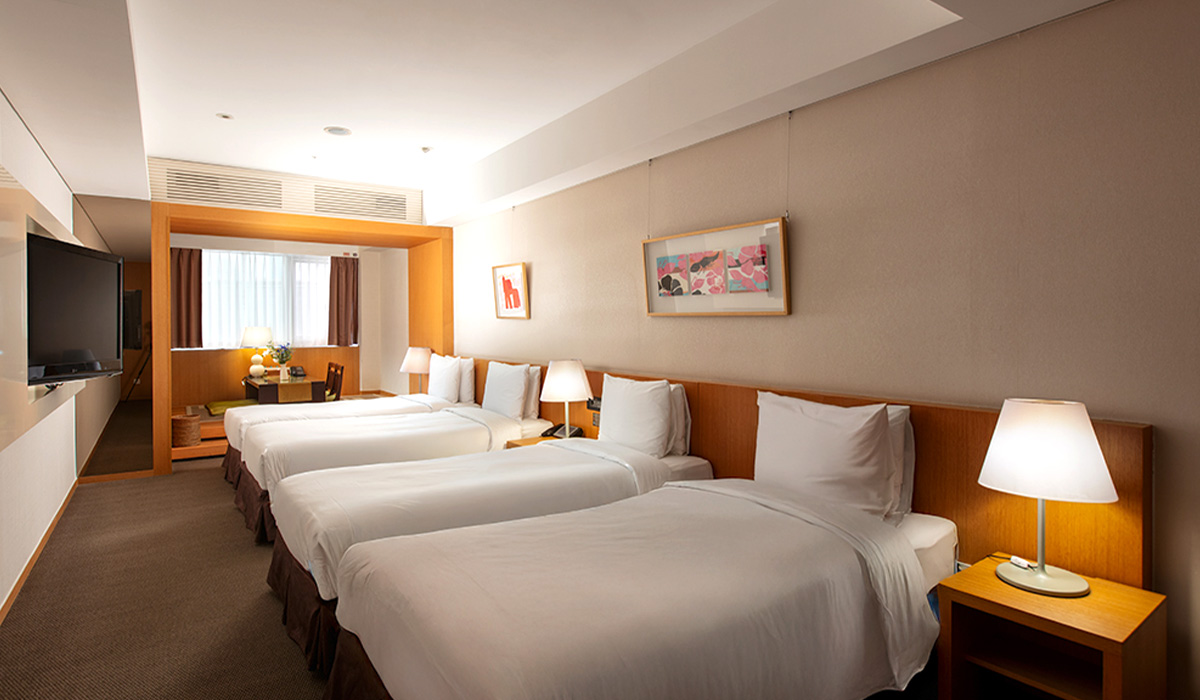
Hotel PJ Myeongdong currently lists its Premier Quad at 56 m² with four 100×200 cm single beds and capacity for four guests. For a family room, that is unusually easy to understand. Two parents and two children do not need to negotiate who shares a double or whether a sofa bed is a real sleeping solution. All four sleeping places are defined before arrival.
The limitation is just as clear. Four beds are still in one room. If one child goes to sleep at 8:30 p.m. while the other stays awake until 10 p.m., the early sleeper can still hear the hairdryer, conversation and tomorrow’s packing. A larger room does not grow another door. That timing problem is why the Seoul hotel guide for two children exists separately: four proper beds solve bed allocation, not two different family routines.
If Hotel PJ’s four-bed logic fits, move down to the Hotel PJ Myeongdong decision page and check whether Euljiro 4-ga, Gwangjang Market, luggage and your evening return route fit the itinerary. A room can pass the bed test and still fail the location test.
Two double or queen beds look simple; the hard condition is that your family already accepts that sleep plan
Two double or queen beds are one of the most space-efficient ways to create a family room for four. The hotel does not need four separate bed footprints, so there is often more usable floor for luggage. Four Points by Sheraton Josun, Seoul Myeongdong currently states that its Myeongdong rooms include options accommodating up to four guests. Its official gallery includes a Double/Double Premier guest room. Moxy Seoul Myeongdong’s official gallery likewise includes Family Queen Queen and Double Double room images.
The danger is not a lack of beds. It is that the person booking silently decides how everybody will share them. If your family naturally splits 2+2 between two larger beds, this can be much more efficient than paying for four singles. If the children are older, move heavily in their sleep, or simply do not want to share, “capacity four” is a booking-system answer rather than a sleep-quality answer. A short stay does not make an uncomfortable bed-sharing arrangement disappear.
If central interchange flexibility matters, continue to Four Points Josun Myeongdong and check the Euljiro 3-ga return pattern and exact room product. If the family will repeatedly use Myeongdong at night, compare Moxy Seoul Myeongdong. Neither property should be chosen simply because a four-person room exists; the room has to work inside the district you will actually use.

Moxy proves the problem inside one hotel: “family room for four” is not one room type
Moxy Seoul Myeongdong is useful because it exposes the category problem without changing the hotel, brand or neighborhood. Its current official room page promotes a family room in Myeongdong and “Four Quad Bunk” for larger groups. The official photo gallery lists Family Queen Queen, Quad Bunk and Double Double among the room images. Even after fixing the same hotel, a family of four can therefore face completely different sleeping structures.
Family Queen Queen makes sense for a family comfortable sleeping as two pairs. Quad Bunk uses vertical sleeping positions, preserving more of the floor for luggage and movement. That can be attractive for older children who want separate beds, but a good-looking bunk photo does not answer whether your younger child is suitable for the upper bunk, whether nighttime care is easy, or whether the exact room is available for your children’s ages. Marriott’s marketing language does not give a universal “best age” for the upper bunk, so the safe approach is to verify the current room terms and ask the hotel if anything is unclear.
If the family is also travelling with a stroller, do not stop when the room works. Add the stroller hotel test: elevator exit and the last 500 metres. Saving effort inside the room is less valuable if every return requires an awkward station exit or repeated detour at street level.

A double plus bunk bed and a living room belongs to another price tier: you are paying for separation and living infrastructure
Novotel Ambassador Seoul Dongdaemun currently lists a Residence Premier Family 1 Bedroom – 1 Double Bed & 1 Bunk Bed. The official room information gives 80.9 m², and the hotel describes a separate living area, kitchenette, washing machine and dedicated workspace. This product is not simply “another room for four.” It tries to solve a different problem: parents and children have distinct sleeping surfaces, while the living area gives the family somewhere to remain awake, eat, sort clothes or prepare for the next day.
That separation becomes valuable when one child naps, one sleeps earlier, or the family will spend several afternoons in the room. A washing machine and kitchenette can also matter on a longer stay. But the upgrade should be earned by the itinerary. If every evening ends in Hongdae and the family barely uses Dongdaemun, paying more for an excellent Residence can create a new transport cost every day. Continue to Novotel Ambassador Seoul Dongdaemun only when Dongdaemun and the central-east side of Seoul already fit the trip.
Do not assume bunk beds automatically make it a children’s room. Check whether the exact sleeping arrangement works for your children, whether any current age or safety condition applies, and whether your selected product accepts the full party. A hotel’s family-oriented description is useful context, not permission to skip the booking terms.
The children’s ages can turn the same four-person room from obvious to impossible
A four-person family room is a product for a specific guest profile, not a mathematical box. Two children aged six and eight may be perfectly happy with two bunks or two separate singles. A toddler and an older school-age child may need a crib, an adult nearby, and a completely different nighttime arrangement. If one child is still in that younger stage, layer in the Seoul hotel guide for babies and toddlers before treating any four-person room as solved.
Always run the final search using the children’s real ages. Do not copy another family’s booking result because “2 adults + 2 kids” looks identical in a sentence. Child occupancy, bed sharing and crib rules can change by property, room type and booking channel. The correct comparison is the exact date, exact room name and exact guest ages.
One bathroom can be the real reason to reject an otherwise excellent four-person room
Families naturally focus on beds because sleeping capacity is the easiest condition to see on a booking page. Yet the morning often fails somewhere else. Four people may need the toilet, showers, teeth, hair, clothes and packing within the same 45 minutes. A 50 or 60 m² room with one bathroom can still feel slower than two smaller rooms that let the family prepare in parallel.
Before paying a large premium for floor area, map the busiest morning. If everybody leaves at the same time, ask whether the room gives you any concurrency. If the answer is no and the children are old enough for a split arrangement, go back to one family room versus two rooms. Two rooms are not automatically an upgrade; they are a way to buy another door, another bathroom and a different morning rhythm.
Floor area matters only after you place four sleepers and the luggage
A room-size number by itself is weak evidence. Four single beds consume more floor than two doubles. Bunks may preserve the center of the room. A separate living area can create a usable place after bedtime even when the bedroom itself is not huge. What matters is the space left after the actual room product has been furnished and your family has opened the suitcases.
Use photos to understand circulation, not to infer a different room type. Hotel galleries mix categories, and a hero image may show the largest or most distinctive product. The exact room name, bed configuration, occupancy and current terms should stay visible while you compare. If a platform page makes the room structure vague, confirm it before payment rather than assuming two similarly named products are equivalent.
Breakfast and cancellation terms get expensive faster when four people are attached to one room
Once the room accommodates four, a small per-person condition becomes a larger family cost. A breakfast-inclusive rate may cover a different number of guests than you expect. A cheaper non-refundable room can create a larger loss if the family’s flights, school calendar or child-related plans are not fully fixed. Compare the same room, same date and same guest ages before deciding that one offer is cheaper.
Use the Seoul hotel breakfast decision to decide whether the family will actually use breakfast, and the hotel cancellation and payment guide when the trip still has moving parts. The four-person room should not be considered a bargain if the family is paying for inclusions it cannot use or accepting a risk it cannot absorb.
Once the room works, only then ask whether Myeongdong, Dongdaemun or another district is the right base
Families sometimes become so relieved to find a room that genuinely accepts four people that they accept any location. Scarcer room inventory can reverse the decision process: instead of choosing a hotel for the trip, the room product starts choosing the district for you. Resist that. First make sure everybody can sleep; then make sure the district supports your daily return-to-hotel pattern, evenings and departure.
If the shortlist is concentrated around Myeongdong and central Seoul, use Hongdae vs Myeongdong with kids to check whether the family is sacrificing the whole trip just to keep one room type. Hotel PJ, Moxy and Four Points sit in different parts of central Seoul and do not create the same evening. If the broader decision is still unsettled, return to the Seoul family-hotel decision hub before forcing the room into the wrong base.
Verdict: do not search for a room that can contain four people; search for the least compromised way for four people to sleep
If both children sleep independently and keep similar bedtimes: four proper singles are the cleanest way to end the bed-allocation question; Hotel PJ Premier Quad is a clear product example. If your family already shares beds as two pairs: two double or queen beds can create four-person capacity with less floor consumed; Four Points Double/Double and Moxy Family Queen Queen are the kinds of products to verify. If the children want separate sleeping places and you need floor for luggage: Quad Bunk can be efficient, but upper-bunk suitability needs its own check. If one child naps or sleeps earlier and the stay is longer: a Residence such as Novotel’s double-plus-bunk family product has a stronger reason to cost more because you are buying separation and living infrastructure. If four people repeatedly need to get ready at once: do not defend one family room at any cost; two rooms may buy more order for less frustration.
Reduce the final decision to one sentence: this room does not merely allow four guests; I can point to where all four people will sleep, and we will not have to renegotiate that plan on the first night. If you cannot say that yet, do not pay just because the room name includes “Family.”
Sources and recheck
- Hotel PJ | Premier Quad: currently lists 56 m², four 100×200 cm single beds, capacity 4, check-in 15:00 and check-out 12:00. Rechecked 2026-08-20.
- Moxy Seoul, Myeongdong | Rooms: current official page references the family room and Four Quad Bunk. Rechecked 2026-08-20.
- Moxy Seoul, Myeongdong | Photo Gallery: current official gallery lists Family Queen Queen, Quad Bunk and Double Double room imagery. Gallery labels are not used here as a guarantee of availability or child occupancy for a specific date. Rechecked 2026-08-20.
- Four Points by Sheraton Josun, Seoul Myeongdong | Rooms: current official page states that hotel rooms include options accommodating up to 4 guests; exact product and child ages must still be checked for the selected dates. Rechecked 2026-08-20.
- Novotel Ambassador Seoul Dongdaemun | Residence Premier Family 1 Bedroom: current official page lists 80.9 m², 1 Double Bed & 1 Bunk Bed, kitchenette, washing machine and dedicated workspace. Rechecked 2026-08-20.
Room inventory, child occupancy, bed sharing, bunk-bed suitability, crib or extra-bed rules, breakfast, price, cancellation and connecting-room arrangements vary by date and product. Re-enter the children’s actual ages and confirm the exact room name and current hotel or booking terms before payment.