
Short answer: when comparing Seoul hotels for two kids, do not begin with a generic family-friendly label or a “4 guests” filter. Write down six things first: where all four people will actually sleep, when each child goes to bed, whether either child naps, how many people need the bathroom at the same time, whether the children can use bunk beds or separate rooms, and how much floor space remains after luggage is open. If the children are close in age and keep the same schedule, four proper beds—or two genuinely workable double beds—can be the cleanest solution. If one child naps or sleeps much earlier, a suite or Residence with usable separation can be worth more than an extra bed. If both children are older and mornings keep collapsing around one bathroom, two rooms may solve more than one larger family room. This S021 guide is about two children creating two routines; it is not a list of every four-person family room in Seoul.
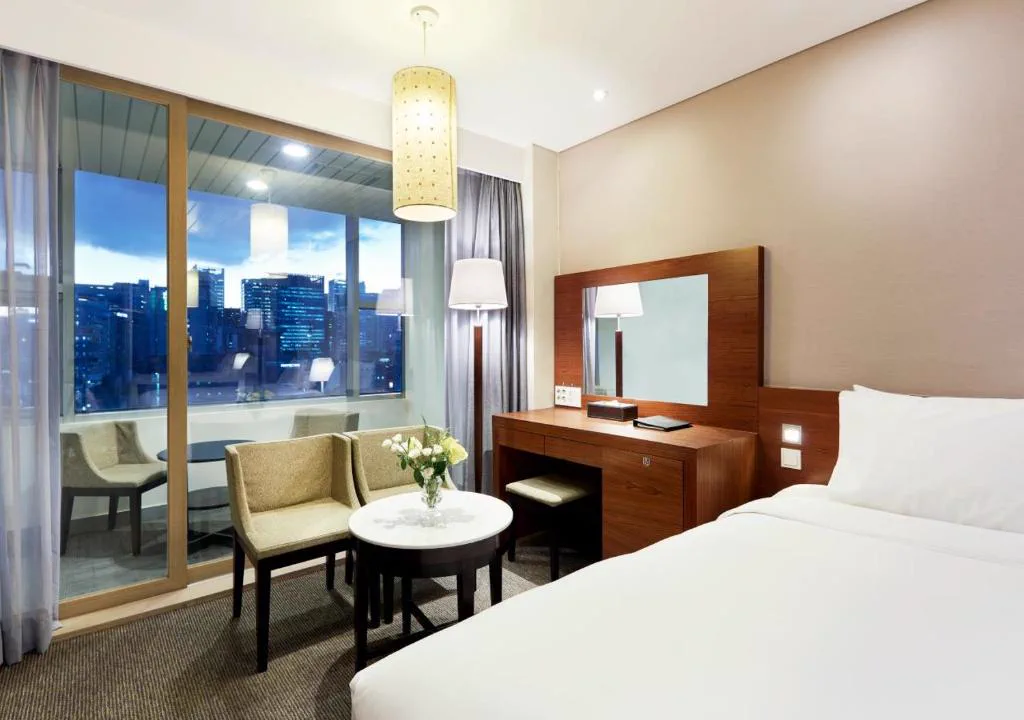
30-second split: two kids are not simply “four guests”
| Your family evening | Start with this room logic | Main trade-off |
|---|---|---|
| The children are similar ages, sleep at the same time and can sleep independently | Four proper beds / two acceptable double beds | Less room zoning; adults may need to quiet down when the kids sleep |
| One child naps or goes to bed much earlier than the other | Suite / Residence with usable separation | Usually costs more, and the hotel location still has to fit the itinerary |
| Both children are older and the whole family gets ready at once | Two rooms or stronger room separation | More keys, room numbers and child-room management |
| One child still needs a crib while the other needs a proper bed | Confirm the crib plus the third proper sleeping position together | This is where “sleeps four” most often fails in practice |
If you still want to sort only by room size after reading the table, the problem is not fully defined. Two children often create a conflict of timing rather than square metres: one is asleep while the other still wants to read, one wakes early while the other wants another hour, one takes a long shower while somebody urgently needs the toilet. A room that can separate those actions can outperform a slightly larger open-plan room.
If the fundamental decision is still one family room versus two rooms, use the broader one family room or two rooms guide first. S021 goes one layer deeper: the issue is not only what the adults do after bedtime; the two children themselves may already be on different schedules.
“Sleeps four” can describe at least three different products—translate the label into four actual sleepers
A platform occupancy filter is only the start. For two adults and two children, the product might be four singles, two doubles, a double plus bunk beds, a double plus a sofa bed, or another extra-bed arrangement. These are not interchangeable evenings. Before comparing price, write four names on paper and put one real sleeping surface beside each name.
If one line still says “we will squeeze in somehow,” remove that room from the final shortlist. School-age children who move a lot in their sleep may hate sharing a double even if the booking system permits it. A younger family that already shares beds comfortably does not necessarily need to pay a premium for four singles. The point is to match the room to your real sleep pattern rather than letting occupancy rules design the night for you.
If one child is still in the infant or toddler stage, layer in the Seoul baby-and-toddler hotel guide. A confirmed crib, a midday nap and nighttime care can change what “four sleeping positions” means.
Hotel PJ’s Quad is unusually direct: four single beds for families that do not want to negotiate who shares
Hotel PJ Myeongdong currently lists a Quad room at 45–69 m² with four 100×200 cm single beds and capacity for four guests. Its Premier Quad is listed at 56 m², again with four 100×200 cm single beds and capacity for four. For two children who already sleep independently, that is a very clear product: every person has a bed, so you do not spend the first night deciding who shares with whom.
Four beds do not automatically make it the best room for two children. If one child sleeps at 8 p.m. and the other stays awake until 10 p.m., all four beds are still in the same room. Light, hairdryers, videos and conversation can still disturb the early sleeper. The critical test is not only “does everyone have a bed?” but do both children turn the lights out at roughly the same time?
If that sleep pattern works, continue to the Hotel PJ Myeongdong decision page and check the location, luggage and evening route. If the real shortlist is Hotel PJ versus ENA, go straight to the ENA Suite vs Hotel PJ family-room comparison rather than restarting the research from OTA home pages.
Novotel Dongdaemun’s Family Residence solves “two routines,” not simply “one more bed”
Novotel Ambassador Seoul Dongdaemun currently lists a Residence Premier Family 1 Bedroom – 1 Double Bed & 1 Bunk Bed. The official page gives it as 80.9 m² and describes a separate living area with a kitchenette, washing machine and workspace. This is a different product logic from a four-single-bed room: the parents have the double, the children have bunk beds, and the living area creates more opportunity to separate activity from sleep.
If the children are different ages, one still naps, or one needs to sleep before the other, that separation can be used every day. On a longer stay, the washing machine and kitchenette may also matter more than a photogenic amenity because two children generate clothing, snacks and small resets continuously.
The trade-off is important. Do not move the whole Seoul stay to Dongdaemun because a bunk-bed room looks perfect. Confirm that your children are suitable for the bunk setup and recheck any current safety or occupancy terms before payment. More importantly, the district itself has to work: if every evening ends in Hongdae and the daytime schedule is centered elsewhere, a clever family room can be defeated by the wrong base. Continue to Novotel Ambassador Seoul Dongdaemun only when Dongdaemun and central-east Seoul genuinely repeat in the itinerary.
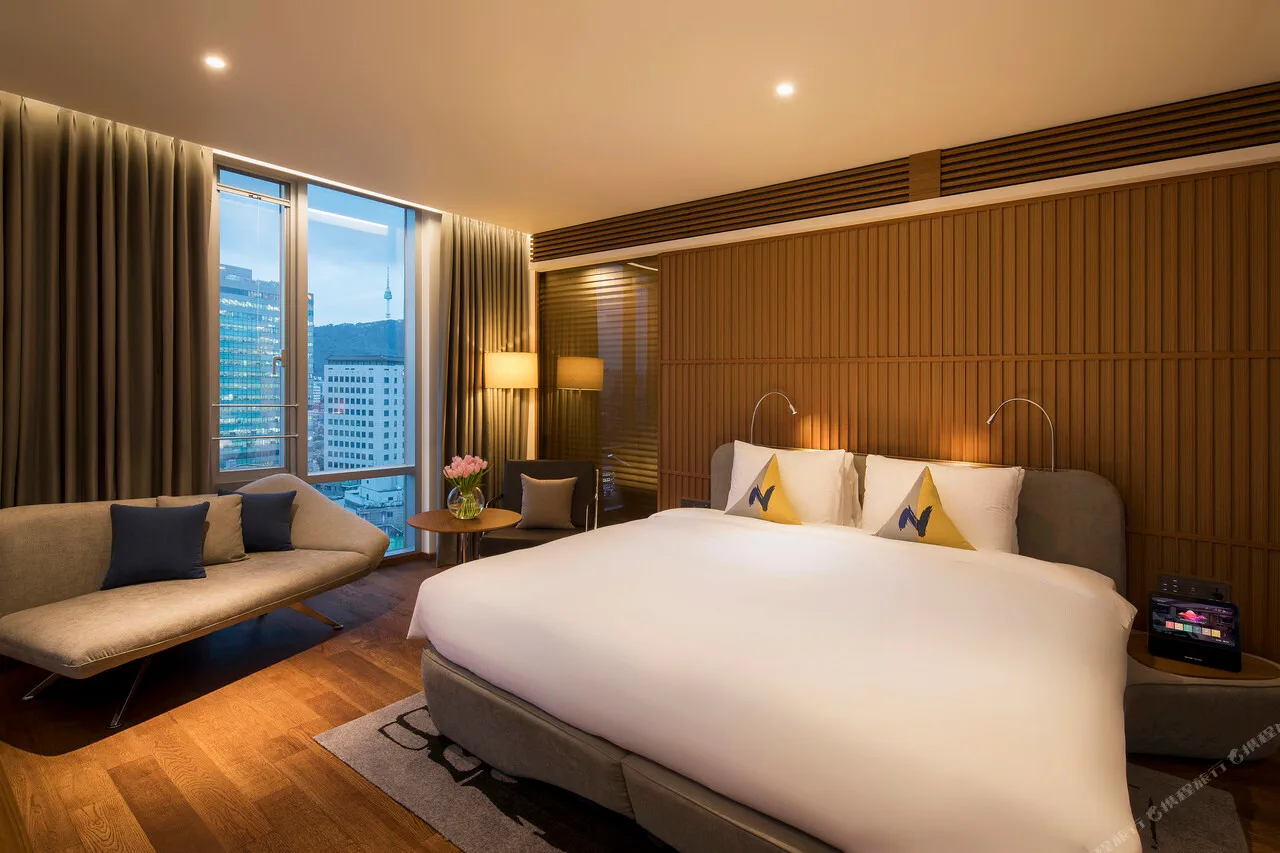
ENA Suite is better used to ask “can the family split the afternoon?”—but the word Family is not a 2+2 guarantee
Visit Seoul currently lists ENA Suite Hotel Namdaemun with 182 rooms and explicitly mentions Suite and Family guest-room categories. That makes ENA useful for a different two-kid scenario: City Hall/Namdaemun works as a real part of the itinerary, the family may return during the day, and one child may rest while the other still needs room to move or prepare for the next outing.
The official tourism listing confirms that Suite and Family categories exist; it does not guarantee that a specific 2-adult + 2-child combination is permitted in every room type or on every date. Put the exact ages into the booking flow or confirm directly with the property, then verify each sleeping position. This is precisely why S021 should not be reduced to a “best rooms for four” list.
If Deoksugung, City Hall, Namdaemun and midday hotel returns recur, continue to ENA Suite Hotel Namdaemun. If the harder question is room order rather than district, use ENA vs Hotel PJ to compare separation versus a multi-bed setup.
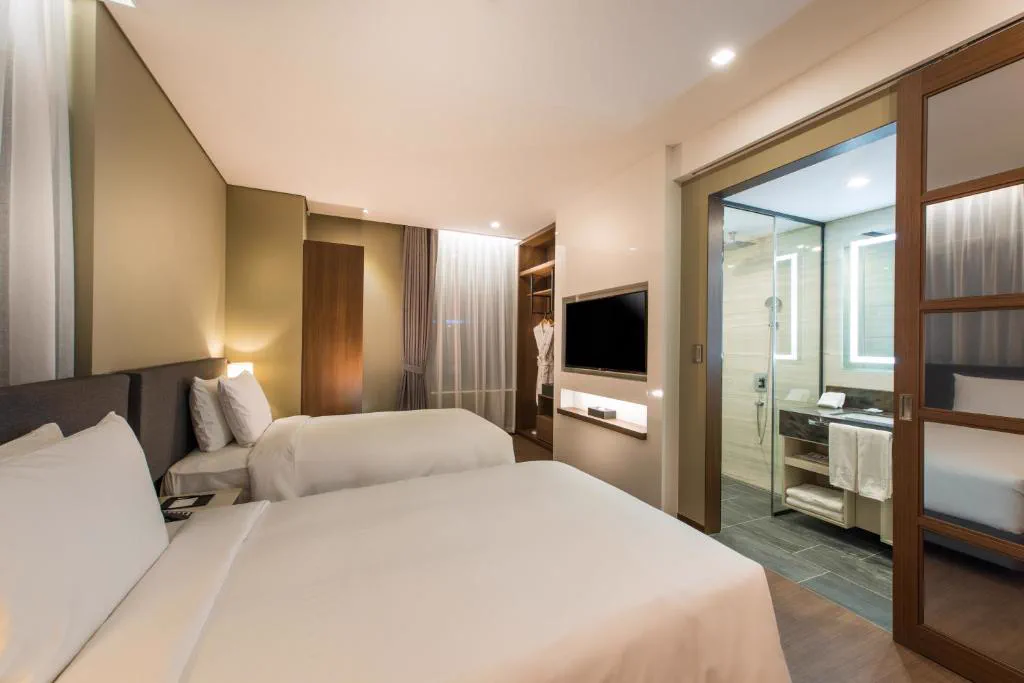
With two children, one bathroom can become the real bottleneck long before room size does
Back at the hotel, the busiest period is often not bedtime itself. It is showers, teeth, pyjamas, tomorrow’s clothes, charging devices, sorting shopping and finding snacks. With one child, adults can often stagger those jobs. With two, everything can queue at the same bathroom door.
This is why an older-child family should not automatically chase the largest single room. A second bathroom—or two separate rooms close together—can buy parallel mornings and evenings. If everybody has to leave at 8 a.m., two bathrooms may create more practical value than an extra ten square metres of shared living space.
The cost is management. Two rooms require clear sleeping assignments, keys and confidence that the room arrangement works for the children’s ages. Connecting rooms or adjacent rooms are property-specific and should never be assumed from two separate reservations. Use the one room vs two rooms guide to decide whether that operational cost is worth it.
The age gap between the children matters more than the phrase “family of four”
Two children aged six and eight may share a bedtime, understand room rules and use separate beds without much management. A two-year-old and a ten-year-old create a different hotel: one may nap and need quiet, while the older child still wants to talk, read or watch something. Those families should not be routed into the same room simply because the guest count is 2+2.
For a large age gap, prioritize usable separation and a location that makes midday returns realistic. For two school-age children with synchronized days, prioritize proper beds, bathroom flow and how quickly everybody can leave in the morning. The broad Seoul family-hotel hub helps if the actual problem is still area, stroller access or facilities rather than the two-child room routine.
A bunk bed can solve the floor plan and still fail the family
Bunk beds are visually efficient because two sleeping surfaces use one footprint. That can create a much better room than adding two rollaways. But the product only works if both children are actually comfortable with that sleep arrangement. Do not let a cute photo decide who sleeps on the upper bunk.
Before payment, check the exact room description and ask about any age, height, supervision or safety restrictions that apply to your dates. If one child refuses the upper bunk or needs an adult close by at night, the theoretical four-person capacity is irrelevant. The right room is the one that survives the first night without renegotiation.
Midday returns amplify every difference between the two children
If neither child naps and the whole family stays out all day, room zoning matters mostly at night. If one child still naps, the hotel becomes daytime infrastructure. The parent who returns with the sleeper needs quiet, while the other child may want to keep moving, eat, read or head back out with the other adult.
This is where a central base and a separate living area can earn their price. It is also where a large open Quad room may feel less flexible even though the bed count is excellent. If the midday-return problem appears on two or three days, use the family midday-break hotel-base guide before choosing a room type in the wrong district.
Do not pay for a “family facility” unless you can place it on the schedule
With two children, pools, Kids Zones and breakfast can look like obvious value because more people may use them. That still does not mean they will fit the itinerary. A pool that nobody reaches because every day is scheduled until dinner has zero practical value. A breakfast package can be useful if four people otherwise spend an hour negotiating the first meal; it can be wasted if the family wants markets or cafes every morning.
Write the use time beside every paid feature. If you cannot place the pool, breakfast or lounge on an actual day, do not let it rescue a weak room layout. The room must first solve sleep, bathroom and hotel-return problems.
Verdict: with two kids, choose the hotel by the two routines—not by the “family of four” badge
My order would be: map four real sleeping positions → compare the two children’s bedtimes and nap patterns → check bathroom pressure → decide how much room separation is needed → test the hotel location → only then compare facilities and total price. This sequence may lead to four singles, a double-plus-bunk Residence, a flexible suite, or two rooms. None is automatically the best family product.
In the current KoriNavi cluster, the cleanest examples are intentionally different: Hotel PJ Myeongdong for a clear multi-bed route when independent beds matter; Novotel Ambassador Seoul Dongdaemun when a double-plus-bunk Residence and living functions match the itinerary; and ENA Suite Hotel Namdaemun when central-Seoul returns and usable room separation matter, while 2+2 occupancy still needs exact confirmation. These are three room logics, not a ranking of the three best hotels for families with two children.
Sources and verification
- Hotel PJ Myeongdong | Quad: current room page lists 45–69 m², four 100×200 cm single beds and capacity 4; rechecked 2026-08-20.
- Hotel PJ Myeongdong | Premier Quad: current room page lists 56 m², four 100×200 cm single beds and capacity 4; rechecked 2026-08-20.
- Novotel Ambassador Seoul Dongdaemun | Residence Premier Family 1 Bedroom: current official page lists 80.9 m², one double bed plus one bunk bed, kitchenette, washing machine and workspace; rechecked 2026-08-20.
- Visit Seoul | ENA Suite Hotel Namdaemun Seoul: current listing states 182 rooms including Suite and Family guest-room categories; this does not by itself guarantee 2+2 occupancy in a particular room. Rechecked 2026-08-20.
Room inventory, child ages, occupancy rules, bunk-bed suitability, breakfast and cancellation conditions can vary by date and exact product. Re-enter two adults plus both children’s ages and confirm the precise bed setup before payment. This Persona page routes decisions upstream and therefore does not insert Booking.com, Agoda or Trip.com conversion CTAs before a specific hotel has been chosen.