
Short answer: when searching for Seoul connecting rooms, do not start by collecting hotels that merely say they “offer connecting rooms.” First identify the confirmation level: is there a directly bookable connected-room product, can the hotel guarantee the arrangement before arrival, is it only a request, or will you not know until check-in? If you would still be fine with two nearby rooms when the request fails, same-floor or adjacent rooms may be an acceptable fallback. But if two children follow different sleep schedules, a caregiver must move directly between the rooms at night, or you are paying for two rooms specifically to get two bathrooms, two sleep zones and one internal door, the connection is a hard requirement. A hard requirement cannot rest on “we will do our best.” This S024 guide starts after two rooms are already under consideration and asks whether the internal door can actually be confirmed. If you have not yet decided between one large room and two rooms, begin with one family room or two rooms in Seoul.
| What the hotel or booking page says | What you can treat it as | If the connecting door is essential |
|---|---|---|
| Directly bookable connected / Family Room product | Closest to a room-type commitment | Still verify beds, total occupancy and cancellation terms |
| Written hotel confirmation / explicit pre-arrival guarantee | A qualifying candidate | Save the confirmation and match names, dates, room types and reservation numbers |
| Connecting rooms available upon request | The property can offer them, but your stay is not automatically guaranteed | Do not treat it as a hard condition without further written confirmation |
| Adjacent / adjoining / same floor | The rooms may be near each other | Do not treat this as an internal connecting door |
| Check availability on check-in day | You find out at the latest possible moment | Reject it if failure would break the room plan |
Connecting, adjacent and same-floor rooms must be separated before you can even tell whether a request succeeded
A connecting room arrangement normally means two independent guest rooms have an internal door between them while each room still has its own corridor entrance. Adjacent or adjoining is often used in booking conversations to mean rooms are beside or near each other, but you should not infer an internal door unless the hotel explicitly confirms it. Same floor means even less: the rooms share a level, not necessarily a wall.
Those differences become very real after bedtime. With the internal door open, two rooms can function like one divided family unit. If the rooms are merely next to each other, any midnight movement still means entering a public corridor, carrying a key and locking doors again. That may be perfectly acceptable for some groups and a complete deal-breaker for others.
So do not send only “please keep our rooms close together.” If the door is the requirement, use wording such as connecting rooms with an internal connecting door and ask whether the hotel can confirm it for your exact stay dates, exact two room types and both reservation numbers. Otherwise a hotel can truthfully reply that it noted an adjacent-room request while you think a completely different product has been promised.
If you are still deciding whether two rooms are necessary at all, go back to the Seoul family room for four or the Seoul Family Room decoder. One genuinely usable large room, two connected rooms and two ordinary separate rooms create three different evening systems.
The useful question is not “does the hotel have connecting rooms?” but “what level of confirmation does the wording give me?”
Current official Seoul hotel wording shows why this hierarchy matters. Andaz Seoul Gangnam currently answers “yes” to connecting rooms in its FAQ and asks guests to contact the hotel directly in advance; the same answer explicitly says this is so the hotel can guarantee availability for your stay. That is materially stronger than a generic “available upon request.” You should still make the hotel tie that assurance to your actual dates and booked room types rather than relying on a saved FAQ screenshot.
Grand Hyatt Seoul now illustrates two different levels inside the same property. Its current Families & Groups FAQ says connecting rooms are available upon request. But the official Rooms section also currently lists a specific Family Room product in which a 1 King Bed room and a 2 Twin Beds room are connected. A room product that explicitly describes the two connected rooms belongs higher in the hierarchy than a generic request note. It still does not excuse you from checking current availability, occupancy and the exact rate conditions for your dates.
Grand InterContinental Seoul Parnas and Holiday Inn Express Seoul Hongdae currently list connecting rooms under “available by request.” That proves the property has the capability, but the wording by itself does not guarantee that your two reservations will receive a connecting pair. If the connection is only a preference, they can remain candidates. If the internal door is essential to how your family will function, ask for a more specific written confirmation before you lock in non-refundable rooms.
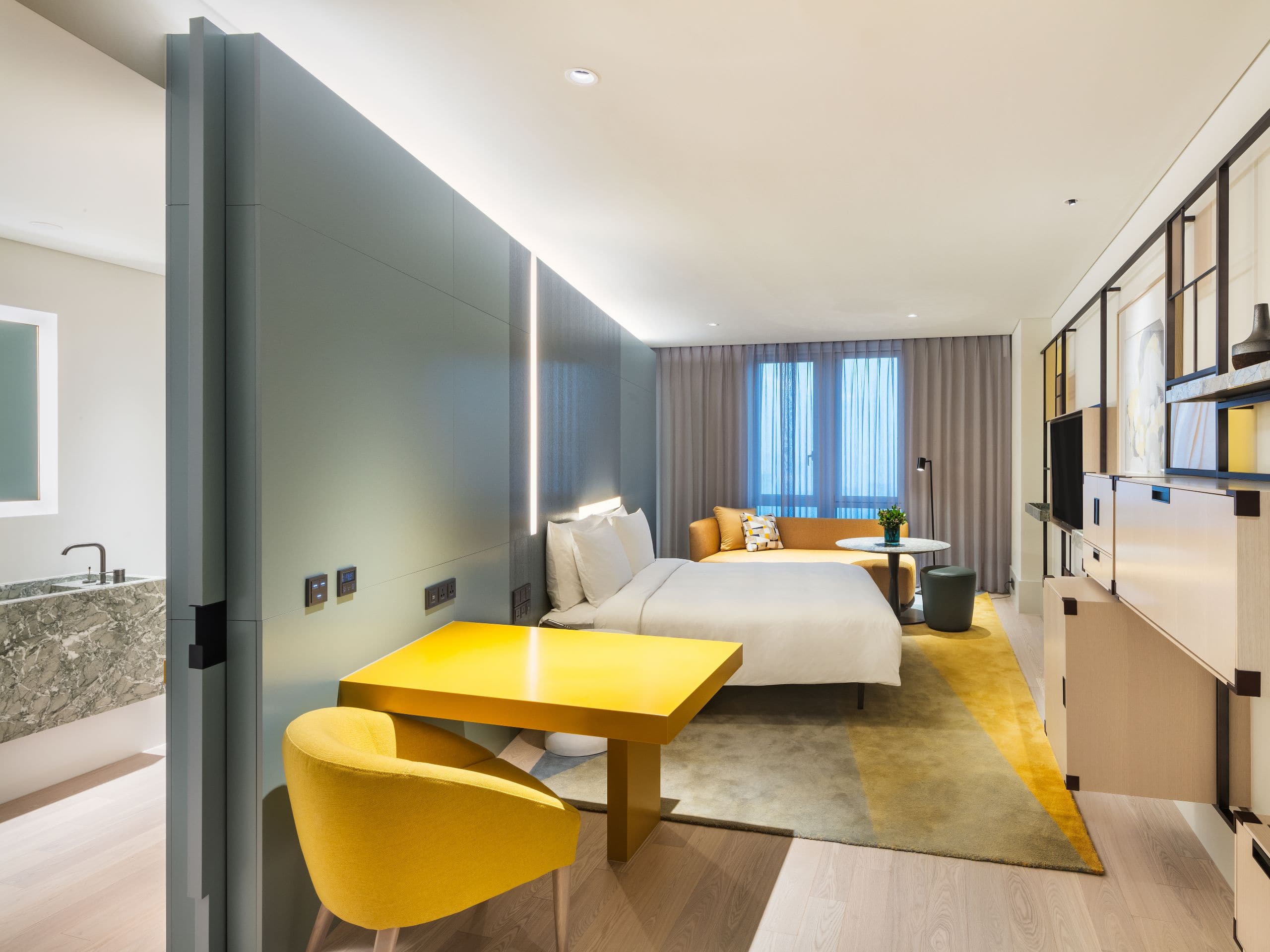
Aloft Seoul Myeongdong is the cleanest counterexample: real connecting rooms can still be too uncertain for a hard requirement
Aloft Seoul Myeongdong currently makes the limitation unusually clear on its official rooms page. It lists four connecting-room sets in total, including Standard King & Twin and Standard King & Breezy Suite Twin combinations. The same line says check availability on check-in day.
That information is still useful if your attitude is “connecting would be nice, but two separate rooms will work.” You know the property has real pairings and you even know examples of compatible room types. But if you need to know before you board the flight that the two rooms will have an internal door, check-in day is too late. Supply exists; allocation to your booking is a different question.
This is the trap in many “hotels with connecting rooms” lists. A hotel can genuinely have connecting inventory without being a safe choice for a traveler whose entire nighttime plan depends on it. The fewer the connecting pairs and the later the confirmation point, the less sensible it is to build the whole stay around the front desk’s final room assignment. This guide does not estimate availability for any specific date; if the official page says check-in day, that timing belongs in the decision exactly as written.
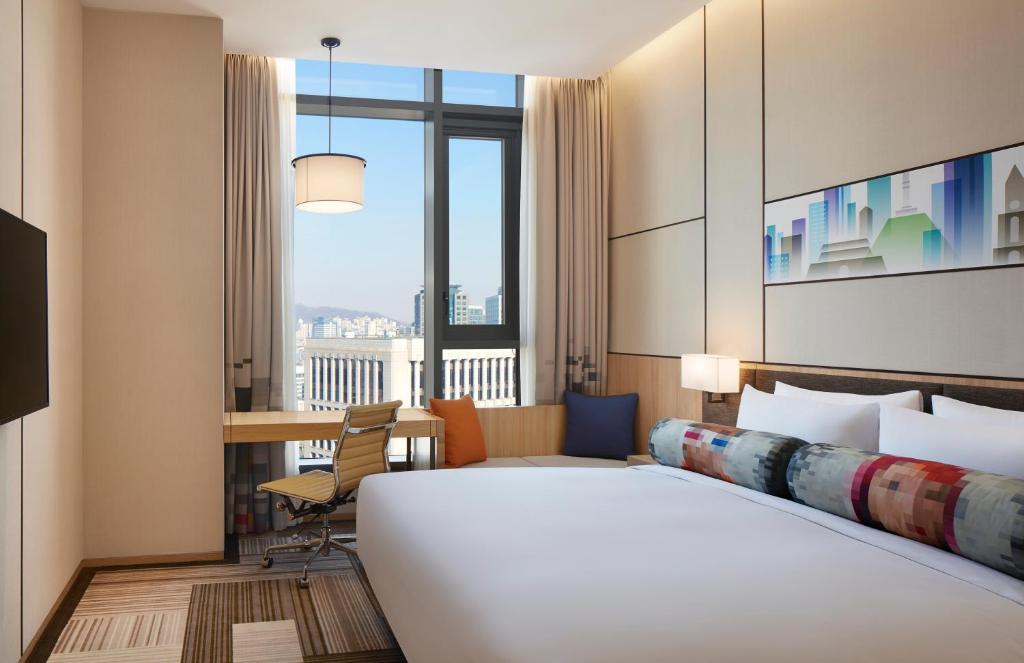
Two completed reservations do not automatically turn into one connecting pair
A common family workflow is to find two reasonably priced rooms on an OTA, book them separately, then type “connecting please” into the notes. The problem is that connecting inventory often works through specific room type A + specific room type B. If you book a King in one reservation and a second room type that cannot physically connect to it, the hotel may be willing to help but still only be able to offer adjacent rooms, same-floor rooms, or a paid room-type change.
If the connection is a hard requirement, reverse the process. First identify which exact room types can connect, then search those products for the same dates and guest count. If you already hold two reservations, send the hotel both reservation numbers, the lead guest names, the children’s ages and the internal-door requirement. Do not ask only “can we have connecting rooms?” Ask whether these two booked room types can be confirmed as one connecting pair with an internal door.
If one reservation is already non-refundable and the hotel will only record the connection as a request, the allocation risk has effectively moved to you. When the dates or party may still change, use the Seoul hotel cancellation and payment guide to place both rooms’ deadlines on the same timeline. A cheap non-refundable first room should not force the second room into an equally inflexible plan before the pair has been confirmed.
Run the worst-case test: if you get two rooms on the same floor but no internal door, can your family still use the booking?
This is more useful than asking for a vague “success rate.” Unless the hotel has already confirmed the arrangement in writing or you are booking an explicit connected-room product, a request can still be affected by room assignment and inventory. Write down the worst reasonable outcome: both rooms are on the same floor but separated by several doors; every move between them uses the corridor; everyone needs a room key; the bathrooms remain independent.
If that outcome is merely inconvenient, treat connecting rooms as a bonus. If it makes nighttime supervision, sleep or key management unworkable, “subject to availability” is not good enough. Your booking plan needs a stronger product or confirmation.
For two children with genuinely different bedtimes or bath routines, first use the Seoul hotels for families with two children. That page decides how two schedules affect the room. This page adds the next question: if you split the family into two rooms, do you truly need the internal door, or are two bathrooms and two closable sleeping spaces enough? Many families need separation more than they need constant movement through a connecting door. Once that is clear, the hotel shortlist gets much larger.
The premium for two connecting rooms buys two independent systems, not simply a larger room
The most practical value is usually two bathrooms, two entry/storage zones and two sleep spaces that can turn the lights off independently, while the group can still move between rooms without entering a public corridor. That is structurally different from one 50–60 m² room. A large room may give you more floor area while still leaving one bathroom, one lighting environment and one shared bedtime.
The cost is equally real. Two rooms can mean two room rates, two breakfast calculations, two cancellation terms, two deposits or card authorizations and more key-card management. If everyone sleeps on roughly the same schedule, mornings are relaxed and the stay is only two nights, one genuinely suitable four-person room may be much simpler. Return to the four-person room decision and compare four singles, two larger beds, bunks, Residence layouts and two rooms at the same decision level rather than comparing only nightly room rates.
If what you really want is extra living space rather than an internal door, the Family Room decoder is the better next page. A Residence or suite with meaningful separation can sometimes solve the evening problem with one reservation instead of two.
The hotel location still has to pass on its own: do not move the entire family to the wrong district for one room feature
Whether Andaz can confirm connecting rooms is a different question from whether your trip should be based in Gangnam. If four days are mostly Myeongdong, the palaces, Dongdaemun and Hongdae, moving the whole stay to Apgujeong for a room configuration can create a transport cost every day. If the itinerary already includes Gangnam, COEX, southern Seoul or repeated south-side plans, then the stronger connecting-room confirmation becomes a genuine advantage rather than a reason to distort the map.
The same logic applies to Holiday Inn Express Seoul Hongdae. IHG currently lists connecting rooms as available by request. If Hongdae is already the right base, continue to the Holiday Inn Express Seoul Hongdae decision page for breakfast, laundry, Hongik University Station and evening rhythm, then compare L7 Hongdae vs Holiday Inn Express. If airport rail and luggage days matter heavily, use the AREX hotel three-way comparison. Those pages decide whether Hongdae is the right base before the connecting-room request gets any weight.
If the family area itself is still unsettled, return to Hongdae vs Myeongdong with kids or the broader Seoul family-hotel decision hub. A perfect room product in the wrong district still gives the whole family the wrong last segment every day.
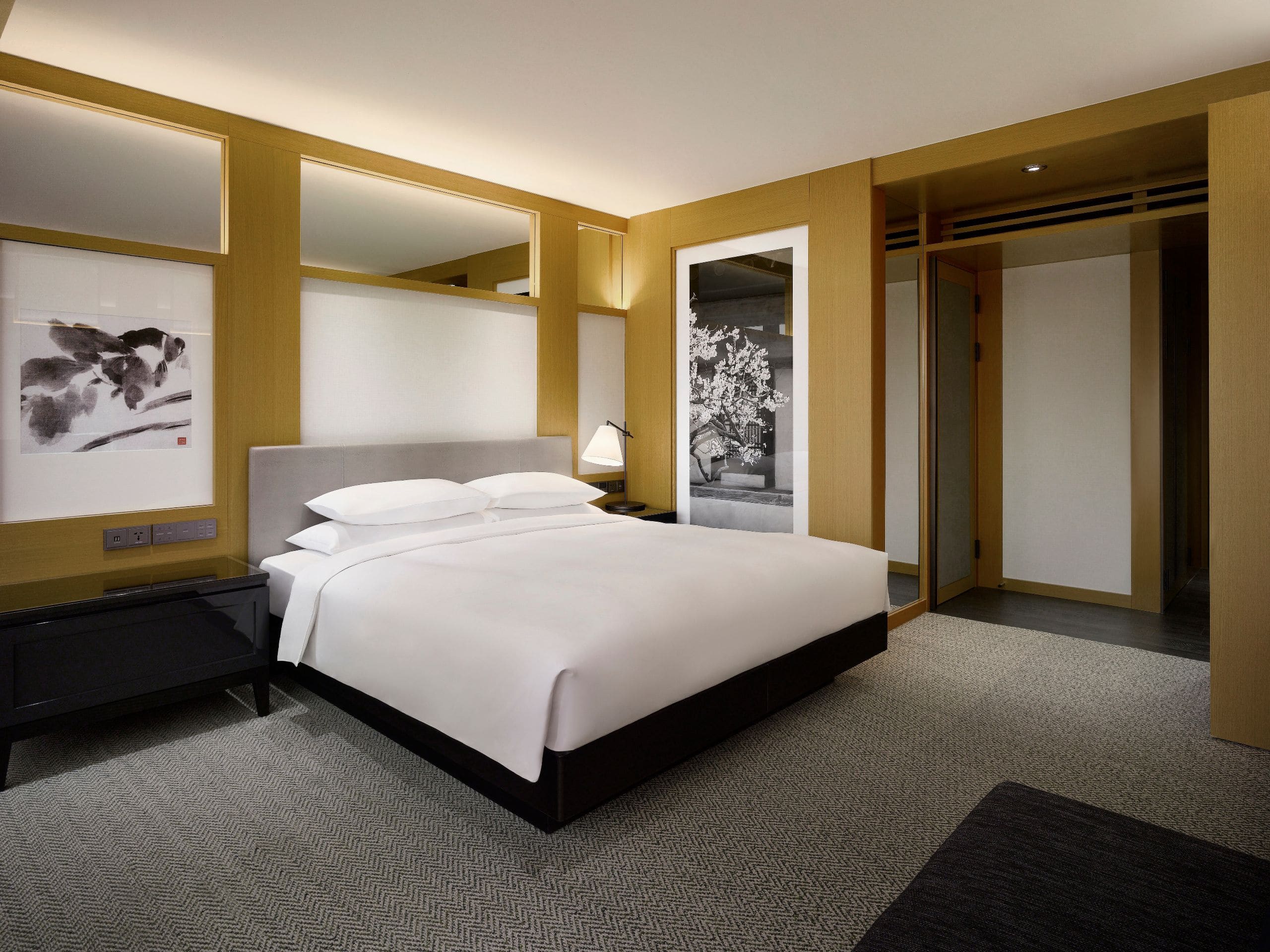
A late Seoul arrival is the worst time to discover that the two rooms are not connected
After a late flight, with luggage split across two rooms and tired children, the front desk is the last place you want to learn that the request meant “nearby” rather than “internal door.” If connecting is essential, finish the confirmation before arrival. If the hotel will only accept a request, at least decide the fallback in advance: who sleeps in which room, how the key cards are divided, and whether same-floor rooms would still be acceptable.
Arrival timing is a separate operational problem. Use the Seoul late check-in guide to confirm the desk and entrance procedure instead of mixing arrival instructions and room-allocation questions into one vague note.
Families with sensitive sleepers should also remember that connecting solves how two spaces connect; it does not guarantee both rooms will be quiet. If one child sleeps early while the other room stays active, room orientation, lifts, corridors and HVAC still need the Seoul hotel sleep-quality check.
Verdict: before making a connecting door mandatory, write down what happens if you do not get it
If two separate rooms would still work: treat connecting as a request and prioritize the right district, valid beds and cancellation terms. If losing the internal door breaks the nighttime room plan: keep only options that can be explicitly confirmed before arrival or are sold as a connected-room product. If the hotel says availability is checked on the day of arrival: real connecting inventory can still be the wrong product for a hard requirement. If you mainly want more space: recompare one large Family Room, Residence or true four-person room before paying for a second room just to chase a door you may not receive.
Use one final question before payment: “If the hotel only records our request and we arrive in Seoul to find two non-connecting rooms, can we still spend the night the way we planned?” If the answer is yes, a request may be enough. If the answer is no, “available upon request” is not a completed accommodation plan.
Sources and verification
- Andaz Seoul Gangnam — FAQ: current FAQ says connecting rooms are available, asks guests to contact the hotel directly in advance, and explicitly says this allows the hotel to guarantee availability for the stay. Rechecked 2026-08-20.
- Grand Hyatt Seoul — FAQ: current Families & Groups wording says connecting rooms are available upon request. Rechecked 2026-08-20.
- Grand Hyatt Seoul — Family Room: current official room product says a 1 King Bed room and 2 Twin Beds room are connected. Rechecked 2026-08-20.
- Aloft Seoul Myeongdong — Rooms: current page lists four connecting-room sets, including Standard King & Twin and Standard King & Breezy Suite Twin, and says to check availability on check-in day. Rechecked 2026-08-20.
- Grand InterContinental Seoul Parnas — Rooms: current “Available by request” section lists connecting rooms available. Rechecked 2026-08-20.
- Holiday Inn Express Seoul Hongdae — Rooms: current “Available by Request” section lists connecting rooms available. Rechecked 2026-08-20.
Connecting-room pairings, adjacent-room arrangements, guarantee level, price, cancellation terms and inventory are date- and room-specific. If the internal door is a hard requirement, have the hotel reconfirm it against your actual stay dates, exact room products and reservation numbers before payment. Do not treat a generic FAQ, an OTA “interconnected room available” icon or a request note as a guarantee for an individual reservation.