
Short answer: for a Seoul three-generation family stay, do not start with “largest family room” or “sleeps five or six.” Start with three questions: how many sleep zones must be behind a closable door, whether the living room still needs to function after someone goes to bed, and whether one bathroom will create a queue every morning and night. If grandparents sleep early, a child naps, and the parents still need to shower, talk or repack later, a two- or three-bedroom residence—or two hotel rooms that are genuinely connected or otherwise confirmed in the arrangement you need—usually works better than one very large open-plan room. If the whole party is only four people, stays two nights and follows roughly the same schedule, one clear four-bed room can still be simpler. This S025 guide is about dividing a multigenerational family inside the accommodation. If the first question is still one large room or two rooms, start with one family room vs two rooms. If the internal door between two rooms is non-negotiable, continue to the Seoul connecting-room confirmation guide.
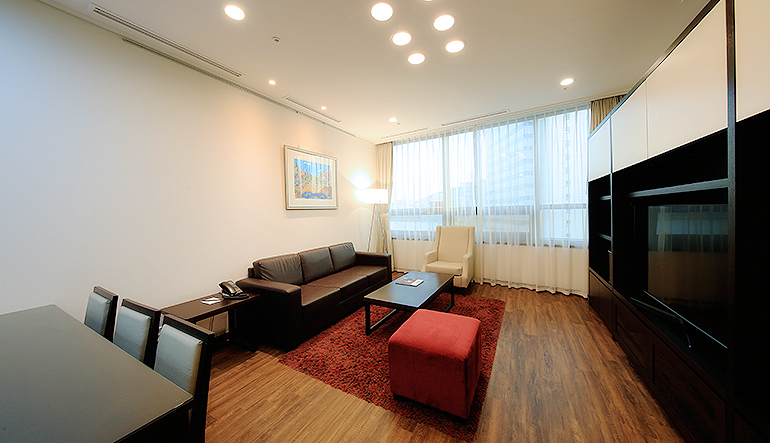
30-second split: decide how many doors your family needs before comparing hotel names
| Your real evening | Room structure to check first | The trade-off people miss |
|---|---|---|
| Grandparents sleep early; parents and children finish later | At least 2 closable sleep zones | A very large open room still has one lighting and noise system |
| The child naps and grandparents may also rest in the afternoon | 2–3 bedrooms plus a living room that stays usable | If somebody sleeps permanently in the living room, the daytime split loses much of its value |
| 4 adults + 1 child, with two adult couples happy to take one room each | 2 Bedroom Residence | The child’s actual bed and the exact occupancy rule still need confirmation |
| Grandparents, parents and child need 3 genuine sleep zones | 3 Bedroom Residence / multi-bedroom serviced apartment | More space costs more and may not sit in the best district for your itinerary |
| Only 1–2 nights and everyone keeps a similar schedule | One clear multi-person room or two normal hotel rooms | Do not pay for a full kitchen, laundry and large living room you will never use |
This is a different decision from a general family-hotel search. A booking engine can accept five names on one reservation and still fail to solve the evening. Grandparents may be ready for lights out at 21:00, the child is still showering at 22:00, and the parents are planning the next day at 23:00. Nothing is wrong with the room or the family. The problem is simply that one space is being asked to act as three generations’ bedrooms, living room and packing area at the same time.
If the only complication is two children following two different routines, the more precise next page is Seoul hotels for families with two children. S025 adds another layer: the adult generations themselves may need privacy, different temperatures and different lights-out times.
The first hard rule: do not turn the shared living room into the third bedroom unless you are willing to lose the living room
Residence-style rooms are attractive because the living room looks generous. Everyone can sit together, eat something, let a child play and give an older traveler somewhere to rest. But if the sofa bed becomes a permanent sleeping position, that space stops functioning as the place where the still-awake part of the family can keep living after bedtime.
For a two- or three-bedroom residence, split the floor plan into four fields before you compare price: how many bedrooms actually close, what bed is in each bedroom, whether the living room remains shared space, and how many bathrooms or toilets the exact product has. Never infer the bathroom count from the number of bedrooms. If the official page does not say it and it changes your decision, ask the property or verify the exact room product before payment.
Orakai Insadong Suites shows what a three-bedroom product can buy: three separate bedrooms plus one shared living zone
Orakai Insadong Suites currently lists a Three Bedroom apartment of 98–110㎡. The official description explicitly says it has three separate bedrooms, along with separate living and kitchen areas, plus a washing machine with dryer. For a multigenerational group, the important point is not simply that 98–110㎡ sounds large. It is that grandparents, parents and children can potentially close different doors at different times while the living room still exists as common space.
The current public room page does not, however, answer every sleeping question for every family. It does not give this article enough evidence to promise the exact bed in each bedroom, a universal maximum guest count or a specific bathroom count. So do not convert “Three Bedroom” into “perfect for X adults + Y children.” Draw your own family first, then verify which adult needs which bed, whether the child needs an independent bed, and whether the exact bookable product for your dates matches that plan.
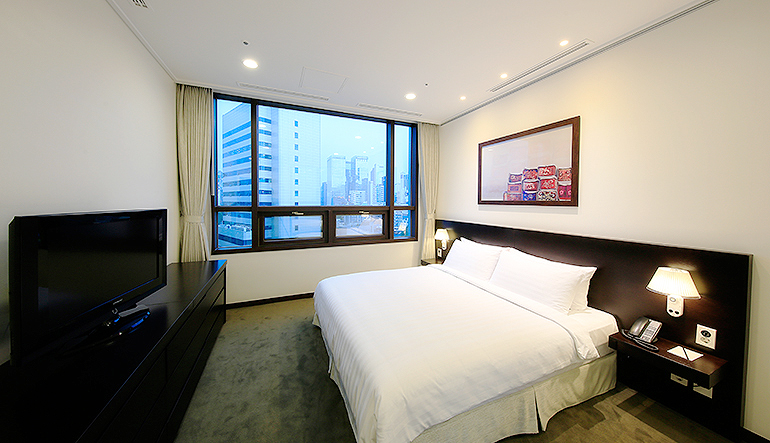
Fraser Place Central is the useful two-bedroom example: five guests can fit the occupancy rule without creating three adult sleep zones
Fraser Place Central Seoul currently lists a Two Bedrooms Deluxe apartment of 81㎡ for up to four adults and one child. The published bedding is one king and one queen, with a kitchenette, refrigerator, microwave and washing machine. The property also lists daily housekeeping and 24/7 reception and concierge service.
This is exactly why a multigenerational family should not stop at “sleeps five.” If the structure is grandparents in one bedroom and parents plus child in the other, and the child’s bed arrangement is valid under the exact product rules, two bedrooms may be enough. If the child is older, the parents do not want three people sharing a bedroom, or one grandparent needs an independent sleep space, the same five-person occupancy figure no longer solves the family.
Fraser Place Central’s current FAQ also says baby cots are available for children under two and that reception and concierge are round-the-clock. Those details may help a family travelling with a very young child, but they are not a substitute for booking confirmation. Crib availability, exact occupancy, bedding and any room-specific restriction still need to be checked for your actual dates.
Hotel PJ Quad is the counterexample: four proper beds can be wonderfully clear and still solve none of the generation-to-generation privacy problem
Hotel PJ Myeongdong currently lists a Quad room of 45–69㎡ with four 100×200cm single beds and capacity for four people. For a family of four with similar bedtimes, that is refreshingly explicit: four people, four real beds, no guessing about who shares a double.
But four beds do not create four rooms. If grandparents sleep at 21:00, a parent is still blow-drying hair and the child is awake later, every sound and light remains in one open space. For a three-generation group of four, the Quad can be the simple answer when schedules are aligned; it becomes the wrong answer when the real requirement is separating generations behind doors. If the bed logic works, use the Hotel PJ Myeongdong decision page to judge Euljiro, Gwangjang Market, luggage and the hotel’s location rather than selecting it from the bed count alone.
Novotel Dongdaemun’s 80.9㎡ Family Residence is another warning: a large living room does not create two adult bedrooms
Novotel Ambassador Seoul Dongdaemun currently lists Residence Premier Family 1 Bedroom – 1 Double Bed & 1 Bunk Bed. The published area is 80.9㎡, with a separate living area, kitchenette, washing machine and workspace. It can be a very useful family product when the child benefits from bunk beds and the adults want living space, laundry and simple in-room food preparation.
For a three-generation family, however, the key phrase is already in the name: 1 Bedroom. Eighty square metres does not magically turn into one private bedroom for the grandparents and another private bedroom for the parents. If the two adult generations both need a closable bedroom, look for a true two- or three-bedroom residence or use two hotel rooms. If Dongdaemun already fits the trip and you only need a child-friendly sleeping setup plus a separate living room, then continue to the Novotel Ambassador Seoul Dongdaemun decision page.
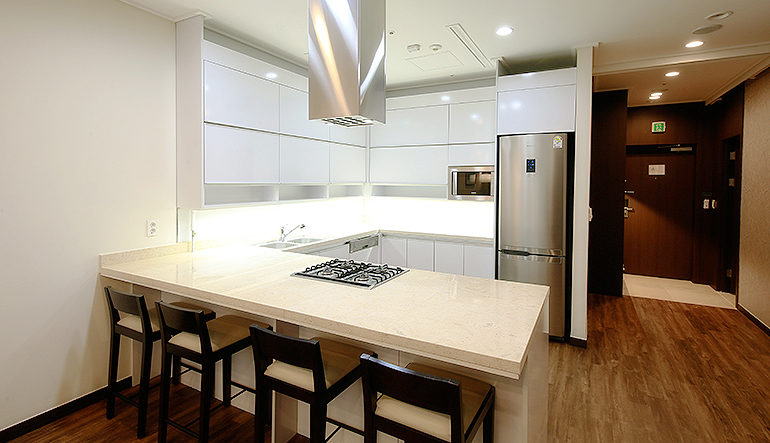
When are two hotel rooms better than a residence? When you are buying two bathrooms and two independent night systems
A serviced apartment keeps the family inside one household-like unit. Two hotel rooms solve a different problem: they often split bathrooms, air-conditioning, lights, keys and waking times into two independent systems. If the adult generations have very different routines, the stay is only two or three nights, and everyone eats out, a large residence may be charging you for a kitchen and living room you barely use.
If you are considering two rooms, first decide whether the internal connecting door is a hard requirement. If the family can function with rooms merely near one another, same-floor or adjacent arrangements may be acceptable. If a caregiver must move directly between the rooms at night without using the public corridor, then you need a genuinely connected product or explicit confirmation. That confirmation ladder is covered in the Seoul connecting-room guide. Do not type “connecting please” into an OTA note and treat the problem as solved.
If you have not even decided whether two rooms are worth paying for, step back to one family room or two rooms. If the confusion starts with the label itself—Family Twin, Family Suite, Residence Family—use the Seoul Family Room decoder before comparing hotel prices.
The bathroom bottleneck can ruin a three-generation morning before an extra 10㎡ ever matters
Imagine 07:30 before a 09:00 departure. Grandparents need the bathroom first, the child suddenly needs the toilet, one parent still has to shower, and somebody is packing medicine and chargers. This is where a beautiful large room can suddenly feel small. For a multigenerational stay, put bathroom and toilet count, whether they can be used separately, and who needs them first ahead of a small difference in floor area.
Again, do not assume Two Bedroom or Three Bedroom automatically means two bathrooms. If the official room description does not state it, ask. You also do not need to pay any price for a second bathroom if one bathroom is genuinely workable. The useful question is how often the queue will delay departure or force people to wake earlier than they want.
Midday splits multiply the value of extra rooms: can somebody sleep while somebody else still has somewhere to be?
Three-generation trips often produce two types of rest at the same time. A child naps; a grandparent also wants a quiet hour. That does not mean the parents want the entire accommodation dark and silent. A usable living room or one additional bedroom can therefore matter more than a pool, a view or a dramatic lobby.
If you already know that somebody will return to the hotel almost every afternoon, connect room structure to the family and senior midday-rest hotel base. That page decides who returns first and how the rest of the group continues the day. S025 decides what happens once those people are back inside the accommodation.
If the family is actually out from breakfast until 23:00 every day, do not upgrade to a three-bedroom residence simply because the trip is multigenerational. You may get more value from the right district, two comfortable hotel rooms and better cancellation terms. Space is valuable only when the family spends time in it.
ENA Suite can be a central hotel-style candidate, but “Family” and “Suite” do not translate into “three-generation room”
Visit Seoul currently lists ENA Suite Hotel Namdaemun at 36 Sejong-daero 11-gil and says its 182 rooms include Suite and Family guest rooms. For a three-generation family, that makes it a reasonable City Hall / Namdaemun hotel-style candidate when usable room space matters. It does not prove that a particular Family or Suite product automatically gives your group two or three adult sleep zones.
If City Hall, Namdaemun and Seoul Station already fit the itinerary, continue to the ENA Suite Hotel Namdaemun family decision page. If the shortlist is ENA versus Hotel PJ, use the ENA Suite vs Hotel PJ comparison. The multigenerational question stays the same: how many adult sleep zones, what actual beds, what bathroom arrangement, and whether the family can split its evening without turning one person into the sacrifice.
Only after the room structure passes should the district win: do not move the whole family across Seoul for one perfect floor plan
A three-bedroom apartment can be so hard to find that the room begins to dictate the entire itinerary. Resist that order. The floor plan must pass, but the district also has to pass independently. A perfect residence that adds a complicated transfer for the older traveler every day or makes a child’s midday hotel return unrealistic may simply move the friction from inside the room to the city.
This article deliberately does not turn into “where should I stay in Seoul with my parents?” or “which district minimizes walking for seniors?” Those are the next Persona layers. For now, if the family base itself is still unclear, return to the Seoul family-hotel decision hub or the broader Seoul hotel shortlist and map your first stop, final stop and likely midday return.
Compare the total cost of the whole family unit, not the nightly rate of one room
A three-bedroom residence, a two-bedroom residence and two hotel rooms look like different products, but they compete for the same accommodation budget. Fix the same dates and the same actual guest count, then compare the total family-unit cost with breakfast, taxes, deposits or card pre-authorisation, extra-bed rules and cleaning conditions beside it.
Two hotel rooms also mean two reservations may have two different cancellation deadlines. A three-generation trip can have more moving parts—different flights, a child’s needs, an older traveler’s schedule—so put the two bookings on one timeline and use the Seoul hotel cancellation and payment guide before both rates become inflexible. If arrival is late, confirm the desk, entrance and room-key process with the late check-in guide rather than solving it at the front desk with the whole family tired.
Give the most stable room to the person whose sleep is hardest to replace
Do not automatically assign the “best room” to the grandparents or the biggest room to the parents and child. A more useful order is: who sleeps earliest, who wakes most easily, who needs the toilet most during the night, and who must leave first the next morning. Protect the least flexible sleep requirement first, then distribute the remaining rooms.
If one traveler is especially sensitive to street noise, corridors or HVAC, three bedrooms do not automatically make the stay quiet. Use the Seoul hotel sleep-quality checklist on the actual property and room conditions. A three-generation stay works when the most fragile part of the night is protected, not when everyone receives exactly the same amount of floor area.
Verdict: a three-generation stay works when each generation can close a door at the moment it needs to stop
Choose a 3 Bedroom Residence: grandparents, parents and children genuinely need three sleep zones and will use a shared living room, kitchen or laundry. Choose a 2 Bedroom Residence: the two adult groups can each take a room, the child’s bed is explicitly valid under the exact room rules, and two sleep zones are enough. Choose two hotel rooms / connecting rooms: the stay is short, most meals are outside, and two bathrooms plus two independent night routines matter more than a kitchen. Choose one multi-person room: the total party is around four, bedtimes are aligned, privacy is not the main problem, and every proper bed is already clear.
Use one final test before payment: at 21:00, grandparents are asleep, the child has not finished showering, and the parents still need to repack—does somebody in this floor plan have to give up sleep or normal activity? If yes, a bigger room has not solved the multigenerational problem. If each generation can naturally wind down, only then compare location and price.
Sources and verification
- Orakai Insadong Suites — Three Bedroom: current official page lists 98–110㎡, three separate bedrooms, separate living/kitchen areas and a washer with dryer. Rechecked 2026-08-20.
- Orakai Insadong Suites — Two Bedroom: current official page lists 74–96㎡ with two bedrooms plus living/kitchen areas and washer-dryer facilities. Rechecked 2026-08-20.
- Fraser Place Central Seoul — Two Bedrooms Deluxe: current official page lists 81㎡, up to four adults and one child, one king plus one queen, kitchenette and washing machine. Rechecked 2026-08-20.
- Fraser Place Central Seoul — FAQ: current FAQ states baby cots are available for children under two and reception/concierge operate round-the-clock. Rechecked 2026-08-20.
- Hotel PJ Myeongdong — Quad: current official page lists 45–69㎡, four 100×200cm single beds and capacity four. Rechecked 2026-08-20.
- Novotel Ambassador Seoul Dongdaemun — Residence Premier Family 1 Bedroom: current official page lists 80.9㎡, one double bed plus one bunk bed, kitchenette, washing machine and workspace. Rechecked 2026-08-20.
- Visit Seoul — ENA Suite Hotel Namdaemun Seoul: current listing states 182 rooms including Suite and Family guest rooms. Rechecked 2026-08-20.
Room names, occupancy, bedding, baby cots, bathroom configuration, rates and availability can vary by date and product. Reconfirm the exact room and current hotel or booking-platform terms before payment.